[Asia Economy Reporter Buaeri] Amid the release of a high-priced item in the mobile game ‘Lineage2M’ that costs 200 million KRW to produce, NCSoft is being criticized for cleverly exploiting loopholes in the self-regulation of probability-based items (loot boxes). The controversy over the gambling nature of probability-based items is considered a chronic problem in the gaming industry. With the recent controversy surrounding NCSoft, attention is focused on whether the government and ruling party’s efforts to regulate probability-based items will gain momentum.
Lineage2M Probability ‘Black Box’ Controversy
According to the gaming industry on the 5th, the ‘Mythical Weapon’ recently introduced by NCSoft in Lineage2M is a top-tier item estimated to cost 200 million KRW just to produce. The Mythical Weapon is created through a two-step probability-based item loot box process, but NCSoft only discloses the probability of the first step. To create the Mythical Weapon, players must collect 1 to 10 ‘Ancient History Books.’ To obtain these history books, players must acquire ‘recipes’ and other items through probability-based loot boxes. NCSoft discloses the probability of obtaining the recipes but does not disclose the probability of obtaining the Ancient History Books.
NCSoft’s position is that since the Mythical Weapon itself is not a cash item purchased directly with money, they have no obligation to disclose the probabilities. However, users are expressing dissatisfaction with having to purchase such an expensive item without knowing the probabilities. Furthermore, there are criticisms that NCSoft is exploiting loopholes in the Korea Game Policy Self-Regulation Organization (GSOK) self-regulation policy. The current self-regulation only recommends displaying probabilities for paid probability-based items, so there is no way to regulate systems that create probability-based items from other probability-based items.
Controversies over probability-based items in game companies are not new. Probability-based items, which are major revenue sources for domestic game companies such as NCSoft’s ‘Lineage’ Execution Sword and Nexon’s ‘The Kingdom of the Winds: Yeon’ Spirit Summoning, have continuously faced gambling-related controversies. Probability-based items are products where users cannot know which item they will obtain before purchase. Moreover, they have been criticized for causing excessive spending by users due to extremely low probabilities comparable to lottery winnings. Conscious of the criticism, the gaming industry voluntarily discloses the types and probabilities of probability-based items through GSOK, but there are no penalties or sanctions even if these rules are violated.
Will the Game Law Amendment Ignite?
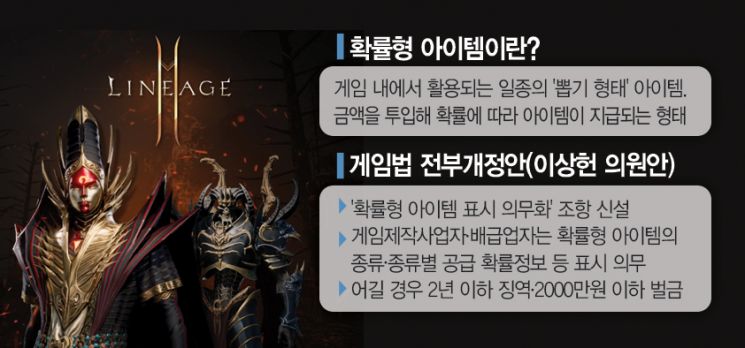
The government and ruling party are also aware of these issues and have taken a firm stance on probability-based items. The National Assembly’s Culture, Sports and Tourism Committee will review the ‘Game Industry Promotion Act Amendment Bill’ proposed by Lee Sang-heon of the Democratic Party on the 17th.
According to the amendment, game developers or distributors must display the game rating, game content information, types of probability-based items, and supply probability information by type when distributing or providing games to users. Violations will be punishable by up to two years imprisonment or a fine of up to 20 million KRW. The government and ruling party also plan to thoroughly examine the controversial two-step probability-based item issue. A representative from Lee’s office explained, “The government believes that detailed regulations on probability-based items can be enforced through this law and presidential decrees.”
Experts also pointed out that the gaming industry should actively ensure transparency of probability-based items. Professor Wi Jeong-hyun of Chung-Ang University, president of the Korea Game Society, said, “Game companies are expressing dissatisfaction, claiming they have complied well with self-regulation, but if they had disclosed honestly so far, they would not face legal penalties. Before the controversy escalates further, game companies need to have the issues regarding probability-based items externally verified (through the government, etc.). Resolving this will help foster a healthy ecosystem and industrial development in the gaming industry.”
© The Asia Business Daily(www.asiae.co.kr). All rights reserved.
![User Who Sold Erroneously Deposited Bitcoins to Repay Debt and Fund Entertainment... What Did the Supreme Court Decide in 2021? [Legal Issue Check]](https://cwcontent.asiae.co.kr/asiaresize/183/2026020910431234020_1770601391.png)
















