Topical, 23rd Management Concert Online Lecture
Inviting Professor Hong Yoon-chul of Seoul National University Department of Preventive Medicine
[Asia Economy Reporter Hwang Yoon-joo] "After this Lunar New Year holiday and once vaccination begins, I believe the 4th wave of COVID-19 can be prevented. It may sound optimistic, but in the second half of the year, even if not completely, some degree of pre-COVID daily life and economic activities will be possible."
The Korea Chamber of Commerce and Industry (KCCI) invited Professor Hong Yoon-chul from the Department of Preventive Medicine at Seoul National University College of Medicine to deliver an online lecture titled "Challenges of COVID-19 and Strategies Beyond" as part of the "KCCI Management Concert," which was released on the 5th.
Professor Hong stated, "Since the 2000s, major infectious diseases such as SARS, novel influenza, MERS, and COVID-19 have occurred every five years, but we cannot rely solely on vaccines and treatments that take at least two years to develop. In particular, South Korea, with its severe aging population, has a structure vulnerable to infectious disease response."
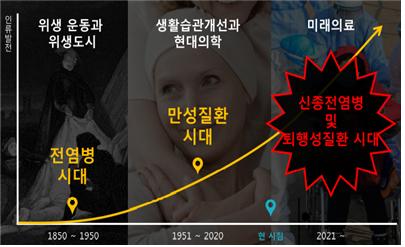
Professor Hong pointed out, "In the past, we lived in an era of chronic diseases like diabetes and hypertension, but now we have entered an era of new infectious diseases and degenerative diseases such as dementia and depression, and it is impossible to accommodate all these patients in nursing homes or long-term care hospitals."
He emphasized, "Pandemics have coexisted with human civilization development for a long time. COVID-19 can be seen as a warning about the future, like a canary in a coal mine. As the population ages, severe diseases are changing, and many people have multiple diseases simultaneously."
As evidence, Professor Hong revealed, "Currently, the elderly population in Korea is about 15%, but by 2060 it will reach approximately 40%. About 90% of all elderly suffer from chronic diseases, and 73% have two or more diseases, with an average of 2.7 chronic diseases per elderly person."
He argued, "To address this, first, we must shift from disease-centered to person-centered care; second, from hospital-centered to community-centered care; third, from a medical delivery system to a medical cooperation system, while actively utilizing ICT-converged advanced medical technologies for remote monitoring such as smartwatches and smart mirrors."
Finally, Professor Hong stated, "By reorganizing into a future-oriented medical system where medical institutions and residents share information and manage together, centered on local communities and neighborhood clinics, we will be able to sufficiently manage and prevent infectious diseases even if they occur again."
This lecture can be viewed from February 5th on YouTube (Korea Chamber of Commerce and Industry Insight) and the KCCI website's 'Online Seminar' section.
© The Asia Business Daily(www.asiae.co.kr). All rights reserved.
!["The Woman Who Threw Herself into the Water Clutching a Stolen Dior Bag"...A Grotesque Success Story That Shakes the Korean Psyche [Slate]](https://cwcontent.asiae.co.kr/asiaresize/183/2026021902243444107_1771435474.jpg)
















