Support of 9.7 Billion Won for 140 Companies with Reduced Registered Capital
Concerns Over Platform-Centric Business Focus and Cutthroat Competition
[Asia Economy Reporter Donghyun Choi] Last month, the global travel and leisure platform Klook secured an investment worth 220 billion KRW. In the same month, domestic startup Triple, which operates a travel platform, also succeeded in raising 20 billion KRW in investment. Domestic leisure activity platform Frip recently surpassed 1 million cumulative members, continuing its rapid growth.
There are tourism and travel companies that continue to grow despite COVID-19. The commonality among these companies is that they have moved away from the traditional offline package tour sales method and instead distribute tourism products through mobile platforms by integrating information technology (IT), big data, and other technologies. In particular, many newly established domestic tourism ventures are pursuing similar business models recently.
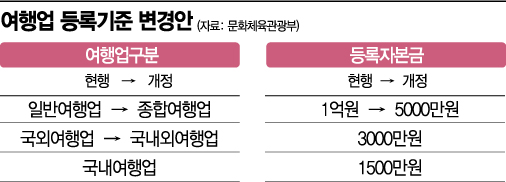
The government has also introduced various support measures from the beginning of the year to foster such companies. On the 27th of last month, the Ministry of Culture, Sports and Tourism announced a legislative notice for the revision of the ‘Tourism Promotion Act Enforcement Decree and Enforcement Rules.’ Among the contents is the reduction of the registered capital requirement for general travel agencies from 100 million KRW to 50 million KRW. The reduction of registered capital has been a consistent demand from small and medium tourism ventures focused on technology and services.
Additionally, the general travel agency category will be changed to comprehensive travel agency, and the overseas travel agency category will be changed to domestic and overseas travel agency. This expands the scope of overseas travel agencies to allow them to operate domestic travel businesses. Comprehensive travel agencies can provide both domestic and international travel products and services to both foreigners and Koreans. Domestic travel agencies can only sell domestic travel products to Koreans, while domestic and overseas travel agencies can sell both domestic and international travel products to Koreans.
The Ministry of Culture, Sports and Tourism’s first tourism venture support project of this year, the ‘12th Tourism Venture Business Contest,’ also began on the 3rd. Winners of the contest receive various support programs such as business funding, consulting, and market development. Especially considering the COVID-19 situation, the number of selected companies has increased from 119 last year to 140 this year. A total project budget of 9.7 billion KRW, including an average of 46 million KRW in business funds per company, will be invested. In particular, companies that utilize data, networks (5G), artificial intelligence (AI), convergence and complex tourism, or non-face-to-face tourism businesses will receive additional points in line with the structural changes in the tourism market centered on digital-first transformation.
Last year, some tourism ventures that benefited from such policy support achieved visible results despite the adverse conditions of COVID-19. Monolith Jeju Park opened the world’s first ICT-based intelligent amusement park ‘9.81 Park’ last year, doubling its sales in the second half compared to the first half. GuideLive commercialized the country’s first paid non-face-to-face online travel product, ‘Live Lan Cable Tour,’ in July last year, presenting a new type of business model to the industry. So far, the cumulative number of paid participants has exceeded 10,000. A Ministry of Culture, Sports and Tourism official emphasized, “Support projects have been prepared not only to assist tourism companies affected by COVID-19 but also in preparation for the post-COVID era,” adding, “Most of the project scale and budget have been expanded compared to last year.”
However, some voices of concern have emerged within the industry. While agreeing with the purpose of fostering tourism ventures, they argue that it does not align with the current situation where many companies face imminent closure. A representative of a tourism venture said, “I wonder why they are lowering the registered capital requirement now when they have not listened to this demand until now,” and pointed out, “The increase in the number of companies will only intensify cutthroat competition.” Another representative of a small tourism company said, “It feels like the focus is too much on platform businesses, perhaps because of awareness that global online travel agencies (OTAs) dominate the domestic market,” and added, “Since travel services such as guides and interpreters ultimately involve face-to-face interactions, I hope attention will also be given to this aspect.”
© The Asia Business Daily(www.asiae.co.kr). All rights reserved.
![Clutching a Stolen Dior Bag, Saying "I Hate Being Poor but Real"... The Grotesque Con of a "Human Knockoff" [Slate]](https://cwcontent.asiae.co.kr/asiaresize/183/2026021902243444107_1771435474.jpg)
















