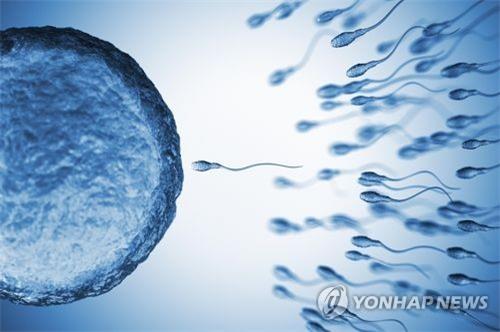
[Asia Economy Reporter Kim Young-eun] It has been revealed that there is a shortage of male sperm needed for artificial insemination in the United States and Europe. This is because the number of women wanting to have children without a spouse is increasing, while sperm donors have sharply decreased.
According to the New York Times (NYT) in the U.S. and the Daily Mail in the U.K., major sperm banks in the U.S. recently stated that "the number of people wanting sperm has increased by 20-30%, while supply has been cut in half."
According to the NYT, only a few hundred men are registered on a popular sperm trading site, but there are more than 14,000 women, and it is known that 30,000 to 60,000 babies are born annually through sperm donation in the U.S. The surge in demand is analyzed to be due to the prolonged COVID-19 pandemic making dating more difficult than before, and women having more free time due to remote work wanting to have children.
To undergo artificial insemination, one must regularly visit clinics for various tests and create an optimal environment for fertilization, but currently, sperm banks and artificial insemination clinics are unable to operate normally due to COVID-19. Additionally, the NYT reported that sperm donors who possess the preferred appearance, intelligence, and health that women desire are limited, leading to fierce competition.
In fact, one of the largest sperm banks in the U.S., the Seattle Sperm Bank, said, "We recently posted an ad at 6:30 a.m. for 'blue eyes, black hair, handsome college graduate,' and 30 reservations sold out within three hours. This enthusiasm is unprecedented." They added, "Not only in the U.S. but worldwide, sales records have been broken since June. Although the number of sperm donors has decreased, sales have increased by more than 20% compared to a year ago."
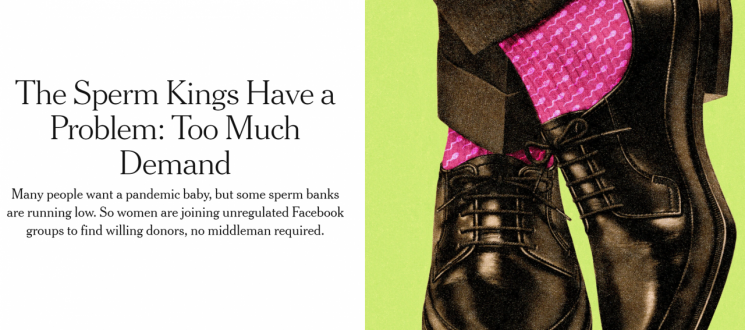
As a result, cases of illegal direct sperm transactions between individuals through social networking services (SNS) such as Facebook and TikTok are also increasing. Authorized sperm banks are regulated by the U.S. Food and Drug Administration (FDA), do not connect sperm donors and recipients directly, and limit one donor from providing sperm to more than 30 recipients. However, private transactions do not involve such complicated procedures. Moreover, men can donate as much sperm as possible and check if the children are growing well, so the NYT reported that more people are using this method.
Because of this, "super donors" who are highly popular among women have also emerged. A 29-year-old man from California who started donating sperm last year told the NYT, "I have 35 biological children, and 5 more are expected to be born."
Also, a 45-year-old single university professor in New York donated sperm while traveling through Europe, Asia, South America, and Africa, resulting in about 70 biological children. A Dutch musician in his 30s is known to have provided sperm to at least 300 people through sperm banks and private transactions over the past five years. Women who received sperm from him in various countries are organizing Facebook groups to devise measures to prevent children with the same father from marrying each other in the future.
© The Asia Business Daily(www.asiae.co.kr). All rights reserved.


















