Phishing and Smishing Impersonation Rampant
Clicking Fake Sites or Messages
Installs Malware on Smartphones
Risk of Personal Data Theft and Small Payment Fraud
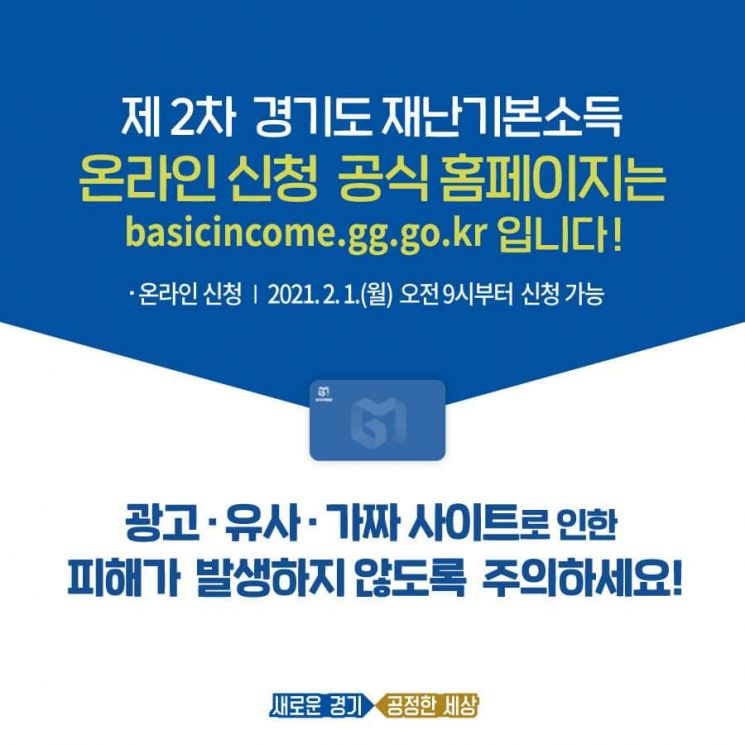 Gyeonggi Province has issued a warning about fake disaster relief fund websites. / Gyeonggi Provincial Government Facebook
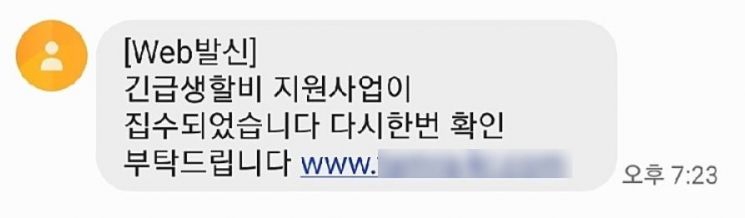
[Asia Economy Reporter Lee Gwan-ju] Lee Mo (31), an office worker living in Suwon, Gyeonggi Province, recently received a text message stating that he had been selected as a recipient of disaster relief funds. The message included a URL for guidance, and Lee clicked on it without much thought. However, instead of receiving information about the disaster relief funds, a suspicious application was installed on his smartphone. This was a typical case of a "smishing" scam.
Fortunately, no financial damage such as small-amount payments occurred, but after receiving advice that his smartphone might have been compromised, Lee ultimately had to replace his phone despite still being under contract. Lee sighed, saying, "I had heard that there were many scams impersonating disaster relief funds, but I never thought I would fall victim myself."
As some local governments began distributing disaster relief funds before the Lunar New Year holiday, various scams targeting this have emerged. Phishing sites and smishing scams aimed at stealing personal information by exploiting local governments' disaster relief fund distributions have been continuously detected.
Since the 1st of this month, Gyeonggi Province, which is accepting applications for disaster relief funds of 100,000 won per person, recently discovered 14 fake sites impersonating the disaster relief fund application site and reported them to the police. It is reported that simply accessing these sites can infect PCs and other devices with malware. The investigation into these sites is currently being conducted by the Southern Gyeonggi Police Agency. A National Investigation Headquarters official stated, "So far, no property damage has occurred due to these sites," and added, "We have ordered thorough investigations and strict responses."
Since the COVID-19 pandemic began, cybercrimes have repeatedly occurred whenever the government or local governments have distributed disaster relief funds. According to the National Cyber Security Center of the National Intelligence Service, last year the Korea Internet & Security Agency (KISA) detected a total of 950,843 smishing cases, a 2.6-fold increase compared to 2019. Especially as the government recently began discussions on the 4th round of disaster relief funds, such phishing and smishing crimes are expected to continue.
Accessing fake sites or clicking on URLs in text messages can result in malware being installed on PCs or smartphones, and personal information being stolen, which can then be exploited for small-amount payments on mobile phones or internet payments. A police official urged, "Do not click on suspicious messages or URLs, and when applying for disaster relief funds, directly access the relevant local government’s official website to verify the internet address and avoid fake sites."
© The Asia Business Daily(www.asiae.co.kr). All rights reserved.


















