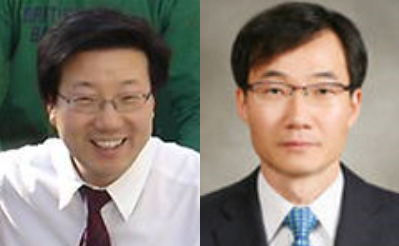
 Professor Kim Seontak, Korea University Law School (left), and Attorney Noh Heebeom (former Constitutional Research Officer at the Constitutional Court)
[Asia Economy Reporter Choi Seok-jin] As the impeachment motion against Lim Seong-geun, chief judge of the Busan High Court, who is accused of improperly interfering in a trial, is likely to be passed in the National Assembly on the 4th, attention is focused on the Constitutional Court's impeachment trial of a judge, which will be conducted for the first time in constitutional history.
With only two previous cases of impeachment trials against presidents in history, there is keen interest in what standards the Constitutional Court will apply to decide on impeachment, and what conclusion will be reached if Chief Judge Lim retires upon term expiration before the Constitutional Court's decision.
On the 3rd, various speculations emerged in the legal community regarding the Constitutional Court's impeachment trial of Chief Judge Lim. So far, only two cases?former Presidents Roh Moo-hyun and Park Geun-hye?have proceeded from the National Assembly's impeachment motion to an actual Constitutional Court impeachment trial.
There have been two attempts to impeach judges: former Chief Justice Yoo Tae-heung in 1985 and former Justice Shin Young-chul in 2009, but both were rejected by the National Assembly or failed to proceed to the Constitutional Court due to expiration of the processing period.
We asked two constitutional experts about the three controversial issues currently under debate.
◆Impeachment motion despite acquittal on abuse of authority?
Chief Judge Lim was acquitted in the first trial on charges of abuse of authority and is currently undergoing an appeal trial. However, both experts agreed that criminal trials and Constitutional Court impeachment trials are entirely separate systems with different purposes, requirements, and effects, so the impeachment trial is not determined solely by guilt or innocence.
Professor Kim Seon-taek of Korea University Law School said, “The court's ruling may have motivated this impeachment motion and can serve as reference material, but the recognition of grounds for impeachment is within the authority of the National Assembly,” adding, “The elements of criminal liability under criminal law and the requirements for impeachment are completely different in nature and the degree of proof differs.”
Attorney Noh Hee-beom, a former constitutional researcher, also said, “Whether one is punishable for abuse of authority and whether one should be excluded from public office for acts violating the constitution in the execution of duties are completely separate issues.”
◆Do judges require ‘serious legal violations’ like the president?
In the 2004 impeachment trial of former President Roh, the Constitutional Court acknowledged violations of statutory law (Public Official Election Act) but dismissed the case, stating that the violations did not constitute ‘serious legal violations’ warranting removal from office.
At that time, the Constitutional Court stated, “If the Constitutional Court Act is interpreted literally, it could be understood that removal must be decided whenever grounds for impeachment are recognized, but this violates the principle of constitutional punishment commensurate with responsibility, i.e., the principle of balancing legal interests,” and “The phrase ‘when the request for impeachment trial is justified’ in Article 53, Paragraph 1 of the Constitutional Court Act refers not to all legal violations but only to ‘serious’ legal violations justifying removal of a public official.”
Professor Kim said, “‘Serious legal violations’ can be seen as the Constitutional Court creating a standard not found in the constitution or laws to limit impeachment, but in fact, it is a natural concept,” adding, “The core issue is whether there is a reason making it difficult for the respondent to maintain the public office.”
However, Attorney Noh predicted, “The Constitutional Court’s judgment at the time was that ‘if it is serious enough to remove the president, minor legal violations are insufficient,’ so a more relaxed standard may apply to other public officials such as judges or prosecutors.”
◆Should the case be dismissed if the judge retires?
Meanwhile, some argue that even if the impeachment motion is passed, there is no practical benefit to the impeachment trial since Chief Judge Lim is scheduled to retire at the end of this month upon term expiration. If the Constitutional Court decides to impeach Chief Judge Lim, it must order “the dismissal of respondent Lim Seong-geun from the position of judge,” but considering the usual duration of the Constitutional Court’s trial, the decision may come after Chief Judge Lim has already ceased to be a judge, making it impossible to issue such an order.
Regarding this, Attorney Noh said, “Since one cannot dismiss someone who is no longer a judge after term expiration, it would be difficult to include that in the decision order,” but added, “However, it may be possible to declare that the acts committed while Chief Judge Lim was a judge constitute grounds for impeachment.”
On the other hand, Professor Kim said, “In the case of impeachment dismissal, there are subjective practical benefits such as restrictions on holding public office, pensions, and retirement benefits, and objectively it is an important constitutional issue, so the Constitutional Court seems to have practical grounds to make a judgment,” adding, “The issue is the form of the order, which is a technical matter, and methods such as retroactively dismissing just before term expiration or considering dismissal as having occurred before term expiration could be considered.”
He continued, “Since there is controversy over whether the effect of the Constitutional Court’s decision extends beyond the order to the main reasoning, it is necessary to specify dismissal in the order for the subjective effect of dismissal to apply to the party,” and explained, “In the U.S., there have been cases where impeachment trials of officials who had already left office were dismissed because the main purpose of impeachment had been achieved, and cases where impeachment trials proceeded.”
Professor Kim added, “In the U.S. this January, a Republican senator proposed that impeachment of a person who has already left office is unconstitutional and should be dismissed, but the proposal was rejected by a 55 to 45 vote, and it was decided to proceed with the impeachment trial related to former President Trump.”
© The Asia Business Daily(www.asiae.co.kr). All rights reserved.
![From Bar Hostess to Organ Seller to High Society... The Grotesque Con of a "Human Counterfeit" [Slate]](https://cwcontent.asiae.co.kr/asiaresize/183/2026021902243444107_1771435474.jpg)
















