Ministry of Science and ICT "Professor Kang Heemin and Professor Kim Younggeun's Team Achievements... Published in International Academic Journal"
[Asia Economy Reporter Kim Bong-su] A magnetic nanocoil system capable of controlling cell adhesion and differentiation in vivo through real-time remote control has been developed by a domestic research team.
On the 3rd, the Ministry of Science and ICT announced that a joint research team led by Professors Kang Hee-min and Kim Young-geun (Department of Materials Science and Engineering, Korea University) developed this magnetic nanocoil system.
Research to induce stem cells to differentiate into desired tissues such as bone, fat, muscle, myocardium, blood vessels, and cartilage by exposing them to specific environments or signals is active in the field of regenerative medicine for artificial organs and cell therapy.
In particular, studies have been conducted to stimulate stem cells on the surface of hard implant structures that can help treat osteoporosis, osteomalacia, and degenerative bone diseases, but it has been difficult to control differentiation remotely in real time. Challenges also remained in terms of reversible control.
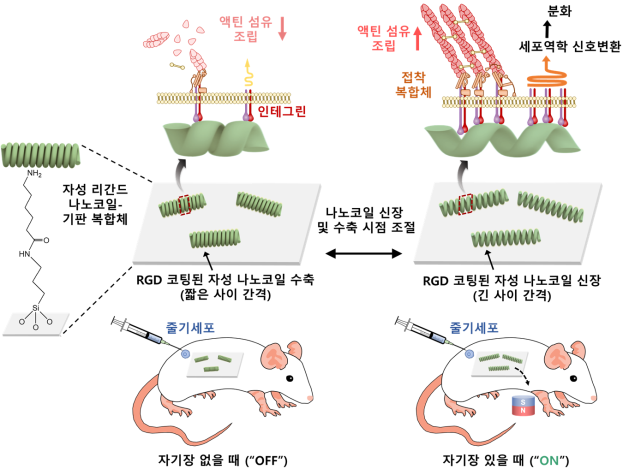
The research team fabricated a spiral alloy nanocoil about 1μm in length (70nm thick) that stretches like a spring under a magnetic field (126% of its original length) and returns to its original length when the magnetic field is removed.
The nanocoil can be precisely controlled at the nanometer scale using a magnetic field both inside and outside the body. It has mechanical strength that prevents it from being engulfed by cells or broken, allowing reversible stretching even in vivo.
The researchers proposed a system that coats the surface of the nanocoil, which responds to magnetic fields, with RGD ligands that can bind to cells, and remotely and reversibly controls the spacing of the ligands in real time using a magnetic field to regulate stem cell adhesion and differentiation.
When implanted in mice and an external magnetic field was applied to stretch the nanocoil inserted in vivo, stem cell adhesion was promoted, and osteogenic differentiation of stem cells was also enhanced.
By verifying the operation of the nanocoil system that can remotely deliver stimuli for stem cell differentiation at desired times in animal models, it is expected to serve as a starting point for future research on precise control of stem cells in vivo.
This research was conducted with support from the Ministry of Science and ICT’s individual basic research programs (mid-career and young researchers). It was published at midnight on the same day in the international materials science journal Advanced Materials.
© The Asia Business Daily(www.asiae.co.kr). All rights reserved.

















