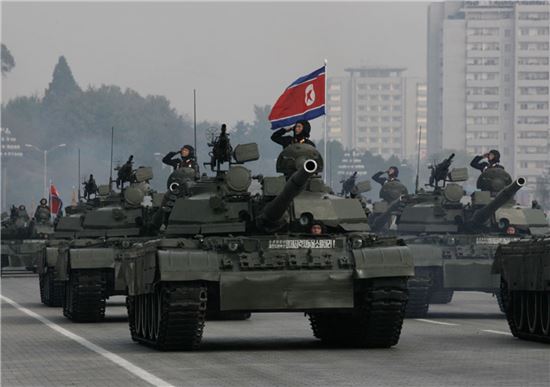
 North Korea has strengthened its latest tank forces by deploying the new tank "Seongunho" into combat following the "Cheonmaho" and "Pokpungho."
[Asia Economy Yang Nak-gyu, Military Specialist Reporter] North Korea's standing army is estimated to be 2.3 times larger than that of South Korea, with quantitative superiority in tanks, fighter jets, and naval vessels. However, the South Korean military is continuously acquiring or developing advanced weapons, leading to a qualitative dominance over the North Korean forces, according to evaluations inside and outside the military.
According to the '2020 Defense White Paper' (hereafter White Paper) published by the Ministry of National Defense on the 2nd, North Korea's standing forces number about 1.28 million, slightly exceeding 2.3 times that of South Korea's approximately 555,000. Compared to the end of 2018, North Korea's troop numbers remained unchanged, but South Korea's forces decreased by about 44,000 due to restructuring under Defense Reform 2.0, widening the gap further.
South Korea's tanks number about 2,130, less than half of North Korea's approximately 4,300. North Korea also has significantly more artillery pieces (South 6,000; North 8,800) and multiple rocket launchers and rocket artillery (South 270; North 5,500). In naval vessels, North Korea leads numerically with about 430 combat ships (South 100), 250 landing ships (South 10), and 70 submarines (South 10).
However, the military assesses that most North Korean vessels are coastal combat ships whose hulls have exceeded their service life cycles. North Korea imported 20 Romeo-class (1,800-ton) submarines, designed by the former Soviet Union in the 1950s, from China between 1973 and 1995. These are aged submarines, 25 to 47 years old.
In combat aircraft (South 410; North 810) and air mobility aircraft (South 50; North 350), North Korea shows quantitative superiority. North Korean air force trainers decreased from about 170 to 80, a reduction of roughly 90, indicating a large-scale retirement of outdated models such as the MiG-15 and MiG-17.
The South Korean Air Force possesses aircraft models more than a generation ahead of North Korea, including the F-35A stealth fighter, F-15K, and KF-16. Based on platforms such as the E-737 airborne early warning aircraft known as 'Peace Eye' and the KC-330 aerial refueling tanker, South Korea holds qualitative advantages in surveillance, reconnaissance, long-range precision strikes, and operational range.
The White Paper also includes major force enhancement plans centered on core military capabilities such as military reconnaissance satellites, medium- and high-altitude reconnaissance drones, high-power and ultra-precision surface-to-surface missiles, Aegis destroyers (KDX-III), F-35A, and the Korean Fighter eXperimental (KF-X), indicating that this qualitative superiority is expected to continue for the foreseeable future.
North Korea's army renamed its existing two mechanized corps as divisions, increasing the number of mechanized infantry divisions from four to six.
The armored vehicles assigned to these units increased by about 100, equipped with anti-tank missiles and mobile artillery. They are developing new tanks with improved mobility and survivability to replace aging forces. The concentration of heavily armed armored vehicles in mechanized infantry divisions is presumed to be part of restructuring unit organizations, such as converting division-level units into manpower-reduced formations. South Korea's main battle tank, the K-2, boasts far superior performance compared to North Korea's main tanks, the Seon'gunho and Pokpungho.
North Korea has also deployed numerous coastal artillery and anti-ship missiles along the east and west coasts to block approaching ROK-US combined naval and landing forces in case of emergency. Notably, the new anti-ship missile unveiled at the September 2018 military parade had its launch tubes increased from four to eight and its transporter erector launcher (TEL) replaced with a new model at the Workers' Party 75th anniversary event in October last year.
The White Paper describes the status of military forces between the South and the North as analyzed by the Ministry of National Defense and the Joint Chiefs of Staff as of the end of last year.
© The Asia Business Daily(www.asiae.co.kr). All rights reserved.
![Clutching a Stolen Dior Bag, Saying "I Hate Being Poor but Real"... The Grotesque Con of a "Human Knockoff" [Slate]](https://cwcontent.asiae.co.kr/asiaresize/183/2026021902243444107_1771435474.jpg)















