Traditional Lunar New Year Table for 4 People: 251,844 KRW at Traditional Markets, 320,265 KRW at Large Supermarkets
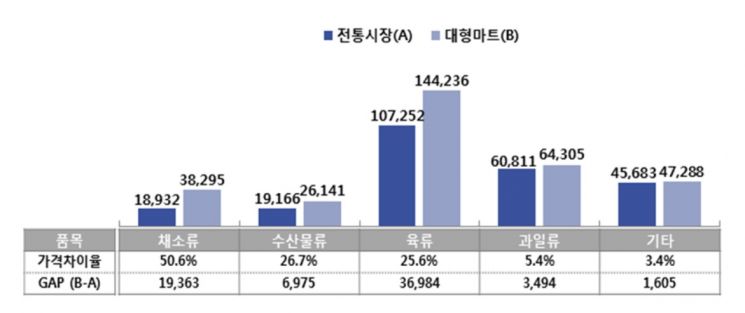 Cost Comparison of Lunar New Year Table Settings (for 4 people) at Traditional Markets and Large Supermarkets.
 [Graphic by Small Enterprise and Market Service]
[Asia Economy Reporter Kim Jong-hwa] This year, the cost of setting up a Seol Charyesang (Lunar New Year ancestral rite table) was found to be about 70,000 KRW cheaper at traditional markets than at large supermarkets.
The Small Enterprise and Market Service (Chairman Jo Bong-hwan) announced on the 2nd that from the 18th to the 22nd of last month, they conducted a price comparison survey of 27 Seol ritual items at 37 traditional markets nationwide and 37 large supermarkets near those traditional markets.
According to the survey results, the average cost of preparing a Seol Charyesang for four people was 251,844 KRW at traditional markets, while it was 320,265 KRW at large supermarkets, showing that traditional markets were approximately 68,421 KRW (21.4%) cheaper than large supermarkets.
By category, traditional markets showed price advantages over large supermarkets in vegetables (50.6%), seafood (26.7%), and meat (25.6%). Among the 27 items surveyed, traditional markets were cheaper in 21 items compared to large supermarkets.
Specifically, items where traditional markets had a price advantage included peeled balloon flower root (Kkandoraji) (66.3%, 8,776 KRW), bracken (Gosari) (65.3%, 8,443 KRW), mung bean sprouts (Sukju) (45.3%, 959 KRW), and beef (for soup) (39.4%, 18,883 KRW), in that order.
Compared to last year's prices for Seol ritual items, prices at traditional markets rose by 10.4% (from 225,680 KRW to 251,844 KRW), while prices at large supermarkets increased by 6.4% (from 299,669 KRW to 320,265 KRW).
This is believed to be due to the high prices of meat caused by a shortage in supply resulting from a decrease in the number of livestock relative to demand. Additionally, the spread of highly pathogenic avian influenza (AI) significantly increased egg prices, and chicken prices also showed a slight upward trend.
Compared to last year, prices of processed goods such as flour and alcohol (Cheongju) also rose overall, which is attributed to the prolonged COVID-19 pandemic causing economic downturn and reduced consumption, leading to a general increase in consumer prices.
Jo Bong-hwan, Chairman of the Small Enterprise and Market Service, said, "During the Seol holiday period, we hope customers will shop more economically at traditional markets, which welcome customers with affordable prices, generous hospitality, and improved services, rather than at large supermarkets." He added, "Using the Onnuri gift certificates, which have been on special sale since February for the Seol holiday, when shopping at traditional markets is expected to further help reduce household burdens."
© The Asia Business Daily(www.asiae.co.kr). All rights reserved.
![Clutching a Stolen Dior Bag, Saying "I Hate Being Poor but Real"... The Grotesque Con of a "Human Knockoff" [Slate]](https://cwcontent.asiae.co.kr/asiaresize/183/2026021902243444107_1771435474.jpg)










