"Calling Joseonjok Joseonjok, What Else to Call Them?"
"They Are Our Fellow Koreans, Choose Words Carefully" Recent Controversy Over Terms for Chinese Koreans
Political Sphere's 'Joseonjok' Remarks Spark Hate Speech Concerns
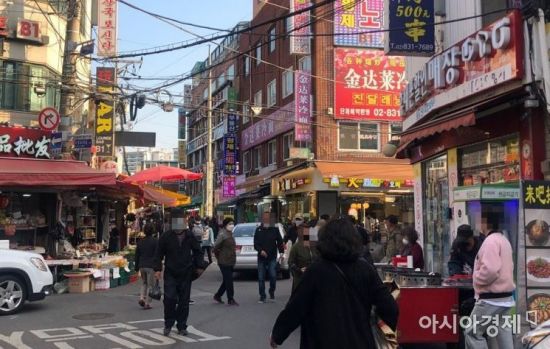 Last April, the area around Daerim Central Market in Yeongdeungpo-gu, Seoul. Photo by Yeonju Kim, intern reporter yeonju1853@asiae.co.kr
[Asia Economy Reporter Han Seung-gon] "Because they are Chinese, people call them Joseonjok." "Looking at history, they are Korean people, so naturally they should be called Chinese compatriots."
Recently, as conflicts over the term 'Joseonjok' have erupted in the political sphere, an unexpected controversy over the designation has arisen. Joseonjok refers to people with Chinese nationality. However, considering the history of the Joseonjok, they can be regarded as Korean people, so there is a view that it is more appropriate to call them Chinese compatriots. Some argue that calling them Joseonjok implies not recognizing them as our compatriots, which is essentially a derogatory remark.
According to the Encyclopedia of Korean National Culture and others, the Joseonjok community in China originated in the 1860s. By the 1870s, the Joseonjok population living in Manchuria (today's Northeast China, encompassing Liaoning Province, Jilin Province, Heilongjiang Province, and the eastern part of the Inner Mongolia Autonomous Region) had reached 77,000.
They are called Korean people or Joseon people (朝鮮民族), referring to an Asian ethnic group living in the Korean Peninsula and surrounding areas such as Manchuria and Primorsky Krai, forming a shared cultural sphere and speaking the Korean language. Those who lived in Primorsky Krai in the early 20th century and were forcibly relocated to Central Asia are also called Koryo-saram (高麗人).
Additionally, during the late Joseon period and Japanese colonial era, as living conditions in Joseon became increasingly difficult, some people migrated to the Chinese border regions, which were considered relatively better. Their numbers grew to 2.2 million in the 1900s and reached about 17 million during the Japanese colonial period. After liberation, 790,000 Joseon people returned to Korea, and according to the 1953 census report, the Joseonjok population was about 11.2 million.
The point of conflict is how to properly refer to these people with such a history. While they are commonly called Joseonjok, some emphasize their status as compatriots and call them Chinese compatriots. However, when calling them Joseonjok, the concept of 'compatriot' is omitted, leading to views that it is essentially a derogatory term. This has sparked debates in the political arena about how to interpret this designation.
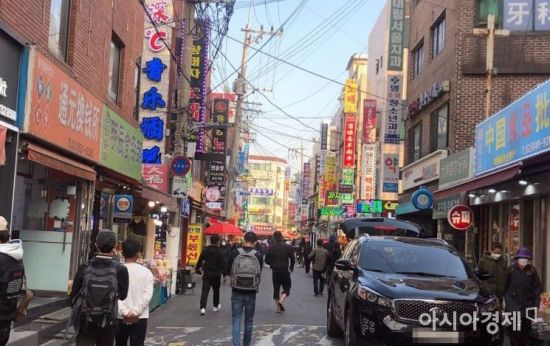 Last April, around Daerim Jungang Market in Yeongdeungpo-gu, Seoul. Photo by Yeonju Kim, intern reporter yeonju1853@asiae.co.kr
Former Seoul Mayor Oh Se-hoon, who recently declared his candidacy for Seoul mayor, appeared on the YouTube channel 'Goseongguk TV' on the 27th and mentioned the Seoul Gwangjin-gu Eul district, where he was defeated by Democratic Party lawmaker Ko Min-jung in the last general election, saying, "There are tens of thousands of naturalized Joseonjok living in the Yangkochi (lamb skewer) street. 90% of them lean toward the pro-Democratic Party."
The ruling party immediately reacted to this remark. Woo Sang-ho, a Democratic Party lawmaker and Seoul mayoral candidate, strongly criticized on his Facebook, saying, "It is deplorable how the 'Oh Se-hoon Law,' created for clean politics, has somehow degenerated into 'Ilbe' politics." Ilbe refers to the far-right online community Ilgan Best, criticizing former Mayor Oh for becoming a politician who utters reckless remarks.
Amid ongoing controversy, Ko Min-jung, who won against former Mayor Oh in last April's general election, visited a lamb skewer street in her Gwangjin-gu district on the 29th. This move is interpreted as a response to Oh's 'Joseonjok' remark.
On that day, Ko posted on her Facebook, "I visited the lamb skewer street in Gwangjin. The residents of Gwangjin are just our neighbors living there." She added, "I took home a meal recommended by the owner at the lamb skewer street." She continued, "Helping is not about holding an umbrella but sharing the rain. I will make sure our Gwangjin residents are not lonely. I will definitely protect them. I will stand with them."
As the naming controversy surrounding Chinese compatriots intensified, former Mayor Oh said in a media interview on the 30th, "President Moon Jae-in also used the expression 'Joseonjok compatriots.' So, is it a hateful expression when Oh Se-hoon uses 'Joseonjok'?" Regarding Woo Sang-ho's criticism calling him an 'Ilbe politician,' Oh responded, "Among our people, are more familiar with the term Chinese compatriots or Joseonjok? This is a logical leap."
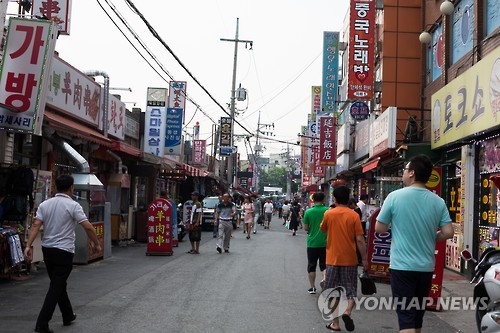 A densely populated residential area of Chinese-Koreans in Garibong-dong, Guro-gu, Seoul. [Yonhap News archive photo]
Civilian reactions to the political controversy were mixed. Kim, a company employee in his 30s, said, "Since they have Chinese nationality, it seems appropriate to call them Joseonjok." He added, "Of course, looking at history, they can be seen as Chinese compatriots, but that term doesn't roll off the tongue easily. This seems to be the social perception."
Lee, a worker in his 40s, said, "They can be seen as Chinese compatriots, but the term Joseonjok is also widely used." He added, "I think everyone should just call them whatever they want. This seems to be their current reality."
On the other hand, some believe they should be called Chinese compatriots rather than Joseonjok. Lee, a university student in her 20s, emphasized, "There is a huge gap between Joseonjok and compatriots. Joseonjok just seem like Chinese, while Chinese compatriots have the sentiment of being Korean people. That is the biggest difference."
Park, a company employee in his 30s, said, "Since they are our compatriots, they should be called compatriots." He criticized, "Calling them Joseonjok seems to carry the intention of not recognizing them as our compatriots, which feels like a derogatory remark."
Meanwhile, separate from the 'Joseonjok' and 'Chinese compatriots' naming controversy, hatred against them has also been an issue. Since COVID-19 started in Wuhan, China, in February last year, areas with many Chinese compatriots, such as Daerim-dong in Yeongdeungpo-gu, Seoul, have been hit hard by hateful remarks. Recently, two Chinese compatriots were arrested by the police on suspicion of murdering two other Chinese compatriots in Daerim-dong, which has again raised criticism against the Daerim-dong area and these people.
A representative of a Chinese compatriot association called for an end to hateful remarks. The representative said, "Even during the COVID-19 spread, hatred continued, and hateful incidents have kept occurring, including recent cases." He appealed, "Please see us as we are." He repeatedly urged, "Aren't we all human? Please stop hatred against people."
© The Asia Business Daily(www.asiae.co.kr). All rights reserved.



















