Battery Electric Vehicle Exports Increase by 66%... Expansion Centered on Europe
[Asia Economy Reporter Jeong Hyunjin] Last year, South Korea's electric vehicle exports surged significantly, ranking fourth in the world in the battery electric vehicle sector, following Germany, the United States, and Belgium. It is evaluated that South Korea is gradually enhancing its competitiveness in eco-friendly vehicles by greatly expanding exports, mainly to the European market.
According to the report "Leaders of New Growth Industries, Trends and Implications of Electric Vehicle Exports" released on the 31st by the Korea International Trade Association's International Trade and Commerce Research Institute, South Korea's eco-friendly vehicle exports last year amounted to $7.14 billion, a 19.3% increase compared to the previous year. This includes battery electric vehicles, plug-in hybrid vehicles, and hybrid vehicles. The share of eco-friendly vehicles in total automobile exports has steadily increased to 19.1%, up from 8.6% in 2017.
Among total eco-friendly vehicle exports, battery electric vehicles accounted for the highest proportion at 54.7%. Battery electric vehicle exports recorded $3.9 billion, a 65.9% increase from the previous year. As a result, for the first time, the export volume surpassed that of hybrid vehicles, which stood at $2.5 billion. Battery electric vehicle exports increased sharply, mainly in the European market. Last year, exports to the United Kingdom, France, and Italy increased by 624.3%, 112.2%, and 260.2%, respectively, compared to the previous year.
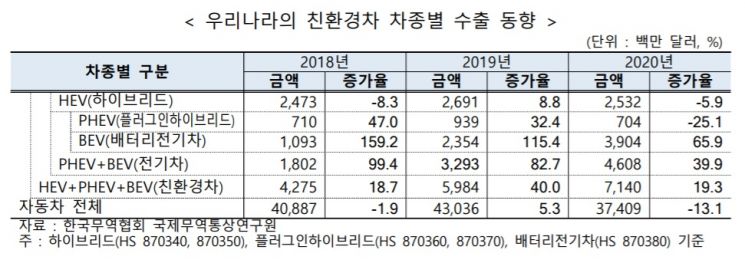
In the case of battery electric vehicles, South Korea also showed a high global ranking based on export value. From January to September last year, South Korea ranked fourth in battery electric vehicle exports, following Germany, the United States, and Belgium. This ranking remained the same as in 2019. Hybrid vehicles dropped one rank to seventh place, and plug-in hybrid vehicles fell two ranks to eighth place. The overall eco-friendly vehicle export ranking was fifth, following Germany, Japan, Belgium, and the United States.
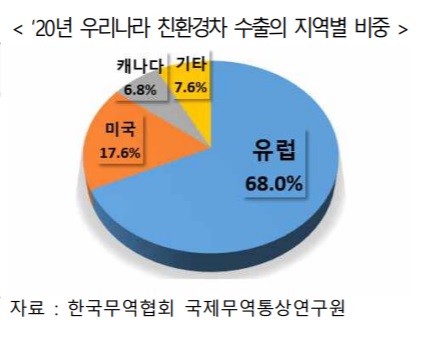
Looking at South Korea's eco-friendly vehicle exports last year, the share of exports to Europe was the largest at 68.0%. This far exceeds the European share of total automobile exports, which is 20.4%, by more than three times. However, there were regional differences; for example, in Norway, where the adoption rate of eco-friendly vehicles is high, 97.3% of the vehicles South Korea exported last year were battery electric vehicles, whereas during the same period, only 3.4% of vehicles exported to the United States were battery electric vehicles.
Hydrogen electric vehicles were exported in a modest volume of 995 units last year, but the export value increased by 26.3% compared to the previous year. In July, South Korea also succeeded in exporting hydrogen trucks to Europe for the first time. In the battery sector, which determines the performance and price of electric vehicles, South Korean companies demonstrated excellent competitiveness by ranking 2nd, 4th, and 5th in the global electric vehicle battery market share from January to November 2020.
Kim Kyunghoon, a research fellow at the Korea International Trade Association's International Trade and Commerce Research Institute, emphasized, "To capture the rapidly growing electric vehicle market, especially the European market, it is essential to closely understand each country's environmental regulations, incentive policies, and market trends, and to supply diverse and competitive vehicle models in a timely manner." He added, "We must continuously secure South Korea's competitive advantage in the electric vehicle industry through institutional improvements, infrastructure investment, and strengthening research and development (R&D) in line with the global trend of tightening environmental regulations."
© The Asia Business Daily(www.asiae.co.kr). All rights reserved.

![Clutching a Stolen Dior Bag, Saying "I Hate Being Poor but Real"... The Grotesque Con of a "Human Knockoff" [Slate]](https://cwcontent.asiae.co.kr/asiaresize/183/2026021902243444107_1771435474.jpg)















