[Asia Economy Reporter Buaeri] As major domestic game companies such as 3N (NCSoft, Nexon, Netmarble) have benefited from the novel coronavirus infection (COVID-19), there is a claim that they should actively engage in social contribution.
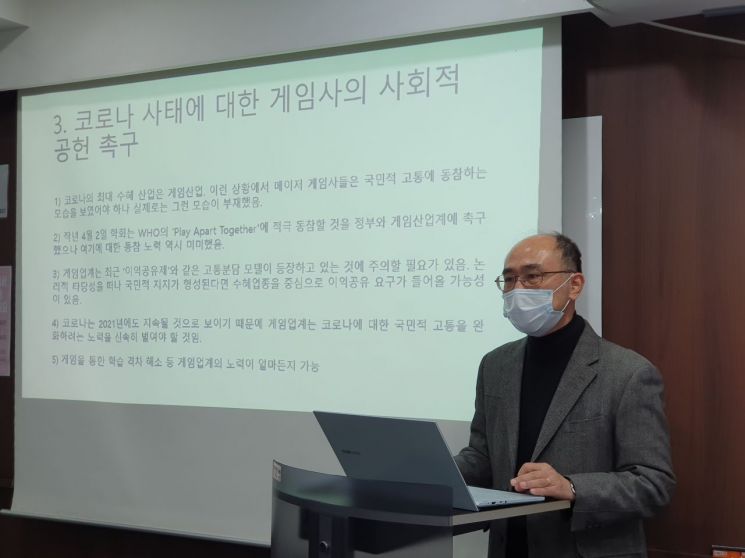
Professor Wi Jeong-hyun, president of the Korea Game Society and professor of business administration at Chung-Ang University, held a New Year's press conference on the 28th and said, "Game companies have seen a significant increase in (sales) due to the COVID-19 situation," adding, "However, major game companies have lacked participation in sharing the national suffering. Reflection is required."
Professor Wi criticized, "Last year, the society urged participation in the World Health Organization (WHO)'s 'distancing through gaming,' but the participation was minimal."
He continued, "When the WHO, which tried to assign a disease code to gaming, suggested overcoming COVID-19 through gaming, if the game industry had participated, it would have gained national support and trust, thereby justifying the assignment of the disease code. However, game companies did not make efforts," he pointed out.
He urged, "If national support is formed for pain-sharing models such as profit-sharing systems, the game industry will have no choice but to participate. The game industry should promptly show efforts to alleviate the national suffering even now."
Regarding the 'gaming disorder (game addiction) disease code,' which has been the biggest issue in the game industry, Professor Wi predicted that movements to promote the gaming addiction disease code will intensify once results come out in March.
He advised, "A firm opposition from the new Minister of Culture, Sports and Tourism is required," adding, "We should note that people worldwide enjoyed gaming to relieve mental stress amid social distancing."
Regarding the controversy over gambling-like 'probability-type items (loot box method),' Professor Wi said, "The probabilities should be disclosed accurately, and discussions on the appropriateness of probability-type items should also begin."
He also raised his voice that efforts should continue to obtain game licenses (panho) for service in China this year as well as last year.
Professor Wi said, "The Ministers of Culture, Sports and Tourism and Foreign Affairs should recognize that China's refusal to grant panho to Korean games is a major obstacle to Korea-China economic and cultural cooperation," adding, "The Game Rating and Administration Committee also needs to strengthen regulations related to Chinese game reviews."
Furthermore, he advised that large domestic game companies should focus on developing new intellectual property (IP) and expanding into the global market rather than diversifying into entertainment or real estate businesses.
Professor Wi emphasized, "Major game companies are in a situation where they must compete with China and advance globally, but it is concerning that they show interest in K-pop or the real estate industry. If they do not develop new IP, the future of the Korean game industry in 10 years will not exist."
© The Asia Business Daily(www.asiae.co.kr). All rights reserved.
![From Bar Hostess to Organ Seller to High Society... The Grotesque Con of a "Human Counterfeit" [Slate]](https://cwcontent.asiae.co.kr/asiaresize/183/2026021902243444107_1771435474.jpg)
















