"Public Corruption Investigation Office is a central administrative agency under the executive branch"
"Legislators' decisions regarding investigative agencies must be respected"
"Constitutional warrant applicants are not limited to prosecutors under the Prosecutors' Office Act"
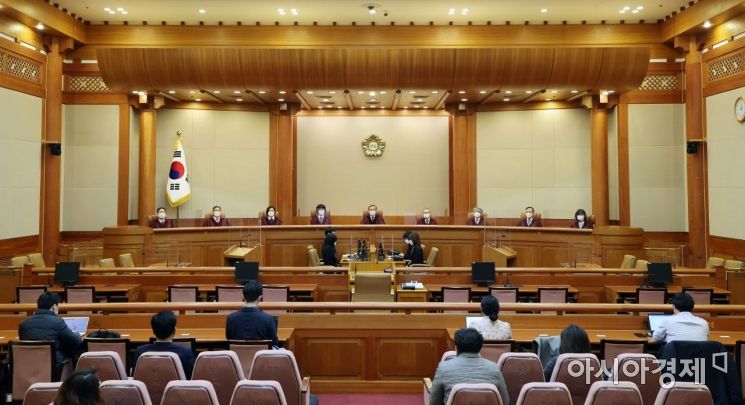 Chief Justice Yoo Nam-seok of the Constitutional Court and the constitutional justices entered and took their seats on the afternoon of the 28th at the Grand Bench of the Constitutional Court in Jongno-gu, Seoul, for the ruling on the constitutional complaint case regarding the Act on the Establishment and Operation of the High-ranking Officials' Crime Investigation Agency. Photo by Kim Hyun-min kimhyun81@
[Asia Economy Reporter Choi Seok-jin] The Constitutional Court ruled on the 28th that the Act on the Establishment and Operation of the Corruption Investigation Office for High-ranking Officials (CIO), which sets the legal basis for the establishment and operation of the CIO, does not violate the Constitution.
The court stated that in response to the petitioners' claim that "the CIO does not belong to the legislative, judicial, or executive branches and thus violates the constitutional system," the CIO can be regarded as a central administrative agency belonging to the executive branch headed by the President, and therefore does not violate the constitutional principle of separation of powers.
Furthermore, since the Constitution does not directly regulate the subjects of investigation or prosecution, the legislature's decision regarding investigative agencies should be respected, and the constitutional provision on the right to request a warrant cannot be interpreted as limiting the warrant requester to prosecutors under the Prosecutors' Office Act.
With the Constitutional Court's ruling of constitutionality on this day, the controversy over the unconstitutionality of the CIO is expected to be settled, and the organizational formation work of the CIO, including the appointment of the deputy chief, is likely to accelerate.
In the afternoon, the Constitutional Court delivered a ruling of constitutionality on the constitutional complaint filed by opposition party lawmakers claiming that the CIO Act violates the Constitution. The court ruled the constitutionality (dismissal) of Article 3 and Article 4, Paragraph 4 of the CIO Act with a vote of 5 (constitutional) to 3 (unconstitutional) to 1 (dismissal), and dismissed the rest of the petitions regarding other provisions of the CIO Act as inadmissible.
Previously, Kang Seok-jin, a former lawmaker from the Future United Party, the predecessor of the People Power Party, and lawmaker Yoo Sang-beom filed constitutional complaints with the Constitutional Court in February and May respectively, arguing that "the CIO Act violates constitutional principles such as separation of powers and the rule of law and infringes on fundamental rights such as equality."
The court first limited the scope of review to Article 2 and Article 3, Paragraph 1, which specify high-ranking officials such as judges and prosecutors and their families as subjects of investigation and prosecution, and Article 8, Paragraph 4, which defines the duties of CIO prosecutors.
The remaining provisions were dismissed without substantive judgment, as they were found not to directly infringe on the petitioners' fundamental rights or lacked the legal requirements for constitutional complaints due to the absence of potential fundamental rights violations.
Regarding the petitioners' claim that the CIO violates the constitutional principle of separation of powers by not belonging to any of the legislative, judicial, or executive branches, the court stated, "Establishing an independent form of administrative agency is not prohibited by the Constitution," and noted that "the exercise of the CIO's authority can be controlled by various institutions such as the National Assembly, courts, and the Constitutional Court."
It further stated, "It can be regarded as a central administrative agency belonging to the executive branch headed by the President."
Regarding the claim of infringement of the right to equality, the court explained the reason for the ruling of constitutionality, saying, "Crimes committed by high-ranking officials have significant negative ripple effects, and it is reasonable to designate them as subjects of investigation and prosecution," and "it is difficult to see this as unreasonable discrimination."
Regarding concerns raised by the petitioners about inadequate, reduced, or targeted investigations, the court rejected these, stating, "There is no objective or empirical evidence to support this, nor can it be considered a problem inherent to the CIO system itself."
Regarding the claim that the CIO infringes on the constitutional right of prosecutors to request warrants, the court stated, "The prosecutor as the warrant requester stipulated by the Constitution is a 'state official prosecutor,' and it is difficult to interpret this as referring only to prosecutors under the Prosecutors' Office Act."
The court added, "In fact, military prosecutors and special prosecutors, who are not prosecutors under the Prosecutors' Office Act, also exercise the right to request warrants."
On the other hand, Justices Lee Eun-ae, Lee Jong-seok, and Lee Young-jin issued a dissenting opinion stating that the reviewed provisions of the CIO Act violate the Constitution. They pointed out, "The rights to investigation and prosecution are the most important fundamental administrative areas, and granting them to the CIO, which is not affiliated with any administrative department, violates the Constitution."
Justices Lee Jong-seok and Lee Young-jin expressed the opinion that the CIO Act infringes on the right to file lawsuits, saying, "Considering the reality that there are many complaints and accusations against judges, there is considerable basis for concern that judges may become subjects of unfair internal investigations."
Article 24, Paragraph 1, which allows the CIO to take over investigative authority if investigations overlap with other investigative agencies, was dismissed, but the minority opinion (unconstitutional) and supplementary opinion (constitutional) were split evenly with three justices each.
Justices Lee Seok-tae, Moon Hyung-bae, and Lee Mi-seon submitted a supplementary opinion supporting the constitutional court's majority opinion (constitutional), stating, "Even if the case were not dismissed and substantive judgment were made, the provision on the transfer of investigative authority does not violate the principles of separation of powers and due process."
Conversely, Justices Lee Eun-ae, Lee Jong-seok, and Lee Young-jin pointed out, "The CIO effectively holds unilateral superiority over other investigative agencies within the executive branch in exercising investigative authority over crimes committed by high-ranking officials, thereby undermining cooperative relationships with other investigative agencies."
Meanwhile, immediately after the Constitutional Court's decision, Yoo Sang-beom, a People Power Party lawmaker who directly filed the constitutional complaint, criticized, "The Constitutional Court's decision is a political decision."
Lawmaker Yoo expressed regret, saying, "I cannot help but express regret that it took a year just to judge three provisions," and "This judgment could have been made well before the launch of the CIO."
He added, "Watching the suspension of the execution of Prosecutor General Yoon Seok-youl's case, I had a faint hope that the judiciary still serves as a bastion of the rule of law, but today's decision makes me question the Constitutional Court's value of existence," expressing dissatisfaction with the court's ruling.
© The Asia Business Daily(www.asiae.co.kr). All rights reserved.

















