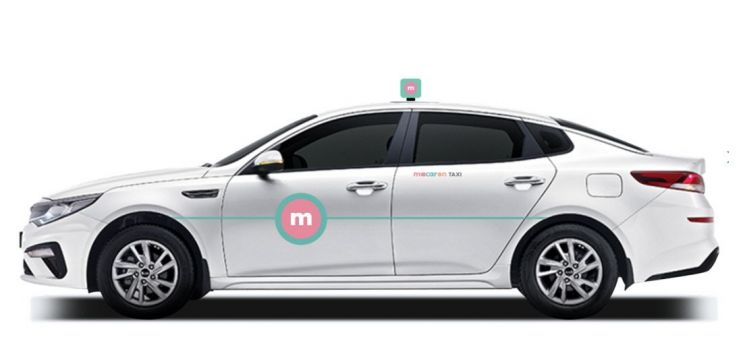
[Asia Economy Reporter Kangwook Cho] The number of "brand taxis," which combine taxis with platforms, has surpassed 30,000 nationwide. This figure represents an 18-fold increase in just over a year. It is analyzed that these taxis are rapidly gaining popularity because they minimize waiting times without ride refusals and offer various additional services.
On the 28th, the Ministry of Land, Infrastructure and Transport (MOLIT) announced that as of the 25th, a total of 30,539 brand taxis operated by six licensed transportation franchise operators under MOLIT were counted. This is an 18-fold increase compared to the end of 2019.
The six transportation franchise operators licensed by MOLIT are KM Solution (KakaoT Blue), DGT Mobility (KakaoT Blue), KST Mobility (Macaron Taxi), Nabi Call Co., Ltd. (Nabi Call), Konatus (Banban Taxi Green), and VCNC (Tada Lite).
By city and province, Seoul operates the largest number with a total of 11,417 vehicles, followed by Daegu (6,275 vehicles), Gyeonggi (3,269 vehicles), and Ulsan (1,891 vehicles). Gyeongnam has not yet started operations.
MOLIT analyzed that this increase in brand taxis is the result of active responses from the platform and taxi industries to policy support for innovation in platform-based taxi services, such as easing entry barriers for transportation franchise businesses and supporting experiments for new services through regulatory sandbox systems. MOLIT has relaxed the licensing standards for transportation franchise businesses, reducing the number from 4,000 to 500 vehicles in Seoul, which is about one-eighth of the previous level.
With the activation of brand taxis, the public can easily call taxis anywhere via smartphones without ride refusals or unnecessary waiting times, and enjoy more convenient and diverse innovative taxi services, including various additional services such as child car seats and pet taxis, MOLIT expects.
Additionally, the taxi industry can expect increased revenue and more effective management through efficient vehicle control, dispatch, and service evaluation using information and communication technology (ICT).
MOLIT forecasts that the spread of brand taxis will continue this year as well.
The business areas and operating numbers of the existing six nationwide franchise operators are expected to continue increasing, and regionally licensed franchise operators are gradually increasing, striving to enhance their influence in their respective areas.
In fact, LiraSoft (Tomato Taxi) obtained a license in Busan in August last year, Uber Korea (Uber Taxi) acquired a Seoul license in December of the same year, and Jin Mobility (IM Taxi) is preparing for a Seoul license.
Furthermore, with the enforcement of the revised Passenger Transport Service Act in April, transportation franchise businesses will be reorganized into platform franchise businesses, expanding consumers' fare options and enabling the emergence of diverse and differentiated services based on this.
For example, franchise taxis that conclude passenger transport contracts through calls and reservations via the franchise operator's platform will offer various fare systems such as dynamic pricing and subscription fares, allowing customers to choose.
MOLIT plans to continuously promote institutional support (such as driver shifts outside garages and temporary taxi qualifications) to resolve overlapping regulations and secure high-quality drivers.
Some companies are also pursuing services using 11-passenger vans or luxury vehicles.
Myungso Uh, Director General of Comprehensive Transport Policy at MOLIT, said, "The quantitative growth of taxi franchise businesses has laid a foundation where platforms and taxis can combine to provide diverse and convenient services. This year, we will focus not only on the quantitative growth of franchise taxi services but also on regulatory improvements, communication with the industry, and the provision of high-quality services and new added value that the public can feel."
© The Asia Business Daily(www.asiae.co.kr). All rights reserved.

















