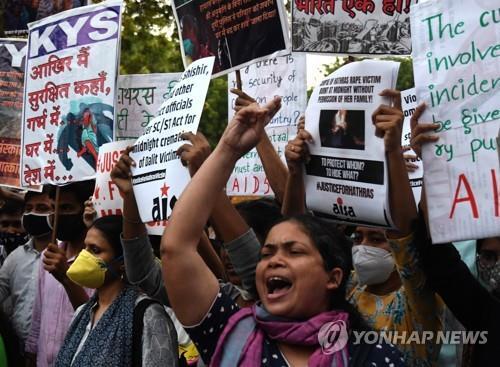
 Protest rally held in New Delhi, India, related to a sexual violence case against a woman. Photo by Yonhap News
[Asia Economy Reporter Kim Young-eun] An Indian court has sparked controversy by ruling that a man who molested a young girl did not commit sexual violence because he did not "remove her clothes."
CNN reported on the 26th (local time) that the Mumbai High Court in India acquitted a man accused of groping a 12-year-old girl.
On the 19th, Judge Pushpa Ganediwala of the Mumbai High Court ruled that the 39-year-old man’s act of groping the 12-year-old girl’s chest did not constitute sexual violence punishable by 3 to 5 years in prison because he did not remove her clothes. The judge stated, "Because the matter is serious, stricter evidence or more severe charges are required," and the court recognized only sexual harassment charges, sentencing him to one year in prison.
According to court documents, the man was sentenced to three years in prison in a lower court for taking the girl to his home in December 2016 under the pretense of giving her guava, then touching her chest and attempting to remove her underwear, and he appealed to the High Court.
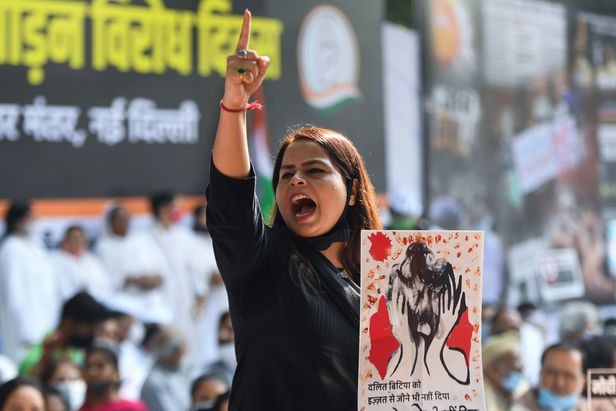 Protest rally held in New Delhi, India, related to a sexual violence case against a woman. Photo by Yonhap News
However, since Indian law enacted in 2012 does not explicitly state that direct skin contact is required for an act to be classified as sexual violence, this news has spread on social media, leading to growing criticism of the ruling.
Karuna Nundy, a Justice of the Supreme Court of India, condemned the ruling as "completely contrary to the law," asserting that "Judge Ganediwala needs to be re-educated about fundamental rights." She added, "Such a ruling will allow crimes against girls to go unpunished."
Additionally, Ranjana Kumari, director of a nonprofit social research center advocating for women's rights in India, criticized the ruling as "shameful, absurd, shocking, and lacking judicial prudence."
After a female college student was gang-raped and murdered on a bus in New Delhi in 2012, the Indian government enacted strict sexual offense laws and calls to eradicate sexual violence have grown, but local women’s activists and foreign media claim that little has changed since then.
In fact, related crimes in India have hardly decreased. According to the National Crime Records Bureau (NCRB), an average of 87 sexual violence cases (a total of 34,000 cases) were reported daily in India in 2019. This means a sexual violence crime occurred every 16 minutes.
This figure represents an increase of more than 7% compared to 2018, and unreported cases are estimated to be even higher. Furthermore, according to the annual crime report released by the Indian Ministry of Home Affairs, over 85% of sexual violence cases were prosecuted, but only 27% resulted in convictions.
© The Asia Business Daily(www.asiae.co.kr). All rights reserved.


















