[Asia Economy Reporter Joeslgina] SK Telecom has formed the 'K-UAM (Urban Air Mobility) Dream Team' to lead the era of 'Flying Cars.' Through close collaboration with capable operators, they aim to develop future mobility services that connect land and air transportation and commercialize them by 2025.
On the 28th, according to SK Telecom, the company signed a Memorandum of Understanding (MOU) for the commercialization of UAM with Korea Airports Corporation, Hanwha Systems, and Korea Transport Institute at Gimpo Airport in Seoul the previous afternoon.
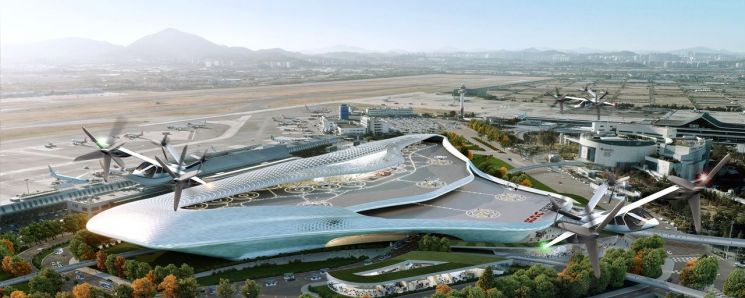
UAM refers to a new transportation service that enables urban mobility without runways by utilizing electric-powered small aircraft capable of vertical takeoff and landing. It can cover distances that take an hour by car in about 20 minutes and can be linked with existing land transportation, making it a promising solution to severe urban traffic congestion.
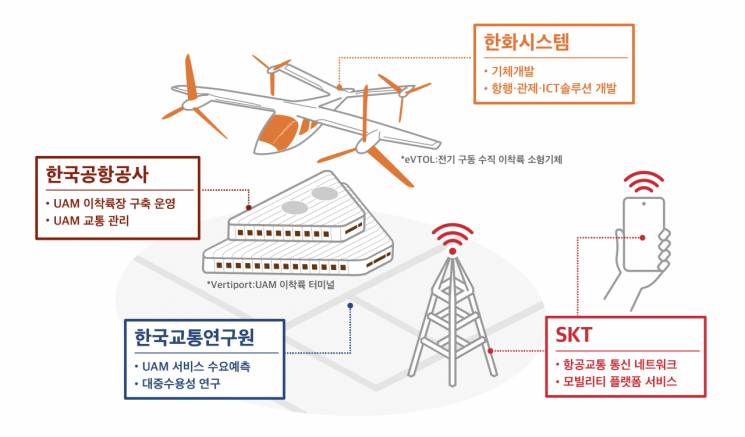
The four companies that signed the agreement represent the fields of service, infrastructure, aircraft, and research, respectively. They are expected to play the role of a dream team leading the successful commercialization of 'K-UAM.' They will continue to collaborate on research and development across all areas, including UAM infrastructure, aircraft, operation services, air navigation and traffic, platforms, demand, and acceptance.
SK Telecom is responsible for demonstrating and establishing an air traffic communication network model for safe UAM control. They are also developing a mobility platform for UAM and laying the foundation to provide integrated transfer services with land transportation. Korea Airports Corporation is in charge of building UAM takeoff and landing sites (vertiports) and traffic management; Hanwha Systems is responsible for developing UAM aircraft and navigation, control, and ICT solutions; and Korea Transport Institute handles research on service demand forecasting and public acceptance.
They aim to commercialize the service by 2025. Through this, they expect to reduce social costs caused by urban traffic congestion in the metropolitan area and contribute to the establishment of eco-friendly transportation with zero greenhouse gas emissions in the long term.
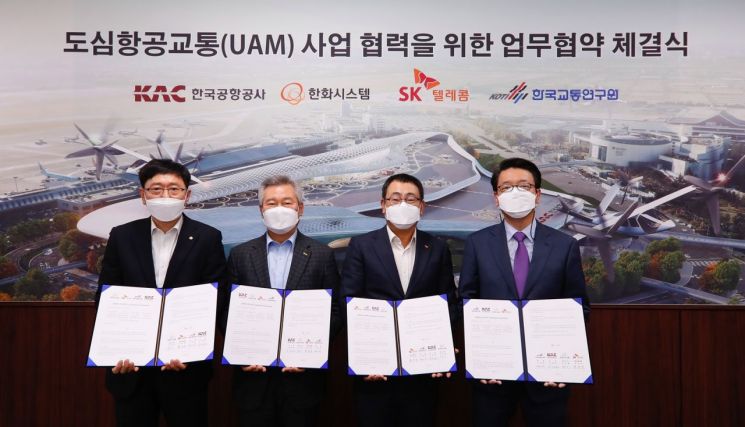 From the left, Kim Yeon-cheol, CEO of Hanwha Systems; Son Chang-wan, President of Korea Airports Corporation; Yoo Sang-young, Head of MNO Business at SK Telecom; Yoo Jung-bok, Deputy Director of Management at Korea Transport Institute
Global competition surrounding UAM, recognized as one of the future innovative industries, is intensifying in various countries. According to the Ministry of Land, Infrastructure and Transport, the UAM-related industry is expected to form a global market worth 731 trillion won by 2040.
Yu Sang-young, Head of SK Telecom's MNO Business, emphasized, "Through collaboration, we will realize the K-UAM roadmap that our country aims for and, furthermore, showcase world-leading mobility infrastructure based on South Korea's advanced ICT." The government formed the pan-government consultative body 'UAM Team Korea' in June last year, setting the goal to launch UAM commercial services by 2025.
© The Asia Business Daily(www.asiae.co.kr). All rights reserved.
![Clutching a Stolen Dior Bag, Saying "I Hate Being Poor but Real"... The Grotesque Con of a "Human Knockoff" [Slate]](https://cwcontent.asiae.co.kr/asiaresize/183/2026021902243444107_1771435474.jpg)













