Public Website Function Expansion Program 'Plugin' Improved by 99.9%... 100% Achievement Within Q1
[Asia Economy Reporter Lim Cheol-young] Users can now access public websites for online civil complaints without installing ‘plugins’ on their PCs. Plugins are programs that must be installed on a user’s PC to provide additional functions beyond the web browser, such as 'ActiveX'.
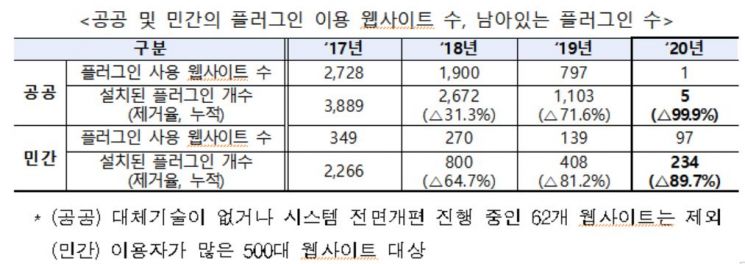
On the 28th, the Ministry of the Interior and Safety announced that, together with the Ministry of Science and ICT and the Financial Services Commission, they have improved 99.9% of plugins in the public sector and 89.7% in the private sector as a result of a government-wide effort to remove plugins from public and private websites over three years since 2018.
The removal of plugins from websites (2018?2020) was carried out according to the government’s ‘Plugin Removal Guidelines,’ which involved eliminating plugins by utilizing web standard technologies or, for certain security plugins such as vaccines and personal firewalls that cannot be resolved by web standards alone, improving them so that users install them only if desired.
Additionally, the joint certificate (formerly the public certificate) now offers methods that do not require plugin installation, or through amendments to the Electronic Signature Act abolishing the public certificate, allowing the introduction of various simple private-sector authentication methods.
In the public sector, excluding 62 websites without alternative technologies or those undergoing system reconstruction, improvements were completed on 2,727 out of 2,728 websites using plugins across central government ministries, local governments, education offices, and public institutions. However, the College Scholastic Ability Test (CSAT) score issuance system, which still uses plugins, is scheduled for improvement by March this year considering the university admission schedule.
In the private sector, improvements have focused on the top 500 websites with high user traffic to enhance public experience, resulting in an increase in the number of websites not requiring plugin installation from 151 in 2017 to 403 in 2020.
Meanwhile, if there are public websites where plugin removal has not been smoothly implemented, related issues can be reported through the People’s Petition system to facilitate improvements.
Going forward, the government will continue monitoring newly established public websites and provide ongoing support to companies requiring technical assistance to foster an environment for voluntary improvements in the private sector.
Furthermore, to use services without installing plugins, users must use the latest versions of web browsers supporting web standard technologies such as Whale, Chrome, Edge, Opera, and Firefox. The government plans to continue encouraging general users to use the latest web browsers.
The government stated, "We have implemented various policies such as establishing guidelines, improving legal systems, monitoring, and providing technical support to resolve public inconvenience caused by plugin installation." It added, "As a result of joint efforts by the public and private sectors, we have achieved meaningful progress in improving the majority of plugins, and we will continue to devise various measures to enable users to access web services easily and quickly."
© The Asia Business Daily(www.asiae.co.kr). All rights reserved.

















