First Judicial Ruling on the Relationship Among CIO, Prosecution, and Police
Majority Expect "Constitutional" Decision, but Possibility Remains for "Unconstitutionality with Grace Period" on Certain Provisions
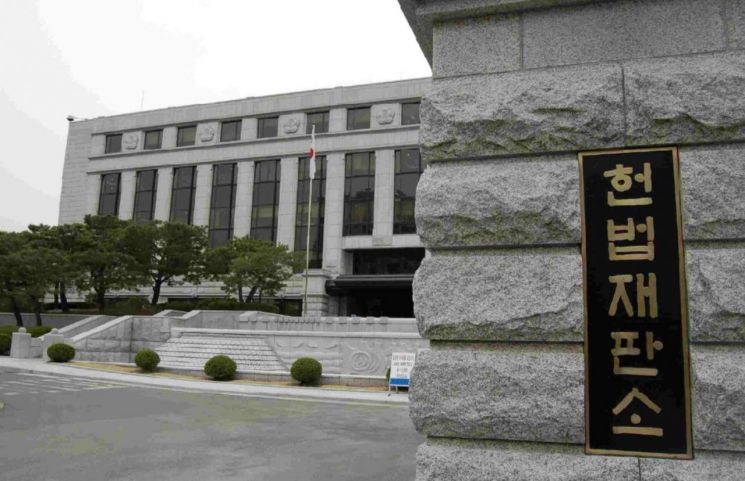
[Asia Economy, reporter Choi Seokjin] On January 28, the Constitutional Court will deliver its final ruling on the constitutionality of the Act on the Establishment and Operation of the Corruption Investigation Office for High-ranking Officials (CIO Act), which serves as the legal basis for the creation of the Corruption Investigation Office for High-ranking Officials (CIO).
As Kim Jinwook, the head of the CIO, has stated that he will announce his position on whether to transfer the "Kim Hakui illegal travel ban case" to the CIO after observing the Constitutional Court's decision later in the day, attention is focused on how the Constitutional Court will address the relationship and distribution of authority among the three investigative agencies: the newly established CIO, the prosecution, and the police.
The Constitutional Court will deliver its decision on two consolidated constitutional complaints concerning the CIO Act at a full bench hearing at 2:00 p.m. on January 28.
Previously, former lawmaker Kang Seokjin and lawmaker Yoo Sangbeom, both from the predecessor of the People Power Party, the United Future Party, filed separate constitutional complaints in February and May, respectively, arguing that the CIO Act violates constitutional principles such as the separation of powers and the rule of law, and infringes on basic rights such as the right to equality. A more recent constitutional complaint filed by lawmaker Yoo regarding the amended CIO Act, which removed the opposition party's veto power, is not included in today's ruling.
The main focus is on how the Constitutional Court will explain, in its reasoning, Article 24 of the CIO Act, which stipulates the "notification obligation" of other investigative agencies to the CIO and the "case transfer request authority" of the CIO head in cases of overlapping investigations.
In his constitutional complaint, lawmaker Yoo argued, "Article 24 of the CIO Act is not consistent with the legal system, as Paragraph 1 obligates other investigative agencies to comply with the CIO head's request for case transfer without any discretion, and Paragraph 2 imposes an immediate reporting obligation to the CIO head when other agencies detect a crime. Taken together, these provisions grant the CIO head a superior position over the Prosecutor General, as if the relationship were one of command and subordination."
He further argued that, since the Minister of Justice, a cabinet member, is the supervisor of the Prosecutor General, it is an ultra-legal and unconstitutional idea for the CIO head-who holds a vice-ministerial rank-to effectively issue instructions and orders to the Prosecutor General regarding cases.
The Constitutional Court's ruling on the relationship between the CIO and other investigative agencies will be the first judicial determination on the matter, as there are no relevant precedents from the courts.
On his way to work the previous day, when asked by reporters about the possibility of transferring the Kim Hakui illegal travel ban case to the CIO, Director Kim stated, "I will announce my position after the Constitutional Court's decision tomorrow." It is known that Director Kim plans to announce his position through an online briefing at 5:00 p.m. today.
In addition, the Constitutional Court is expected to rule on the constitutionality of several issues, including: ▲ subjecting individuals to investigation by different agencies depending on their status; ▲ granting the CIO the authority to enact rules through parliamentary legislation without constitutional delegation; ▲ including family members and retired public officials of high-ranking officials as subjects of investigation; ▲ the procedure by which the ruling party designated the CIO Act as a fast-track bill and passed it; and ▲ the constitutional status of the CIO, which does not belong to the legislative, judicial, or executive branches.
Within the legal community, the prevailing view is that the Constitutional Court is unlikely to declare the entire CIO Act unconstitutional, given that the appointment of the CIO head has already been completed.
However, there remains the possibility that the Constitutional Court may point out the unconstitutionality of certain provisions with constitutional issues, but instead of immediately invalidating them, it may issue a decision of unconstitutionality with a grace period, requiring the National Assembly to improve the legislation while temporarily maintaining the law's effectiveness.
© The Asia Business Daily(www.asiae.co.kr). All rights reserved.

![A Woman with 50 Million Won Debt Clutches a Stolen Dior Bag and Jumps... A Monster Is Born [Slate]](https://cwcontent.asiae.co.kr/asiaresize/183/2026021902243444107_1771435474.jpg)















