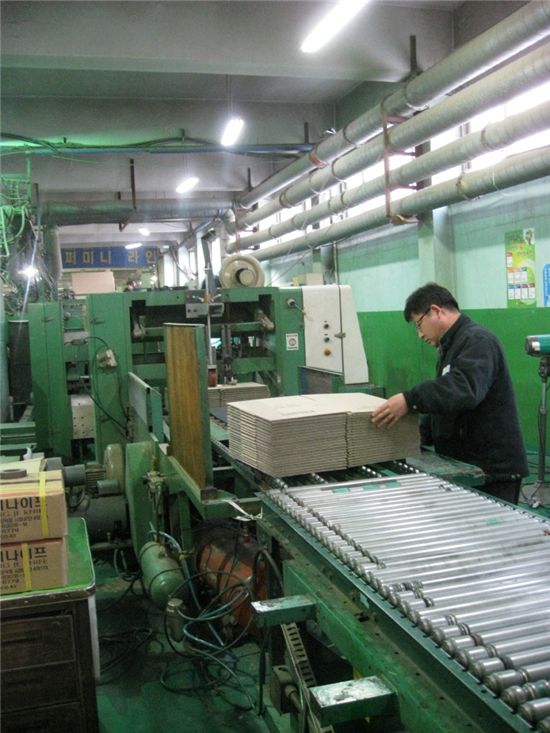
 An employee of a corrugated cardboard box manufacturer is inspecting a corrugated cardboard box in processing with a worried expression.
 [Photo by Asia Economy DB]
[Asia Economy Reporter Kim Jong-hwa] "It seems we have to wrap the items with bubble wrap instead of boxes for delivery."
This is the complaint of Lee Seon-yong (47, pseudonym), the CEO running an online shopping mall in Gangnam, Seoul. Lee said, "We almost ran out of box stock and urgently placed orders at several places, but all I received were replies saying there was no stock. Usually, the boxes I ordered would arrive in 3 to 4 days, but now they say I have to wait 3 to 4 weeks. Without boxes to pack, I can't sell the products."
Ham Seong-hoon (50, pseudonym), who runs a tangerine farm in Jeju, said, "The Lunar New Year peak season was ruined." He failed to order packaging boxes in advance due to a miscalculation of box inventory. Ham said, "I ordered boxes last week, and they said I have to wait about 20 days. Even if orders come in, I have no boxes to pack the tangerines for delivery, so I stopped sales starting this week." He expressed regret, saying, "Last Lunar New Year, I sold over 50 to 60 boxes."
Corrugated cardboard supply shortage continues for over three months
About two weeks before the Lunar New Year, the 'box crisis' has intensified. Since the fire at Daeyang Paper in October last year, the shortage of corrugated cardboard raw materials has continued for over three months. At the same time, parcel delivery volumes due to COVID-19 have reached record highs, and combined with the Lunar New Year demand, there is a shortage of gift and delivery boxes.
According to the paper industry on the 27th, after the fire at Daeyang Paper’s Ansan plant, which accounts for 7% (30,000 tons per month) of domestic raw material production, the industry increased raw material imports and reduced exports to compensate for the shortage. However, excessive demand driven by anxiety caused a surge in demand, leading to failure in supply adjustment.
Kim Jin-moo, Executive Director of the Korea Corrugated Packaging Industry Cooperative (Corrugated Cooperative), said, "After the Daeyang Paper fire, capable companies bought more raw materials fearing shortages, and distributors placed large advance orders for boxes, increasing excessive demand. Due to this excessive demand, the corrugated cardboard market is short by more than 30% compared to demand."
In fact, due to large advance orders for packaging and delivery boxes by distributors, the shortage of raw materials increased to about 100,000 tons per month. This 100,000 tons accounts for 22.6% of the domestic corrugated cardboard raw material production (440,000 tons per month).
Demand does not decrease despite price hikes, causing concentration phenomenon
Corrugated cardboard boxes are made by producing the outer surface and the wavy corrugated medium from raw materials, then making corrugated cardboard from the medium, and finally producing boxes from the corrugated cardboard. As supply tightened, the price of raw materials for corrugated cardboard also rose significantly. Since the fire, the delivery price of raw materials has increased by about 20-25%. The price of corrugated cardboard has also risen sharply. For example, the box material used for Korea Post parcel delivery now costs around 550-560 KRW per square meter, up from 480-490 KRW before the fire.
Despite price increases, demand has not decreased, and the concentration of supply to large paper companies has intensified. Integrated companies such as Taerim Packaging, Sambo Paperboard, and Korea Export Packaging, which have vertically integrated from raw materials to corrugated cardboard and dominate the market, are unable to meet delivery deadlines due to the flood of orders. Meanwhile, small corrugated cardboard and box manufacturers, unable to receive raw materials and produce boxes despite high prices, are being pushed to the brink of collapse.
Kang Kyung-beom (65), CEO of company D, which manufactures packaging boxes in Siheung, Gyeonggi Province, said, "We have been just keeping the company open for two months because raw materials have not arrived. As a small company, we cannot afford to pay extra to get raw materials and are just waiting for the paperboard factory to send them." He expressed frustration, saying, "We need to deliver ordered boxes to generate sales, but without sales, we cannot even pay employee salaries."
Corrugated Cooperative supports small businesses through 'joint purchasing'
To alleviate the difficulties faced by small corrugated cardboard and box manufacturers, the government and the paper industry came together on the 30th of last month to propose measures including 'joint purchasing,' requests for integrated companies to refrain from excessive advance procurement, and on-demand inspections if necessary. Joint purchasing involves the Corrugated Cooperative buying about 4,000 to 5,000 tons of raw materials monthly, produced by modifying manufacturing facilities of newsprint manufacturers such as Jeonju Paper and Daehan Paper, and supporting small corrugated cardboard and box manufacturers with these materials.
However, it is expected to take time before joint purchasing is implemented, so it will not immediately affect the market, and integrated companies are still fighting fiercely to secure supplies. Executive Director Kim said, "If joint purchasing can relieve the pressure on small and medium-sized companies, the market concentration phenomenon will improve. If the market is not controlled now, the corrugated cardboard crisis will continue into the second half of the year."
Future restrictions by the Ministry of Environment on mixed waste paper imports and limitations on waste corrugated cardboard imports are also expected to hinder market stabilization. A paper industry official said, "Imported waste paper is necessary to mix with domestic waste paper to maintain strength and other qualities. If exports are allowed but imports are banned, supply will become even tighter. As demand for waste paper increases alongside new expansions by paper companies, the shortage of supply will continue for the time being."
© The Asia Business Daily(www.asiae.co.kr). All rights reserved.
![From Bar Hostess to Organ Seller to High Society... The Grotesque Con of a "Human Counterfeit" [Slate]](https://cwcontent.asiae.co.kr/asiaresize/183/2026021902243444107_1771435474.jpg)















