Controversy Over Verbal Abuse and Assault on Elderly in Uijeongbu
Perpetrator Is a 13-Year-Old Juvenile... Difficult to Punish Due to Juvenile Law
Expert: "Prioritize Strengthening Educational Guidance"
 A video capturing middle school students grabbing the neck of a man in his 70s and assaulting him on the Uijeongbu Light Rail Transit in Gyeonggi-do. Photo by YouTube capture.
[Asia Economy Reporter Kang Juhee] On the 22nd, an incident occurred on the Uijeongbu Light Rail Transit and Subway Line 1 where middle school students assaulted an elderly person. However, since all the offending students fall under the category of "chokbeopsonyeon" (juveniles exempt from criminal punishment), it is virtually impossible to punish them, which has sparked public outrage. The offending youths mocked, verbally abused, and physically assaulted the elderly person, even filming the incident.
The Uijeongbu Police Station announced on the 22nd that they had summoned A (13) and B (13), middle school students attending a middle school in the Uijeongbu area, who were identified as the perpetrators in the video, and investigated them on assault charges. The investigation revealed that the video was filmed and uploaded by the offending students themselves, and the filming date was a few days prior.
Additionally, the police completed their investigation of C, a woman in her 70s who was the victim of the assault in the video. It was reported that C expressed her intention to seek punishment for the students during the investigation.
Earlier, controversy erupted as videos showing the circumstances of the incident were released primarily on social networking services (SNS) such as YouTube and Facebook. The released video shows the offending students strangling C’s neck inside the Uijeongbu Light Rail Transit, causing her to fall to the floor, and using severe verbal abuse.
In another video, while the offending students were sitting without masks in the subway’s priority seats for the elderly and disabled, an elderly person pointed this out, and the students pushed the elderly person's shoulder and threatened them. In the video, the offending students uttered harsh words and insults such as, "Old person. It wasn’t intentional. Why are you being a nuisance to us, XXX," and "If you drank, just go home and sleep."
However, since the offending students are classified as chokbeopsonyeon, punishment is difficult. Chokbeopsonyeon refers to juveniles aged 10 or older but under 14 who commit acts punishable under criminal law but lack criminal responsibility, thus receiving protective measures instead of criminal punishment.
The police stated that they will not file criminal charges against the offending students but will send the case to the juvenile court.
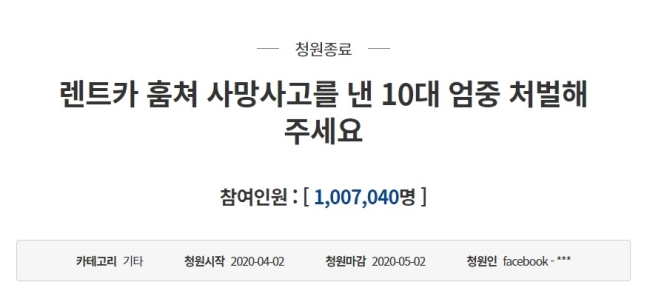 A Blue House petition post from last April requesting severe punishment for the perpetrators in connection with an incident where teenagers fled in a rental car and fatally struck a university student working part-time as a delivery worker. / Photo by Blue House petition board capture
As this fact became known, voices demanding severe punishment for the offending students have grown louder among citizens. Some argue that the Juvenile Act should be abolished so that juveniles can be subject to criminal punishment.
Netizens responded with comments such as, "What kind of juveniles are those who behave like that?", "If the punishment level increases and becomes stronger, wouldn’t such crimes decrease?", and "Not punishing because they are young is a law outdated for today’s world." On the 22nd, a petition urging punishment for the offending students was also posted on the Blue House’s public petition board.
The number of crimes committed by chokbeopsonyeon has been steadily increasing year by year. According to Supreme Court data, the number of chokbeopsonyeon (based on juvenile court filings) crimes was 7,236 in 2014, 7,045 in 2015, 7,030 in 2016, 7,897 in 2017, 9,051 in 2018, and 9,102 as of November 2019, showing a consistent rise.
In March last year, a youth driving a rental car fled the scene and struck a university student working part-time as a delivery worker, resulting in the student’s death. This incident sparked intense debate over the abolition of the Juvenile Act. A petition demanding severe punishment for the offender gained over 200,000 signatures, meeting the Blue House’s official response threshold.
In response, the Blue House stated that the issue of criminal punishment for chokbeopsonyeon requires further social discussion.
Kang Jeongsoo, head of the Blue House Digital Communication Center, said, "Most experts pointed out that strengthening punishment for juvenile offenders is not an effective means to reduce recidivism, and there are no overseas cases where lowering the age for chokbeopsonyeon led to a decrease in crime," emphasizing, "In addition to the criminal justice aspect of strengthening punishment, social welfare and educational perspectives that properly educate juvenile offenders and reintegrate them into society must also be considered."
Experts also stressed that educational guidance is more important than criminal punishment for chokbeopsonyeon.
Professor Lee Sujeong of the Department of Criminal Psychology at Kyonggi University said, "Children are still young and do not have fully developed personalities. Since they have the potential to change, indiscriminate criminal punishment is unlikely to be very effective," adding, "Punishment does not improve the behavior of children who commit delinquency. It is more important to look into their family environment and the education they received at school."
Professor Lee continued, "Abolishing chokbeopsonyeon essentially means sending children to prison, which would interrupt their education and expose them to negative influences living with adult criminals in prison," and said, "The Juvenile Act is intended for education and guidance, and its purpose cannot be ignored."
© The Asia Business Daily(www.asiae.co.kr). All rights reserved.


















