CJ CheilJedang's Trend Forecast for This Year
Escape from Three Meals a Day, Increase in Brunch and Early Dinner
Home Meals Expand in Meaning as Rest Play
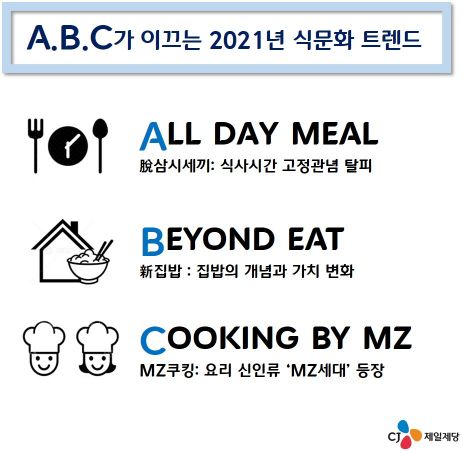
[Asia Economy Reporter Lim Hye-seon] The prolonged COVID-19 pandemic has transformed the concept of ‘Wellness’ in food culture. It has evolved beyond simply eating to pursuing enjoyment and sharing experiences, establishing itself as a new trend.
On the 25th, CJ CheilJedang forecasted this year’s food culture trends with three key themes: ‘Allday meal (탈(脫)삼시세끼)’, ‘Beyond Eat (신(新)집밥)’, and ‘Cooking by MZ (MZ쿠킹)’. CJ CheilJedang’s Trend Insight Team analyzed approximately 90,000 meal plans and 260,000 cooking method menus from 4,700 people in the first half of last year using big data to make these predictions. ‘MZ’ refers to the Millennial generation born in the early 1980s to early 2000s and Generation Z born in the mid-1990s to early 2000s.
Anytime Instead of Three Meals a Day
The biggest change is that the boundaries of three meals a day have blurred due to increased remote work and online classes after COVID-19. While last year saw the ‘fourth meal’ such as late-night snacks and snacks become a new trend, this year more people are combining breakfast and lunch or skipping lunch to eat dinner early instead of sticking to three meals a day. Analyzing actual meal times showed that breakfast, lunch, and dinner decreased by 1.4%, 0.3%, and 0.3% respectively compared to last year, while ‘Ajeom (breakfast + lunch)’ and ‘Jeomjeo (lunch + dinner)’ increased by 0.5% and 0.1% respectively.
Looking at meal methods, consumers choosing home meal replacements (HMR) for ‘Ajeom’ and ‘Jeomjeo’ increased by 3.6% and 4.3% compared to the previous year. The proportion of meals ordered for delivery or takeout also rose by 1.5%. Consumption of HMR products showed the highest growth rate during the active time slot of ‘Jeomjeo’. The proportion of snacks prepared and eaten directly increased by about 1.7%.
From Meals to ‘Rest and Play’
With the surge in HMR and delivery food consumption, the concept of ‘home-cooked meals’ is also changing. As the number of meals eaten at home has significantly increased, the meaning of home-cooked meals has expanded from ‘meals cooked directly at home’ to ‘the table I set’. On social networking services (SNS), cases introducing ‘home-cooked meals’ prepared with ‘HMR’, ‘meal kits’, and ‘delivery food’ are increasing. In fact, the growth rate of HMR consumers has accelerated fivefold compared to the previous year.
Along with this, the meaning of ‘mandatory meals’ has been supplemented with the concepts of rest and play. Representative examples include ‘Netflix snacks’ enjoyed while watching video content at home, ‘home baking’ challenges undertaken by families together, and ‘cooking challenges’ through SNS channels. A CJ CheilJedang official analyzed, “With the expanded meaning of home-cooked meals, this year, healthy convenience foods that pursue both health and ease, camping foods enjoyed in outdoor spaces, and home snacks that people comfortably reach for during leisure time will gain popularity.”
New Cooking Tribe: The MZ Generation
Last year, the only generation that increased the frequency of cooking at home was the MZ generation. This is the biggest change for the MZ generation, who mainly preferred dining out.
The tendency to use ‘cooking’ as their own content was prominent. Therefore, meal kits or restaurant meal replacements (RMR) that allow them to create their own ‘home restaurant’ with the same taste enjoyed when dining out are expected to receive even greater love from the MZ generation this year. In addition, as the importance of ‘health’ is emphasized more than ever, global interest in ingredients and immunity is expected to expand along with the awareness that ‘the food I eat makes me.’
Overseas, fermented foods have been known to help improve immunity, and the related search volume for kimchi and immunity on global portal sites has more than doubled compared to the previous year.
© The Asia Business Daily(www.asiae.co.kr). All rights reserved.
![Clutching a Stolen Dior Bag, Saying "I Hate Being Poor but Real"... The Grotesque Con of a "Human Knockoff" [Slate]](https://cwcontent.asiae.co.kr/asiaresize/183/2026021902243444107_1771435474.jpg)
















