Starting with IBK on the 28th, Sanctions Review Committee to Convene
High-Intensity Sanctions Expected Like with Securities Firms
Banking Sector "Cannot Accept Additional Penalties"
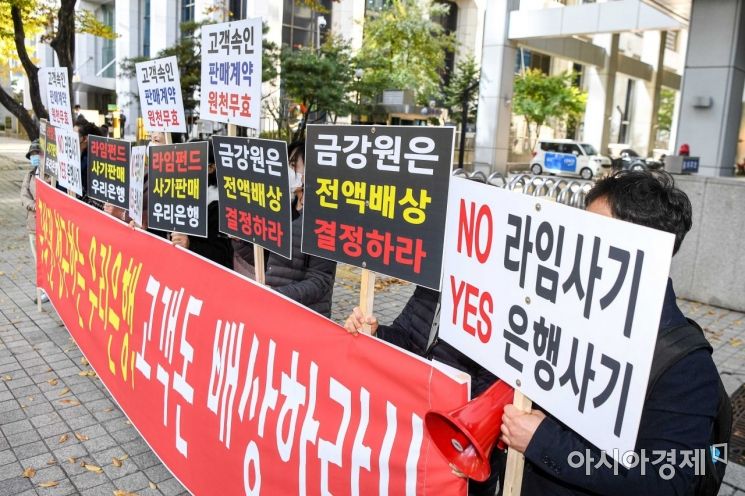 On the 2nd, in front of the Financial Supervisory Service in Yeouido, Seoul, victims of the Lime Fund held a rally urging dispute mediation for victim protection regarding the Lime Fund. Photo by Jinhyung Kang aymsdream@
[Asia Economy Reporters Kwangho Lee, Sunmi Park] As financial authorities have officially announced sanctions against banks that sold private equity funds such as Lime and Discovery, the banking sector is on high alert. Since most former and current CEOs of securities firms that sold Lime funds last November received severe disciplinary actions such as suspension of duties and institutional warnings, it is widely expected that financial authorities, mindful of fairness and public opinion from victims, will impose strict disciplinary measures on bank presidents.
According to the financial sector on the 25th, the Financial Supervisory Service (FSS) will hold sanction review committees for a total of eight banks that sold private equity funds, starting with Industrial Bank of Korea on the 28th. Industrial Bank of Korea sold approximately 679.2 billion KRW worth of Discovery funds from 2017 to 2019. However, the U.S. asset manager failed to recover bonds invested with the fund’s capital, causing a delay in redemption payments amounting to 91.4 billion KRW. Industrial Bank of Korea also sold Lime funds worth about 29.4 billion KRW.
The FSS plans to initiate sanction reviews for Woori Bank, Shinhan Bank, KDB Industrial Bank, Busan Bank, and Hana Bank within the first quarter. An FSS official stated, "We plan to begin the sanction procedures against banks that sold defective private equity funds starting this week." The levels of sanctions include caution, cautionary warning, disciplinary warning, suspension of duties, and recommendation for dismissal, totaling five stages. Disciplinary warnings and above are classified as severe sanctions. If a bank head receives a sanction of disciplinary warning or higher, they face restrictions on reappointment and, in principle, are barred from employment in the financial sector for 3 to 5 years from the time of the sanction.
Banking Sector: "If All Responsibility Is Shifted to Sellers, Private Equity Fund Sales Will Inevitably Shrink"
Within the financial sector, it is anticipated that the FSS will impose strong sanctions on banks similar to those applied to securities firms during their sanction reviews. Issuing weak sanctions only to banks could spark fairness controversies. A senior bank official awaiting the sanction review explained, "On-site investigations related to Lime funds at banks have already been completed, and we expect to receive an opinion letter from the FSS regarding the sanction review soon. Once we receive the letter, we plan to convey the bank’s position as much as possible, and after a two-week adjustment process, the sanction decision will be made." He added, "We did not expect additional sanctions related to Lime sales after having already received severe sanctions for the Derivative Linked Fund (DLF) incident. The DLF and Lime cases are similar, but the atmosphere is moving toward additional sanctions rather than combined sanctions, which we find unacceptable."
The banking sector expresses a sense of injustice regarding the stringent sanctions from financial authorities. Under current law, sellers market products based on the asset manager’s investment plans, but there is a lack of systems to track whether the asset manager conducted proper investments as planned or if there were issues during the investment process, and to reflect such findings. Additionally, the 2015 reform of private equity fund regulations, which lowered the minimum investment amount from 500 million KRW to 100 million KRW and changed the private equity fund pre-approval system to a post-reporting system, is argued to have caused excessive commission competition, inevitably leading to incomplete sales.
Another bank official lamented, "While incomplete sales due to commission competition can be punished, it is unfair to hold banks responsible for the private equity fund incident simply because they sold the products."
Meanwhile, the FSS will also hold a dispute mediation committee next month for banks that sold Lime funds. Based on the estimated loss amount from the Lime funds, the mediation decision will prioritize compensation to victims first, with additional recoveries settled afterward. Woori Bank, which sold the largest amount of Lime funds and has agreed to compensate estimated losses and completed on-site investigations, is expected to be the first case presented to the mediation committee.
© The Asia Business Daily(www.asiae.co.kr). All rights reserved.
![Clutching a Stolen Dior Bag, Saying "I Hate Being Poor but Real"... The Grotesque Con of a "Human Knockoff" [Slate]](https://cwcontent.asiae.co.kr/asiaresize/183/2026021902243444107_1771435474.jpg)
















