[Asia Economy Reporter Joselgina] Newly launched domestic online video service (OTT) providers such as Wavve, TVING, and Watcha are set to officially initiate administrative lawsuits against the government as early as next week. This follows ongoing controversies over the Ministry of Culture, Sports and Tourism’s (MCST) announced ‘OTT Music Copyright Royalty Rates,’ which are considered excessively high and involve issues such as discrimination against identical services and double charging. There is also a growing concern that native OTT platforms could be wiped out if the situation continues. This is why the OTT industry, composed of emerging companies, is taking the unprecedented step of filing administrative lawsuits against the MCST, which holds the leading role in the content industry.
◆Why Did They Pull the Administrative Lawsuit Card?
According to industry sources on the 26th, the OTT Music Copyright Countermeasure Council, which includes Wavve, TVING, Watcha, KakaoPage, and Lotte Cultureworks, will soon begin administrative lawsuit procedures against the MCST. A representative from the OTT Music Copyright Council explained, "An official announcement is expected as early as the beginning of next week." This is a move to nullify the previously announced ‘Amendment to the Music Copyright Usage Fee Collection Regulations’ by the MCST. The amendment proposes raising the royalty rate from 1.5% this year to 1.9995% by 2026.
It is not an easy decision for the OTT industry, made up of emerging companies, to take legal action against the government. It is reported that even within the OTT Music Copyright Council, there were strong concerns about potential direct and indirect disadvantages in future content industry policies led by the MCST. However, the decision to proceed with the administrative lawsuit was ultimately driven by the judgment that the MCST’s rate determination was unreasonable and failed to maintain even the minimum mechanical neutrality among stakeholders.
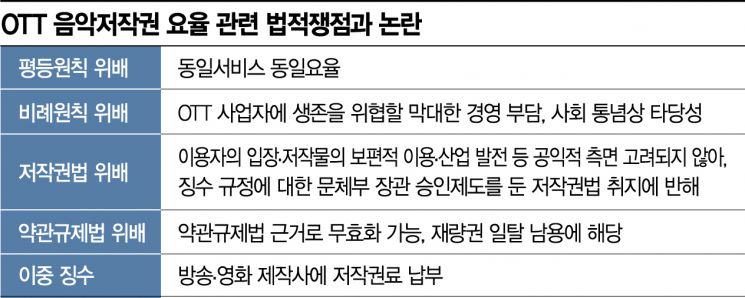
The OTT Music Copyright Council criticized, "The amendment violates the purpose of the Copyright Act, contradicts the principles of equality and proportionality, and constitutes an abuse and deviation of discretionary power. It is a rash decision that could cause serious negative impacts on the overall domestic content industry ecosystem."
So far, the OTT Music Copyright Council has conducted legal reviews regarding the bias toward rights holders in the rate-setting process and the rate discrimination against similar services. Separately, Wavve requested the MCST to disclose information related to the OTT music copyright rate decision, including the final report and the Copyright Commission’s review report. However, the MCST refused to disclose the information.
◆Why Are Only OTTs Charged for Watching the Same Drama?
There are numerous controversies surrounding the OTT music copyright royalty rates. Legal experts point out concerns such as discrimination against identical services and double charging.
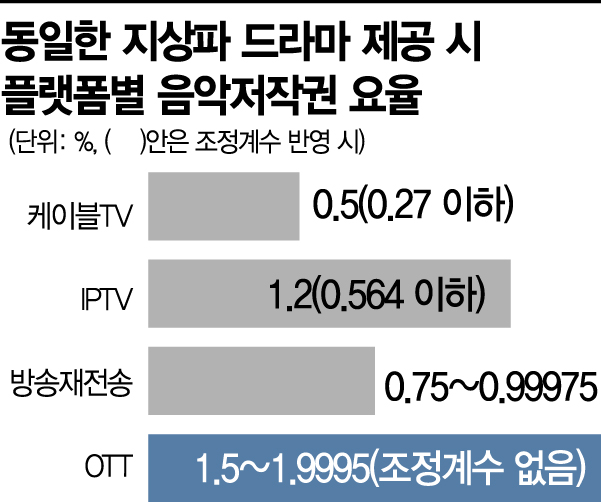
For example, the same royalty rate should apply to identical services, but the rates differ when watching terrestrial dramas on cable TV (0.5%), IPTV (1.2%), and OTT (1.5%). Additionally, cable TV and IPTV rates drop to approximately 0.27% and 0.564%, respectively, when adjustment coefficients are applied, but OTTs are excluded from this. This has led to criticism that OTTs, which are still in their growth phase, are being held hostage.
There is also unavoidable controversy over double charging, as additional copyright fees are collected for content whose rights have been collectively managed through production companies. The MCST’s authoritative interpretation that ‘OTT and broadcast retransmission are different’ can be seen as unfair discrimination between media.
Professor Kim Kyung-sook of the Department of Copyright Protection at Sangmyung University pointed out at a related seminar that "copyright fees should be calculated based on the usage form rather than the technology providing the service," highlighting the unclear standards. Even within the MCST’s Music Industry Development Committee, it was acknowledged that there are no global standards to refer to.
Nevertheless, despite mounting criticism, the MCST appears to be pushing forward with the current rates by citing some ambiguous overseas cases. This is expected to lead to an increase in OTT subscription fees by several thousand won, ultimately disadvantaging consumers. The loss of competitiveness of native OTTs could result in global players like Netflix taking over the platform market. Critics also argue that this runs counter to the government’s cross-ministerial digital media policy, which aims to nurture at least five global OTT companies.
Even within the government, there are critical voices regarding the MCST’s unilateral approach. Han Sang-hyuk, Chairman of the Korea Communications Commission, recently stated that support measures related to the OTT administrative lawsuit are under consideration. The Korea Communications Commission and the Ministry of Science and ICT have repeatedly requested the MCST to consider public interest aspects such as users and OTT industry development, but reportedly only received complaints that such requests "interfere with their work."
© The Asia Business Daily(www.asiae.co.kr). All rights reserved.
![Clutching a Stolen Dior Bag, Saying "I Hate Being Poor but Real"... The Grotesque Con of a "Human Knockoff" [Slate]](https://cwcontent.asiae.co.kr/asiaresize/183/2026021902243444107_1771435474.jpg)

















