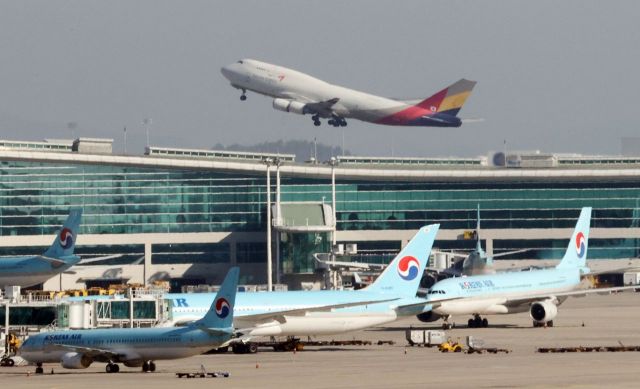
[Asia Economy Reporter Eunbyeol Kim] As the Korea Fair Trade Commission (KFTC) officially begins the corporate merger review of Korean Air and Asiana Airlines, attention is focused on the criteria for judging whether a monopoly exists. The KFTC considers market share when evaluating whether a merger intensifies monopoly power and restricts competition, and in the airline industry, market share can be divided into route-specific market share and major airport slot (aircraft takeoff and landing capacity) market share.
According to government authorities and industry sources on the 24th, the KFTC has formed a dedicated team consisting of four employees and two external experts to accelerate the review related to the corporate merger.
Based on route-specific market share, routes where a monopoly occurs after the integration of Korean Air and Asiana Airlines (operating share over 50%) were counted as 32 out of 143 routes operated by both companies (22.4%). Seven routes departing from Incheon?Los Angeles (LA), New York, Chicago, Barcelona, Sydney, Palau, and Phnom Penh?had a combined market share of 100%. Routes from Incheon to Honolulu, Rome, Phuket, and Delhi had market shares exceeding 75%.
Previously, the National Assembly Legislative Research Office explained in its report titled "Issues and Points of Contention Related to Large Airline Mergers and Acquisitions (M&A)" that whether monopoly intensifies should be judged based on route-specific market share rather than each airline’s overall market share.
However, within the airline industry, the prevailing view is that due to the presence of foreign airlines, the focus should be on major airport slot market share rather than individual route market share. The logic is that for international routes, foreign airlines can freely decide operations based on profitability, so monopoly should not be judged solely by current route-specific market share.
At Incheon Airport, Korean Air holds 24% of slots and Asiana Airlines holds 16%, totaling 40% combined. It is estimated that about 30% of these slots are actually in use, with the remainder held by foreign airlines and low-cost carriers (LCCs). The 40% figure is not high compared to the slot market share of foreign airlines at their home hub airports. Major airlines’ slot shares at their home hub airports are Delta Air Lines 79%, Lufthansa 67%, Air France 49%, and Emirates 68%, among others.
Even if there are routes operated only by the merged airline, competition restriction concerns are difficult to justify because foreign airlines holding slots can open routes at any time. For example, if profitability improves after the launch of the merged airline on the Incheon-New York route, foreign airlines can open routes, making it difficult for a monopoly to occur.
The degree of airport hub status, measured by the slot market share of national airlines at their hub airports, is also a factor the KFTC is expected to consider. A high slot share by national airlines increases the number of aircraft takeoffs and landings at the airport and is advantageous for attracting transfer passengers.
However, if foreign airlines do not operate, some routes of the merged airline will inevitably be operated solely, which could deepen the KFTC’s concerns. Ultimately, whether the KFTC focuses on route-specific market share or major airport slot market share will likely determine the judgment on monopoly existence.
Additionally, even if the KFTC recognizes competition restriction concerns on some routes, there is a possibility that it may approve the merger by applying exceptions for cases where recovery is impossible, as in the precedents of Jeju Air and Eastar Jet.
© The Asia Business Daily(www.asiae.co.kr). All rights reserved.
![Clutching a Stolen Dior Bag, Saying "I Hate Being Poor but Real"... The Grotesque Con of a "Human Knockoff" [Slate]](https://cwcontent.asiae.co.kr/asiaresize/183/2026021902243444107_1771435474.jpg)
















