60% of Parents Say "Middle School Admission Assignment Method Should Change"
Option 1: Balanced Local Assignment · Option 2: Pre-application Local Assignment Proposed
[Asia Economy Reporter Han Jinju] A research report has been released suggesting that the criteria for assigning middle school admissions for students residing in Seoul should prioritize 'proximity.'
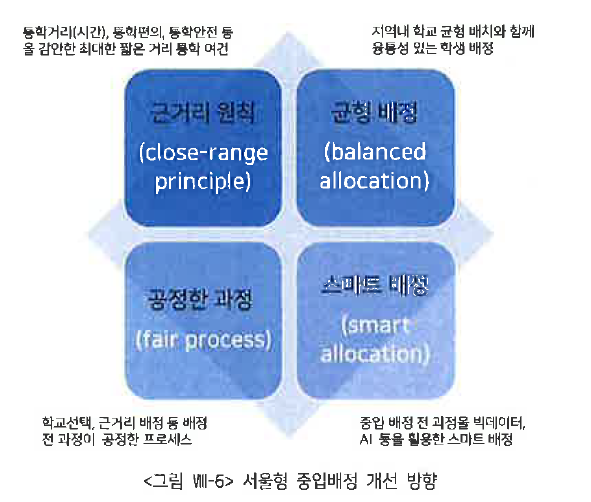
On the 25th, the Seoul Metropolitan Office of Education published the report of the "Research on the Improvement of Middle School District Setting and Assignment Methods in Seoul" on the Office of Education and Onnara Policy Research websites. The research team proposed the basic directions for improving the assignment method as prioritizing proximity, balanced assignment, a fair process, and smart assignment. The research team included Professor Lee Hwaryong from the Department of Architecture at Kongju National University, Professor Ha Bongun from the Department of Education at Gyeonggi University, Professor Dong Jaewook from the Department of Architecture at Kongju National University, Researcher Cho Changhee from the Industry-Academic Cooperation Foundation at Kongju National University, and Woo Hyojin, the administrative director of Seoul Mangwoo Elementary School.
The Seoul Metropolitan Office of Education stated, "The research results are suggestions from the research team and do not immediately become the Office of Education's middle school assignment policy (draft). We will gather diverse opinions from students, parents, and citizens and conduct thorough and multifaceted reviews over sufficient time."
'Proximity Balanced Assignment' Reflecting Proximity and Commute Time
The first improvement plan proposed by the research team is the 'Proximity Balanced Assignment' plan. It assigns students based on proximity ranking, and when conditions are the same, assigns sequentially based on commuting distance and time. This method introduces the concept of time into the current distance-based assignment system, applying both absolute and relative proximity criteria.
The second plan is the 'Priority Application Proximity Assignment' plan. Students can apply to up to three schools within their residential school district, and if the number of applicants exceeds capacity, assignment is done by proximity (80%) and computerized lottery (20%). If the number of students with the same proximity ranking exceeds capacity, adjustments are made to favor students who are relatively closer.
The research team explained, "Plan 1 has the advantage of providing the shortest commuting conditions but is insufficient as an assignment method stipulated by law. Plan 2 has the advantage of guaranteeing school choice but raises concerns about distant assignments and concentration on preferred schools."
The team added, "From the parents' perspective, there is a strong belief that commuting should be possible within 30 minutes on foot, making improvements difficult. Challenges such as distant assignments due to choice systems and the ranking between preferred and non-preferred schools must also be overcome. Since the issue tends to be interpreted as a social issue related to real estate policies, promoting the necessity of assignment improvements and gaining community consensus is the top priority."
Reasons for the Flood of Complaints Regarding Middle School Admission Assignments
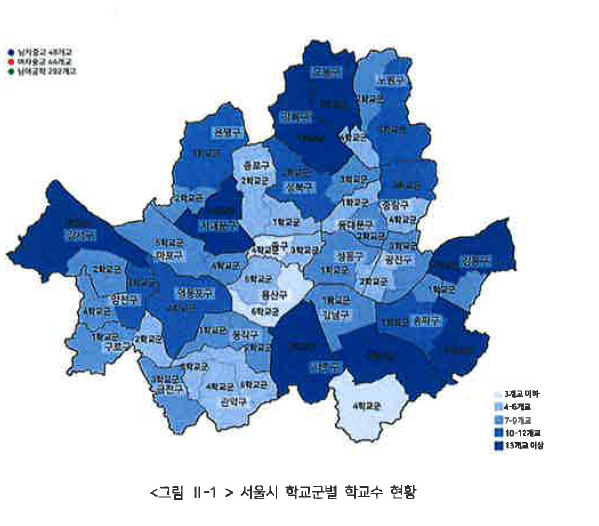
Controversies regarding school assignment methods have been consistently raised. Complaints related to middle school assignments submitted to the Seoul Metropolitan Office of Education via the National Petition System mostly concern non-assignment to specific schools, accounting for 76.3% of the total. The school districts of the Seoul Metropolitan Office of Education have not been revised since 1996, failing to reflect the changed geographical situation of Seoul and limiting responses to decreases or increases in student numbers. The school-age population is declining, and sporadic redevelopment projects cause population shifts, leading to imbalances in school distribution by region.
The complaint areas remain the same each year, and the scope of affected areas continues to expand. According to a survey in the research report targeting parents and school staff across Seoul, 61.5% of elementary school parents and 54.6% of middle school parents responded that improvements are necessary. Regarding parents' criteria for choosing a preferred middle school, 55.4% chose a nearby school, while 44.6% chose a preferred school even if it was farther away, showing a slight preference for 'proximity.' An analysis of commuting conditions for students assigned in 2020 (first-year middle school students) using big data showed that 5.69% had walking commute times exceeding 30 minutes, and 4.79% had distances exceeding 2 km.
Seoul operates a proximity assignment system for middle school admissions that reflects administrative districts and neighborhood units based on the student's residence. 83% of students are assigned to a single school per residence area (single assignment), while 17% are assigned through a lottery among two or more schools per residence area (joint assignment). By region, Seoul, Incheon, and Busan use lottery-based proximity assignments; Daejeon, Ulsan, Daegu, and Sejong use priority application assignments; and Gwangju uses random lottery within school districts.
Choi Seongmok, Director of School Support at the Seoul Metropolitan Office of Education, said, "Considering the high public interest in the research, we have disclosed the results in hopes that it will serve as an opportunity to build trust and consensus regarding the Seoul Metropolitan Office of Education's policies, especially middle school assignment policies."
© The Asia Business Daily(www.asiae.co.kr). All rights reserved.
!["The Woman Who Threw Herself into the Water Clutching a Stolen Dior Bag"...A Grotesque Success Story That Shakes the Korean Psyche [Slate]](https://cwcontent.asiae.co.kr/asiaresize/183/2026021902243444107_1771435474.jpg)

















