More than 12% of Laying Hens Culled... "Prices Increased but Supply Shortage Not Yet"
Confectionery and Bakery Industry Faces Cost Pressure... Imported Eggs to Enter Market from Next Week
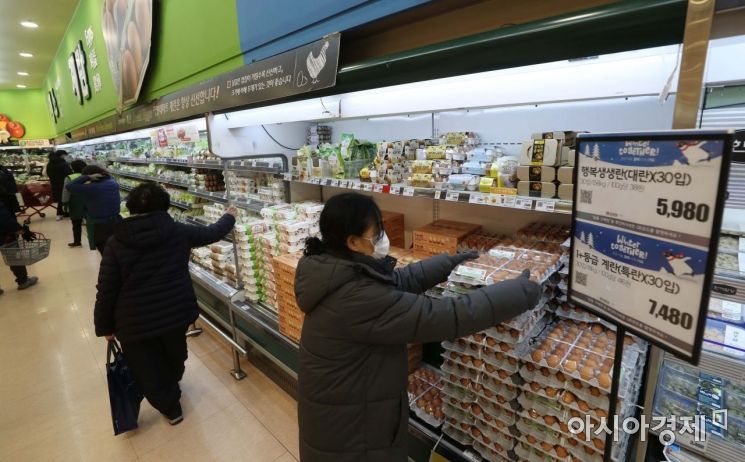 Due to the spread of highly pathogenic avian influenza (AI), the price of a carton of eggs has surpassed 6,000 won. According to the Korea Agro-Fisheries & Food Trade Corporation (aT) on the 11th, the retail price of a carton of eggs was recorded at 6,082 won as of the 8th. As the spread of AI shows no signs of slowing, concerns are rising that the prices of chicken and eggs, which affect meal costs, may increase further. Citizens are examining eggs at a large supermarket in Seoul on this day. Photo by Moon Honam munonam@
[Asia Economy Reporter Jo In-kyung] As the supply of eggs decreases and prices rise sharply due to the spread of highly pathogenic avian influenza (AI), imported eggs are expected to be released into the market as early as next week.
According to the Livestock Products Quality Evaluation Service's Livestock Distribution Information on the 23rd, the consumer price for one carton of eggs (30 special eggs) was 6,610 won, up 16.5% (935 won) from 5,675 won a month ago. Compared to the consumer price of 5,578 won on November 23, two months ago, it is 18.5% (1,032 won) higher, and compared to the price of 5,249 won a year ago, it is a staggering 25.9% (1,361 won) more expensive.
Usually, egg prices show a slight upward trend as household demand increases before holidays, but this year, it has been directly hit by AI outbreaks nationwide since November last year. The culling of poultry such as chickens and ducks has surged, with the number of laying hens culled reaching 8,788,000 as of the 20th of this month. According to Statistics Korea, the domestic laying hen population in the fourth quarter of last year was 72,580,000, meaning it has already decreased by 12.1%.
In the distribution industry, including large supermarkets, the current situation is not considered to cause supply disruptions beyond the rise in egg prices. However, to prevent panic buying, measures such as limiting consumer purchases to 'one carton per person' are being considered.
The government, anticipating a possible 'egg crisis' if additional culling occurs due to AI spread, decided on the 20th to temporarily apply emergency tariff quotas on a total of 50,000 tons of imported fresh eggs and processed egg products, allowing duty-free imports. The Korea Agro-Fisheries & Food Trade Corporation (aT), responsible for supplying these imported eggs, has been conducting public bidding for 60 tons of fresh eggs from the United States since the day before, and these eggs are expected to be supplied to the market as early as next week.
Previously, in 2017, when egg prices soared due to AI spread, the government exempted import tariffs and imported eggs from the United States, Australia, and Spain to stabilize prices. At that time, the price of one carton of eggs, which exceeded 9,000 won and approached 10,000 won at the beginning of the year, dropped to the 7,000 won range after the imported supply was released into the market, and fell to the 5,000 won range around September.
A distribution industry official said, "The current egg supply situation and prices are not yet at the 2017 level," and added, "Based on past experience, general consumers are unlikely to strongly prefer imported eggs." He also said, "However, for small and medium-sized self-employed businesses such as restaurants and bakeries that consume eggs in large quantities, increased cost burdens could lead to product price hikes, so it is necessary to induce price stability depending on the impact of AI spread."
© The Asia Business Daily(www.asiae.co.kr). All rights reserved.
!["I'd Rather Live as a Glamorous Fake Than as a Poor Real Me"...A Grotesque Success Story Shaking the Korean Psyche [Slate]](https://cwcontent.asiae.co.kr/asiaresize/183/2026021902243444107_1771435474.jpg)
















