New COVID-19 Cases Decrease by 300-400
Increased Movement in Capital and Non-Capital Areas Last Weekend
Experts: "Lunar New Year Holiday Critical... Vigilance Must Not Be Relaxed"
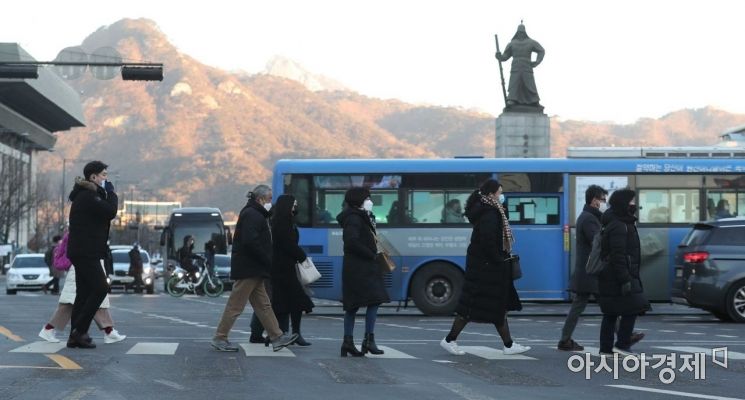 On the 19th, citizens wearing thick clothes hurried their steps at the Gwanghwamun intersection in Seoul. Photo by Mun Ho-nam munonam@
[Asia Economy Reporter Kang Juhee] As the number of new domestic COVID-19 cases drops to the 300-400 range per day, evaluations are emerging that the "third wave" has entered a stabilization phase. However, concerns are also being raised that COVID-19 might resurge again as citizens' outdoor activities noticeably increase following the government's relaxation of quarantine guidelines.
Experts have urged that vigilance must not be relaxed as the final critical period for quarantine, including the Lunar New Year holiday, remains ahead.
According to the Central Disease Control Headquarters on the 22nd, the number of new COVID-19 cases as of midnight was recorded at 346, a decrease of 55 from the previous day (401). The number of new cases falling to the mid-300s is the first time in two months since late November last year, the early stage of the third wave.
For the past fifteen days since last month, the daily new cases have remained below 1,000, recorded as 674 → 641 → 657 → 451 → 537 → 561 → 524 → 512 → 580 → 520 → 389 → 386 → 404 → 401 → 346. In the recent four days, the number has stayed in the 300-400 range, showing signs that the third wave is entering a stabilization phase.
Accordingly, the government announced on the 17th that it would extend social distancing (Level 2.5 in the metropolitan area, Level 2 in non-metropolitan areas) until the 31st of this month but would ease gathering bans on some multi-use facilities.
Therefore, indoor sports facilities such as gyms, karaoke rooms, and cafes, which had been prohibited from operating or had restricted use, had their gathering bans and operational restrictions lifted starting from the 18th. However, the government decided to maintain the ban on private gatherings of five or more people and the restaurant operating hour restriction until 9 p.m.
 Yoon Tae-ho, Head of the Central Disaster and Safety Countermeasures Headquarters' Quarantine General Division, is answering reporters' questions after concluding a regular briefing on the response to the novel coronavirus infection (COVID-19) in the morning of August last year at the Government Complex Sejong in Sejong City. Photo by Yonhap News
The issue is that while the number of confirmed cases is decreasing, citizens' mobility is gradually increasing. Increased movement naturally leads to more meetings, raising the possibility of infection spread.
According to the Central Disaster and Safety Countermeasures Headquarters (CDSCH), the metropolitan area recorded 26,241,000 movements during the weekend of January 16-17, an increase of 13.3% (3,073,000 movements) compared to the previous weekend (January 9-10). The metropolitan area's mobility had been decreasing until January 2-3 but increased by 3.6% compared to the previous week on January 9-10.
The non-metropolitan area's weekend mobility increased even more sharply. On January 16-17, non-metropolitan mobility was recorded at 26,372,000, a 20.2% (4,431,000 movements) increase compared to the previous weekend.
Consequently, voices expressing concern about a COVID-19 resurgence are emerging. Analysts suggest that as citizens' outdoor activities increase due to the government's easing of quarantine measures, the possibility of infection spread will also grow. Especially, recent COVID-19 infection cases show ongoing transmissions in everyday places such as workplaces, post offices, and saunas, indicating that it is not yet a stage to be complacent.
The quarantine authorities have repeatedly requested people to refrain from weekend gatherings and appointments as much as possible. Yoon Taeho, head of the CDSCH quarantine team, emphasized at a regular briefing on the 20th, "Although the number of cases is declining, infections through personal contact continue to spread," adding, "It is important to maintain efforts to reduce gatherings, appointments, and movement."
Yoon further stated, "It is by no means a situation to lower vigilance, and if we become careless, the scale of the outbreak can grow again at any time," urging, "Please cancel all private gatherings, meetings, and travels, and especially adhere to the 'ban on private gatherings of five or more people'."
Experts emphasize that vigilance must be maintained as critical periods for quarantine, such as the Lunar New Year holiday, remain ahead.
Professor Kim Wooju of the Department of Infectious Diseases at Korea University Guro Hospital pointed out, "It is fortunate that the third wave is showing signs of stabilization, but since quarantine easing measures have been implemented and the final critical period including the Lunar New Year holiday remains, it is not yet a stage to be relieved."
Professor Kim added, "Many self-employed people have suffered due to business restrictions imposed for over six weeks on some establishments," and suggested, "Therefore, while it is right for the government to ease quarantine guidelines to some extent, the risk of infection spread still exists, so careful quarantine policies by the government must be supported."
© The Asia Business Daily(www.asiae.co.kr). All rights reserved.
![Clutching a Stolen Dior Bag, Saying "I Hate Being Poor but Real"... The Grotesque Con of a "Human Knockoff" [Slate]](https://cwcontent.asiae.co.kr/asiaresize/183/2026021902243444107_1771435474.jpg)

















