Air Premia Faces AOC Review Delay
Increases Domestic Flights Including Korean Air
Faces Initial Price War on First Flights
Air K Launches Capital Increase Review
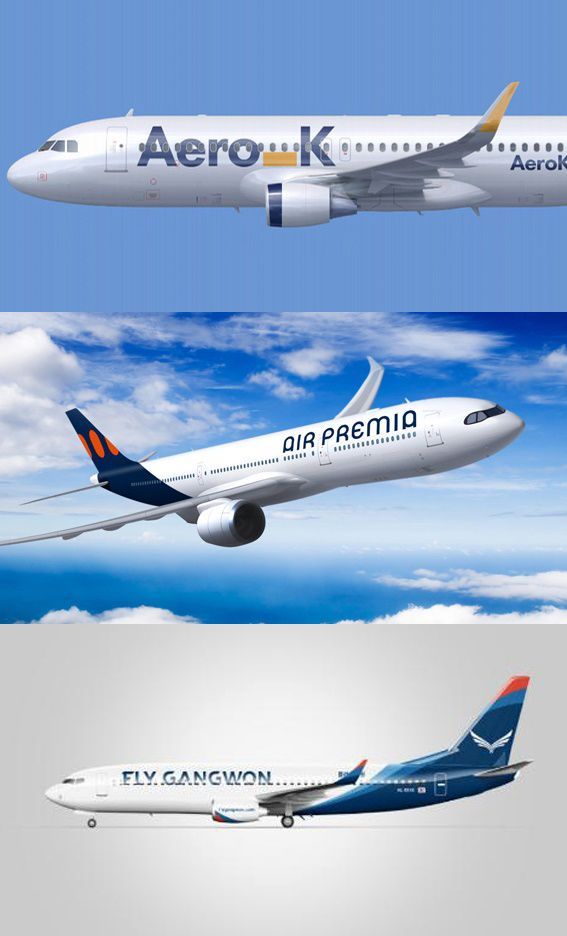
[Asia Economy Reporter Dongwoo Lee] New low-cost carriers (LCCs) are pushed to the brink of collapse due to the prolonged COVID-19 pandemic. With passenger demand normalization uncertain, the financial stability of relatively vulnerable new entrants is under threat.
According to the industry on the 22nd, Air Premia is expected to receive a Boeing 787-9 Dreamliner as early as the 2nd of next month. This comes about two years after obtaining its air transport business license in March 2019. Air Premia plans to resume the Ministry of Land, Infrastructure and Transport's (MOLIT) Air Operator Certificate (AOC) review immediately after the aircraft delivery.
The AOC is a system that inspects and approves whether an airline has the capability to operate safely and is essential for commencing operations. Air Premia will undergo inspections of various capabilities such as crew coordination, maintenance, and flight management, including the emergency evacuation review, considered the biggest hurdle in the AOC process.
However, considering that Air Premia must commence operations by March 5 to maintain its air transport business license, it is uncertain whether the review can be completed within the period. Typically, the AOC review takes about five months, requiring an extension from MOLIT.
Earlier, Aero K received its AOC in December last year and obtained route approval for Jeju-Cheongju flights on the 18th of this month.
The problem is that it will face cutthroat competition from the first flight. Major airlines such as Korean Air and Asiana Airlines have increased flights to Cheongju Airport, Aero K's base, to compensate for reduced international demand.
Aero K plans to consider additional capital expansion through paid-in capital increases. An Aero K official said, "Having received the AOC and being recognized as a full-fledged airline, we plan to proceed with a full-scale capital expansion plan."
Fly Gangwon, in its 1 year and 4 months of operation, currently operates the Yangyang-Jeju route based at Yangyang International Airport. The Yangyang-Taiwan and Yangyang-Philippines Clark routes were temporarily suspended in February last year due to the spread of COVID-19. Two-thirds of its approximately 250 employees are on unpaid leave, and employee salaries have been cut by 30%.
As of the end of last year, Fly Gangwon returned two of its three aircraft due to lease burdens. Typically, aircraft lease fees, excluding maintenance and reserves, are known to be around 200 to 300 million KRW per 737 aircraft. Fly Gangwon plans to retry a paid-in capital increase this year after a failed attempt last year to expand capital.
An aviation industry official said, "Due to the prolonged COVID-19 crisis, especially new LCCs are facing threats to their financial stability," adding, "It is time to consider additional measures such as lowering government support eligibility."
© The Asia Business Daily(www.asiae.co.kr). All rights reserved.
![Clutching a Stolen Dior Bag, Saying "I Hate Being Poor but Real"... The Grotesque Con of a "Human Knockoff" [Slate]](https://cwcontent.asiae.co.kr/asiaresize/183/2026021902243444107_1771435474.jpg)
















