Hyundai Motor and Kia in Talks with Various IT Companies Including Apple on Future Vehicles
Expected to Become a Leading Future Mobility Company Based on a Strong Electric Vehicle Platform
[Asia Economy Reporter Changhwan Lee] As rumors of cooperation between Hyundai Motor Group and Apple emerge as the biggest issue in the automotive industry, there are prospects that Hyundai Motor and Kia could become a unique outsourcing company in the semiconductor industry, similar to TSMC in the future.
According to industry sources on the 22nd, Hyundai Motor Group, including Hyundai Motor, Hyundai Mobis, and Kia, is currently exploring autonomous electric vehicle partnerships not only with Apple but also with several overseas companies. A company official said, "We are currently discussing partnerships with various IT companies. The discussions are in the early stages, and we are keeping multiple possibilities open."
The cooperation between Hyundai Motor and IT companies has progressed amid global IT giants such as Apple, Google, Microsoft (MS), and Amazon entering the future automotive market with optimism. They are promoting future vehicle production through active cooperation with complete car manufacturers that have production platforms, such as Hyundai Motor, Volkswagen, and GM.
If Hyundai Motor Group joins hands with these companies, the most desirable business model is considered to be Taiwan's TSMC. TSMC is the world's largest semiconductor foundry company, holding over 50% of the global market share. Considering that Samsung Electronics, the second-largest foundry market player, holds less than 20%, TSMC boasts a dominant position.
TSMC receives orders from major global system semiconductor companies such as AMD, Qualcomm, and Nvidia, mass-produces products, and earns profits. It supplies semiconductors based on advanced process technology and is recognized as an independent semiconductor company rather than a simple partner. In terms of semiconductor sales, it is ranked among the world's top three semiconductor companies alongside Intel and Samsung Electronics. Recently, due to a surge in foundry orders, it announced an additional investment of 30 trillion won this year alone.
Hyundai Motor and Kia Can Definitely Become the TSMC of the Mobility Industry
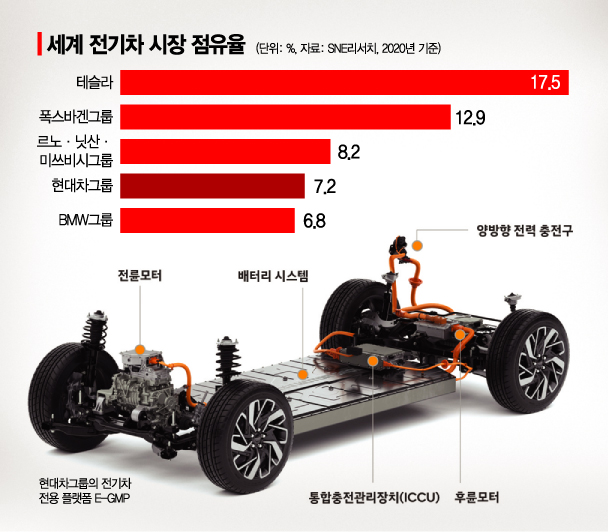
Industry insiders believe that Hyundai Motor and Kia have a strong potential to become the TSMC of the mobility industry. This is because Hyundai Motor and Kia are among the few complete car manufacturers capable of handling mobility orders from IT companies. In particular, there are high expectations for the electric vehicle dedicated platform ‘E-GMP (Electric-Global Modular Platform)’ announced last month. E-GMP is a dedicated platform applying a body structure, chassis, motor, and battery optimized for electric vehicles.
Electric vehicles based on E-GMP can travel over 500 km on a single charge according to domestic standards and feature an 800V charging system that allows charging up to 80% within 18 minutes using ultra-fast chargers. This means an electric vehicle capable of driving 100 km with just 5 minutes of charging. Additionally, since E-GMP is a modular and standardized integrated platform, it offers the advantage of quickly expanding the electric vehicle lineup and simplifying the manufacturing process to improve production efficiency.
The electric vehicle dedicated platform is evaluated as the production foundation for high-spec electric vehicles demanded by IT companies. Competitors in the electric vehicle sector include the US’s Tesla and GM, as well as Europe’s Volkswagen and Renault. These companies have the most important platform for electric vehicle production and are receiving love calls from various IT companies.
Hyundai Motor’s transformation into a comprehensive mobility company encompassing electric vehicles, autonomous vehicles, robots, and aviation, beyond just a simple car manufacturer, is also an advantage. It possesses a value chain that general electric vehicle companies cannot match.
A single car contains over 10,000 parts, and new companies find it difficult to manage such a value chain easily. Hyundai Mobis, an affiliate, plans to expand its core parts business for future vehicles. Through this, it is analyzed that Hyundai Motor Group will have the capability to mass-produce future vehicles tailored to the characteristics of the orderers.
Researcher Eunyeong Lim of Samsung Securities said, "The electric vehicle platform standardizes the battery system, enabling cost reduction and increasing design flexibility, while effectively integrating electric/electronic signals with vehicle operation." She added, "Hyundai Motor Group has sufficient capability to become the second TSMC in the mobility industry with its differentiated electric vehicle platform and strong supply chain management."
© The Asia Business Daily(www.asiae.co.kr). All rights reserved.
!["The Woman Who Threw Herself into the Water Clutching a Stolen Dior Bag"...A Grotesque Success Story That Shakes the Korean Psyche [Slate]](https://cwcontent.asiae.co.kr/asiaresize/183/2026021902243444107_1771435474.jpg)
















