Output Gap Rate Showing the Difference Between Potential and Actual Growth Rates
Dropped Sharply to -4.48% Last Year, Maintaining the -4% Range This Year
Potential Growth Rate Declines and Actual Value Added Created
Falls Short of Basic Economic Strength
Low Birthrate, Aging Population, and COVID-19
Continuous Decline in Working-Age Population
Industrial Dynamism Ranks 30th out of 33 Peer Countries
[Asia Economy Reporter Kim Eun-byeol] South Korea's potential growth rate has fallen to a historic low, threatening even to maintain the 2% range. However, a bigger problem than the decline in figures is the widening gap between the potential growth rate and the actual growth rate. This means that while the 'basic economic strength' achievable with the labor, capital factors, and productivity level of our economy has declined, the actual value added created does not even meet this basic strength.
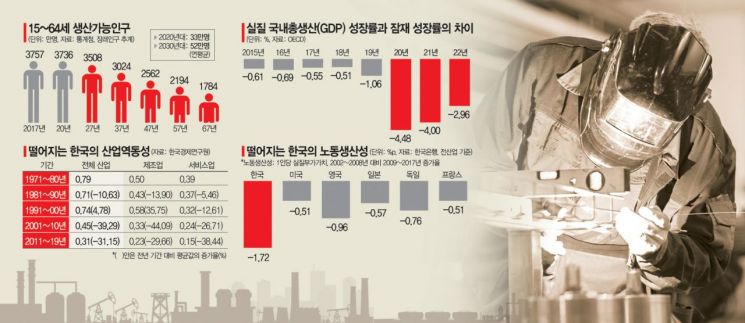
According to the Organization for Economic Cooperation and Development (OECD) on the 22nd, the 'output gap rate,' which represents the ratio of the gap between South Korea's potential growth rate and actual growth rate last year, was -4.48%, a sharp drop of 3.42 percentage points compared to the previous year (-1.06%). The output gap rate this year is also expected to remain in the -4% range at -4.0%. Although the output gap rate is expected to rebound next year as the shock from the COVID-19 pandemic subsides, the gap is still anticipated to widen to -2.96%. Compared to the average annual output gap rate of about -0.69% from 2015 to 2019 before the COVID-19 crisis, the gap has grown larger after the crisis.
This is why it is urgent to raise the potential growth rate and reduce the gap with the actual growth rate through the long-advocated 'economic and industrial structural reforms.' Experts agree that fundamental solutions are needed to address South Korea's chronic problems such as rapid population decline due to low birthrate and aging, and decreasing industrial vitality.
The 'Working-Age' Population Continues to Decline
According to the Statistics Korea's future population projections, the working-age population (ages 15-64) last year was approximately 37.36 million, a 0.61% decrease compared to the previous year. The working-age population has been continuously declining since a 0.3% decrease in 2017. It is projected to fall to 35.08 million in 2027 and 30.24 million in 2037. Statistics Korea explained, "In the 2020s, the working-age population is expected to decrease by an average of 330,000 people annually, and in the 2030s, by an average of 520,000 people annually."
The causes of the decline in the working-age population include the ongoing low birthrate and aging population, as well as increased reluctance toward marriage and childbirth due to concerns about the COVID-19 pandemic and economic recession. According to an analysis by the Bank of Korea, the total fertility rate may fall below the pessimistic scenario forecasted by Statistics Korea last year (0.72 in 2022). This means the average number of children a woman is expected to have during her childbearing years may be less than 0.72 next year.
This is related to the fact that recent employment and income shocks have been relatively concentrated among people in their 20s and 30s. The youth are postponing or canceling decisions about marriage and childbirth. A Bank of Korea official explained, "The population continues to decline, so the potential growth rate inevitably falls. With productivity improvement trends stagnating and capital and labor inputs slowing, measures to improve the labor sector are necessary." The decline in the working-age population also negatively affects consumption. As productivity falls and the total dependency ratio rises, disposable income decreases, reducing consumption capacity.
Ultimately, there is a call to identify and resolve the fundamental reasons why young people are reluctant to marry, have children, and raise families. Jeon Gwang-woo, Director of the Institute for Global Economics (IGE), pointed out, "To improve labor productivity both quantitatively and qualitatively, solving youth unemployment and housing problems should be prioritized to increase the labor supply." He argued that measures such as childbirth subsidies and rental housing are only short-term remedies. He believes that labor quality can improve only with appropriate incentives. He said, "Labor productivity does not increase by forcibly cutting people but by providing definite rewards for performance."
Bold Investment and Regulatory Reform Needed to Foster High Value-Added Industries
Productivity in the economy is also steadily declining. According to the Bank of Korea Economic Research Institute, the labor productivity growth rate across all industries fell by 1.72 percentage points from 2009 to 2017. This decline is larger than that of the United States (-0.51 percentage points) and Japan (-0.57 percentage points) during the same period. Labor productivity refers to output per labor input and indicates how efficiently a country's workers perform.
The Korea Economic Research Institute's report, "Diagnosis of the Dynamism of the Korean Economy," also confirms a sharp decline in industrial dynamism. From 2014 to 2018, industrial dynamism ranked 30th out of 33 peer countries. The decline in the speed of industrial structural change in the service sector was much greater than in manufacturing. From 2011 to 2019, the average speed of structural change in the service sector fell by 38.44% compared to the previous decade, which is much larger than the 29.66% decline in manufacturing during the same period. Although the government repeatedly emphasizes revitalizing the service sector and allocates funds, the problem lies in not easing regulations and not improving conditions that make it difficult to create new companies. Regulatory measures such as restrictions on large discount stores and bans on new mobility businesses like Uber and Tada indicate that innovation in the service sector is difficult to occur in South Korea.
The Bank of Korea Economic Research Institute suggested, "To increase labor productivity, efforts should be made to activate investment, enhance the utilization of ICT in work, and improve the efficiency of research and development (R&D). Additionally, an institutional environment should be established to allow low-productivity companies to exit smoothly."
© The Asia Business Daily(www.asiae.co.kr). All rights reserved.

















