Intel Indicates Expansion of Outsourcing... Core Products Produced In-House
Samsung Begins Chipset Orders... Gradual Increase Expected
GPU Outsourcing Handled by TSMC
Intel's Dual Vendor Strategy Likely Increasing
[Asia Economy reporters Su-yeon Woo and Hyun-jin Jeong] Intel, the world's No. 1 integrated device manufacturer (IDM), has hinted at expanding outsourced production, increasing the likelihood of adopting a 'dual vendor' strategy by outsourcing to Samsung Electronics and TSMC, who compete for the top spot in the foundry (outsourced manufacturing) market share. Samsung Electronics is expected to gradually increase its volume, starting with securing orders for the 'Southbridge' chipset.
Pat Gelsinger, Intel's CEO-designate, stated during the Q4 earnings conference call on the 21st (local time), "We are confident that most of our 2023 products will be made in the United States," adding, "However, considering our portfolio, we expect to increase the use of external foundries for certain technologies and products."
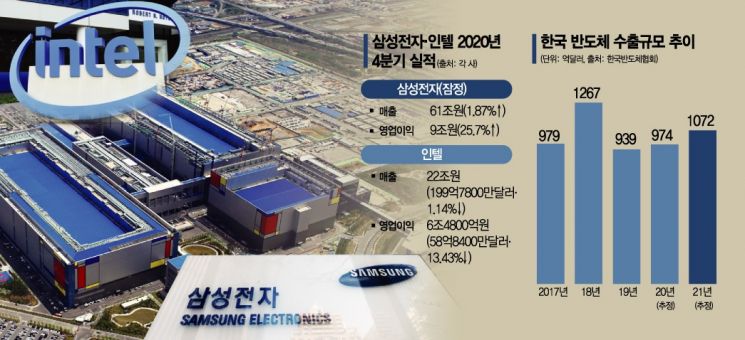
◆ Intel hints at foundry expansion... Core products to be produced internally= Intel's indication of foundry expansion reflects its recognition that production technologies for core products such as central processing units (CPUs) and graphics processing units (GPUs) are falling behind competitors. This shift in policy is interpreted as a positive signal for domestic companies like Samsung Electronics, which ranks second in the foundry market share. However, Intel clarified that it will not outsource all products and plans to continue internal production of next-generation core products, such as the 7nm processor.
However, there was no separate mention of foundry vendor selection for GPUs or other products, which had been anticipated during the earnings announcement. Intel plans to officially disclose its external foundry utilization plans after the new CEO takes office. An industry insider noted, "Even when outsourcing vendors are selected, it is often not publicly announced," adding, "It is possible that serious deals are already underway," reflecting a cautious atmosphere.
The policy shift of Intel, the world's No. 1 IDM, is also detected in the extreme ultraviolet (EUV) system market, which is essential for semiconductor chip manufacturing processes. A foreign media outlet reported that ASML, the exclusive supplier of EUV equipment to Samsung Electronics and TSMC, has recently experienced a shift in order volumes. Although specific company names were not mentioned, the industry estimates that EUV equipment shipments previously destined for Intel are being redirected to Samsung Electronics and TSMC.
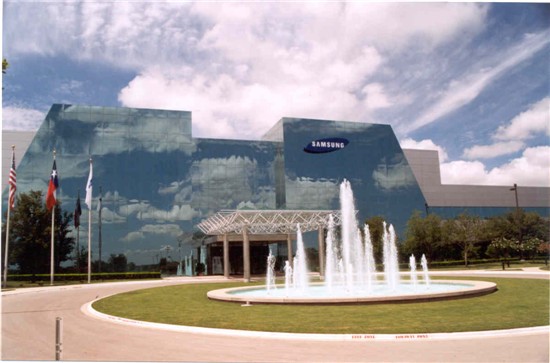 Samsung Electronics Texas Austin Factory Overview / Photo by Asia Economy DB
◆ Samsung Electronics, having secured chipset orders, is positive about future Intel order expansion= The industry predicts that the GPU outsourcing volume, which had attracted much attention, has gone to TSMC. Instead, Samsung Electronics is expected to increase its Intel foundry order volume in the future by first securing Southbridge chipset orders.
Samsung Electronics is reportedly planning to produce about 15,000 wafers per month starting in the second half of this year at its Texas Austin plant in the United States, which is equipped with a 14nm production line. Kim Sun-woo, a researcher at Meritz Securities, forecasted, "With future expansion of the Austin plant, mass production of high-value-added products using advanced processes of 5nm or smaller will also become possible."
The success of the upcoming intense competition depends on who gains the upper hand in the foundry market for ultra-fine processes below 5nm. Intel announced plans to recover issues with the existing 7nm process and produce 7nm products internally starting in 2023, but its technology and manufacturing efficiency for ultra-fine processes below 5nm are already significantly lagging behind.
The industry expects that even if Intel secures ultra-fine process technology within a few years, it will be difficult to catch up all at once since it is already about 2 to 3 years behind competitors. Moreover, to realize the new CEO's first priority of "catching up with competitor Apple," Intel must secure a 3nm-level process by the second half of 2022 at the latest, making it strategically inevitable to expand its foundry share.
TSMC, having grasped Intel's strategy, announced a record-scale capital investment plan of $25 billion to $28 billion this year in preparation for large-scale orders. The industry expects Samsung Electronics to announce plans for increased investment in response, but the absence of a group head makes it difficult to predict.
© The Asia Business Daily(www.asiae.co.kr). All rights reserved.
![Clutching a Stolen Dior Bag, Saying "I Hate Being Poor but Real"... The Grotesque Con of a "Human Knockoff" [Slate]](https://cwcontent.asiae.co.kr/asiaresize/183/2026021902243444107_1771435474.jpg)
















