Launch at Baikonur Cosmodrome in Kazakhstan
Moved to launch site today... Two months of launch preparations
Domestically developed... Low Earth orbit practical satellite
Providing high-resolution ground observation images from June next year
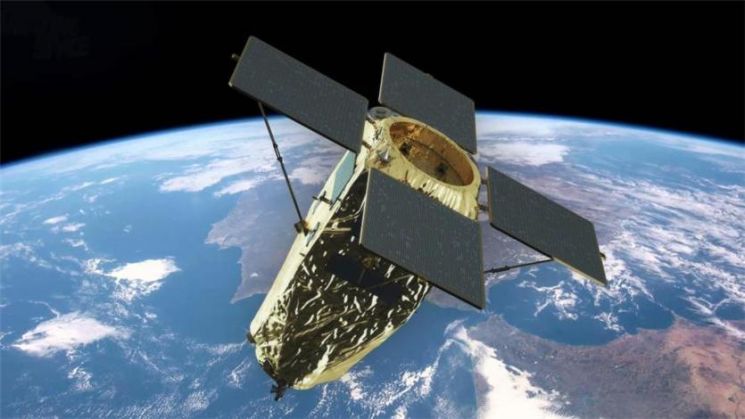 Next-Generation Medium-Sized Satellite No. 1 Conceptual Image (Photo by Ministry of Land, Infrastructure and Transport)
[Asia Economy Reporter Moon Jiwon] The 'Next-Generation Medium-Sized Satellite 1' for land and resource management will be launched from Kazakhstan on March 20. It is expected that land management and disaster response capabilities will improve once precise ground observation images begin to be provided from June next year.
The Ministry of Land, Infrastructure and Transport and the Ministry of Science and ICT announced on the 22nd that the Next-Generation Medium-Sized Satellite 1 will be launched from the Baikonur Cosmodrome in Kazakhstan at 3:07 PM Korean Standard Time (12:07 PM local time) on March 20.
The Next-Generation Medium-Sized Satellite 1 will depart from the Korea Aerospace Research Institute on the same day and is scheduled to arrive at the Baikonur Cosmodrome launch site on the 24th local time. After arrival, it will undergo launch preparations including status checks, fuel injection, and integration with the launch vehicle. The launch vehicle is the Russian JSC Glavkosmos Soyuz 2.1a.
After launch, it will undergo an initial operation phase for about two months in an orbit at an altitude of 497.8 km, and from June next year, it will begin providing full-scale precise ground observation images.
The Next-Generation Medium-Sized Satellite 1 is a domestically independently developed low Earth orbit practical satellite for precise ground observation, designed to flexibly respond to various public sector observation demands.
The development project was carried out in two phases. In phase one, a 500 kg-class standard satellite platform and two medium-sized satellites for precise ground observation (0.5 m black-and-white, 2.0 m color) were independently developed domestically. In phase two, three medium-sized satellites were localized and developed using the 500 kg-class standard platform technology.
KARI secured medium-sized satellite-class system and standard bus (platform) technology through the Next-Generation Medium-Sized Satellite 1 development project. This technology was successfully transferred to domestic industries, localizing the precise optical payload, which had previously relied on overseas technology, into a domestically independent model.
In particular, the domestically localized precise ground optical payload was lightened by more than 100 kg while maintaining the same performance compared to the Multipurpose Practical Satellite 3A. Additionally, it adopted a next-generation flash memory-based image data processing device, reducing weight and cost while increasing storage capacity.
Nam Young-woo, Director of the Land Information Policy Division at the Ministry of Land, said, "Once we receive precise ground observation images from KARI, the Land Satellite Center installed within the National Geographic Information Institute will be able to quickly provide high-quality precise orthophotos processed with a location accuracy of 1 to 2 meters." He added, "We plan to utilize this in public and private service sectors that enhance the quality of life for citizens, such as land and resource management and disaster response."
© The Asia Business Daily(www.asiae.co.kr). All rights reserved.

















