[Asia Economy Reporter Changhwan Lee] From this year, electric vehicles priced over 90 million KRW will be excluded from government subsidy support.
The Ministry of Economy and Finance, Ministry of Environment, and Ministry of Trade, Industry and Energy announced the 2021 subsidy system reform plan including this content on the 21st.
The government stated that it will distribute a total of 136,000 vehicles this year, including 121,000 electric vehicles and 15,000 hydrogen vehicles, through subsidy payments and infrastructure improvements. This represents an increase of 21.4% for electric vehicles and 49.2% for hydrogen vehicles compared to the previous year. The support budget will also be increased to 1.023 trillion KRW and 365.5 billion KRW, respectively.
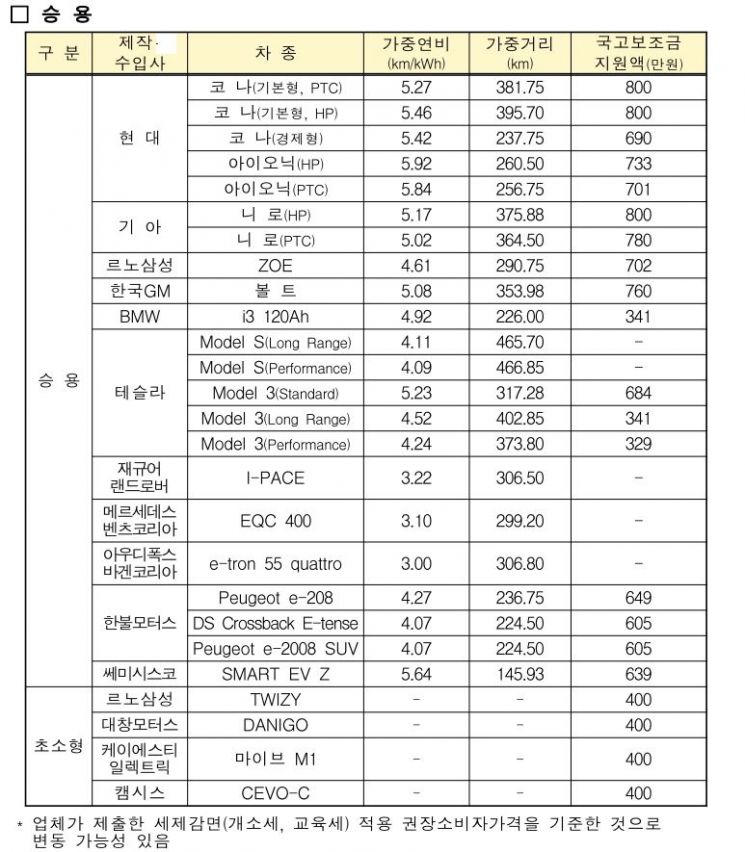
However, support for high-priced electric vehicles over 90 million KRW will be reduced. This is to prevent tax benefits from being concentrated on some wealthy groups and expensive imported cars. According to the Korea Automobile Manufacturers Association, Tesla is estimated to have received nearly half of the 90 billion KRW in electric passenger car subsidies paid in the first half of last year. Accordingly, subsidies for Tesla Model S, Jaguar Land Rover I-PACE, Mercedes-Benz Korea’s EQC 400, and Audi Volkswagen Korea’s e-tron 55 Quattro will be excluded.
Electric vehicles priced under 90 million KRW will maintain subsidies. However, those priced under 60 million KRW will receive full payment, while those priced between 60 million and 90 million KRW will receive only 50% of the subsidy.
Among passenger cars, Kona (PTC·HP) and Niro (HP) receive the highest national subsidies of 8 million KRW. When combined with local government subsidies, electric passenger cars can receive up to 19 million KRW in support. The national subsidy for the hydrogen vehicle Nexo is 22.5 million KRW. Including local government subsidies, this can increase up to 37.5 million KRW.
Support for commercial vehicles such as taxis, buses, and trucks will also be restructured. This year, 1,000 electric buses, 25,000 electric trucks, and 180 hydrogen buses will be distributed.
To rationalize market prices, a minimum purchaser co-payment is set at 100 million KRW for large electric buses, 750,000 KRW for small electric two-wheelers, 1.15 million KRW for medium-sized, and 1.3 million KRW for large and other types.
© The Asia Business Daily(www.asiae.co.kr). All rights reserved.

















