60% Increase in Noise Complaints Between Floors Since COVID-19
'Multiple Noise Tools' Emerging
No Punishment or Regulatory Legislation
Experts Advise "Reducing Dichotomous Thinking and Making Efforts"
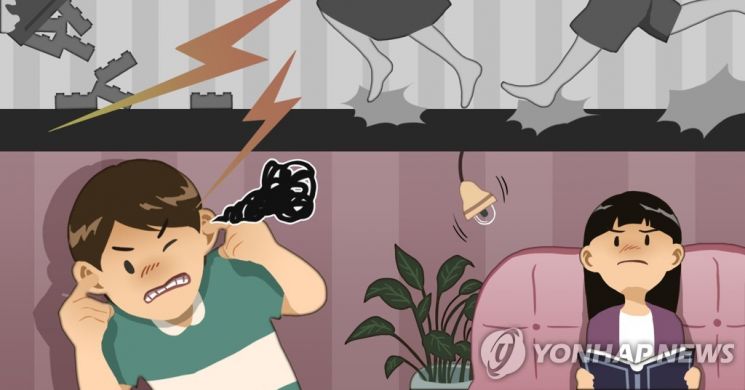
[Asia Economy Reporter Kim Young-eun] Conflicts over noise between floors have intensified as more people stay at home due to the impact of the novel coronavirus infection (COVID-19).
Recently, so-called 'inter-floor noise revenge tools' that generate noise at a similar level to the noise caused by neighbors have even appeared. As the time spent at home has increased since COVID-19, conflicts over inter-floor noise have become more severe.
According to the Korea Environment Corporation, complaints about inter-floor noise received until November last year totaled 36,105 cases, a 51% increase compared to the same period last year (23,843 cases).
As the inter-floor noise problem persists, 'inter-floor noise revenge tools' such as woofer speakers, vibration speakers, bone conduction speakers, and brick hammers have become popular on internet shopping malls and online communities. These products allow users to generate the same level of noise to take revenge on their neighbors.
Among these products, bone conduction speakers were created as a result of inter-floor noise disputes. It can be seen as a reflection of the times. Bone conduction is a function that transmits sound waves through the bones of the skull to the inner ear. This technology is mainly used in hearing aids or headsets, but as people suffering from inter-floor noise sought 'revenge tools' and demand increased, some companies developed and started selling 'bone conduction speakers.'
The appearance of this product, optimized for taking revenge on inter-floor noise, features a long rod with a speaker attached at the end. The speaker is pressed against the ceiling and connected to a mobile phone to play music files. Users can play anything from ordinary music to heavy metal music depending on the noise stress level they have experienced, allowing them to literally take revenge.
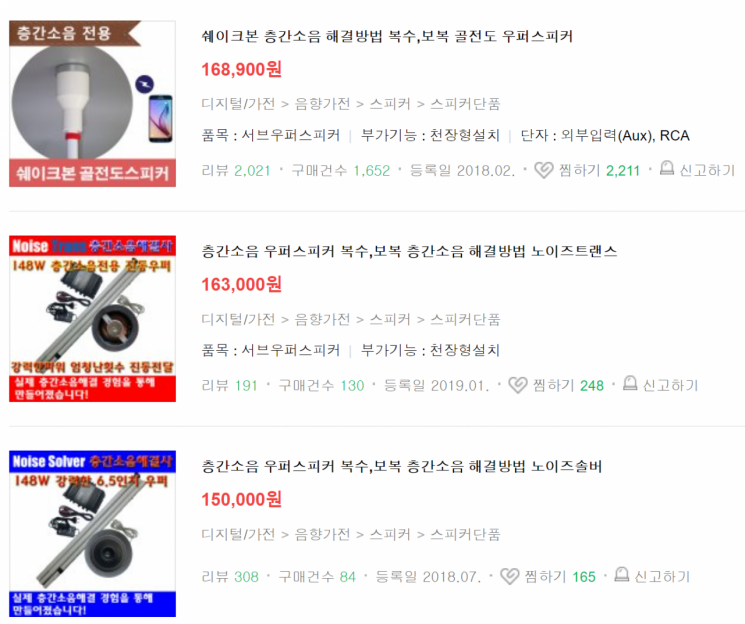
Online communities such as victim cafes for inter-floor noise have continuously posted messages like 'I want to take revenge on inter-floor noise' to the extent that such products are being sold.
A community member, Mr. A, said, "I am really angry because of the upstairs neighbors who make me grit my teeth," adding, "Even if I file complaints with the management office, nothing changes, so I am starting to look for other alternatives. If anyone has clever methods for taking revenge on inter-floor noise, please recommend them."
Another member, Mr. B, said, "It may seem like a minor issue, but you would never understand unless you experience it. After going through it, you will understand why inter-floor noise problems can escalate into bigger criminal cases," and added, "Because of COVID-19, I stay at home all the time and am already sensitive, but even after asking several times to be quiet, they keep making loud thumping noises, which causes me extreme stress."
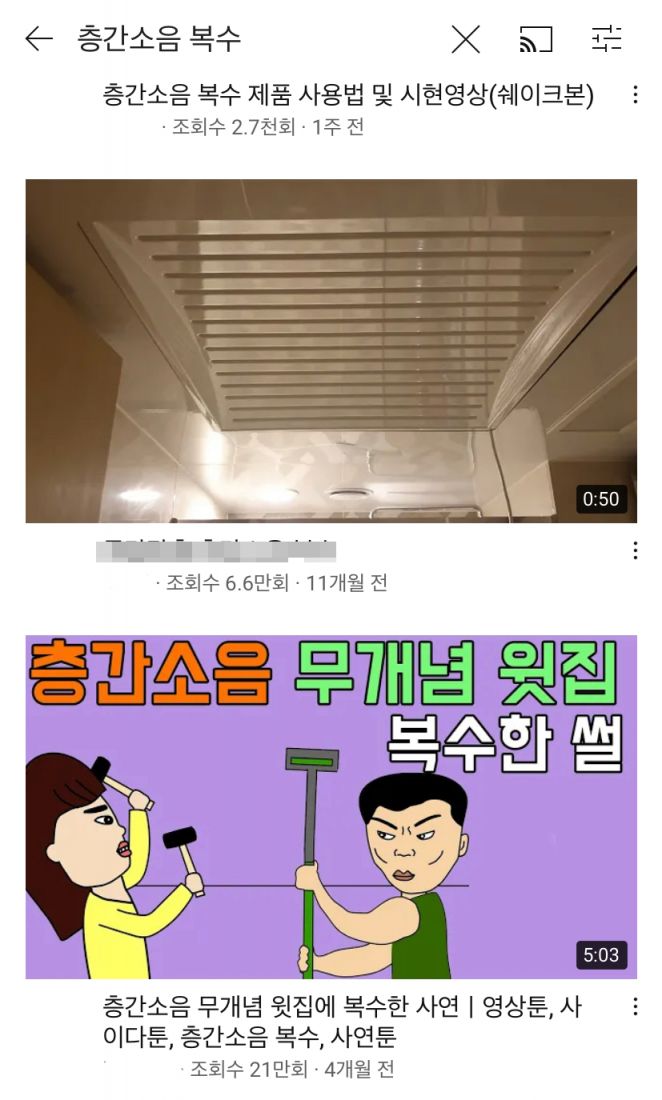 Videos related to revenge against noise between floors are uploaded on YouTube. Photo by YouTube capture
On YouTube, there are videos showing people retaliating against neighbors using 'inter-floor noise revenge tools' or moving upstairs to take revenge. Comments on these videos include, "I watched this while angry about inter-floor noise, and it felt somewhat relieving," "I came here to experience vicarious satisfaction," and "I also live a hellish life thinking all day about how to put the upstairs neighbors in trouble."
Although conflicts caused by inter-floor noise continue, there are currently no clear regulatory measures such as penalties. Since 2016, the 'Regulations on Standards for Inter-floor Noise in Multi-family Housing' have been established, but they only define the scope and standards of noise, without specifying penalties for exceeding those standards.
Also, when inter-floor noise occurs, one can apply for mediation through the Multi-family Housing Management Dispute Mediation Committee or the Environmental Dispute Mediation Committee, but even in such cases, most mediation results end with recommendations rather than enforceable actions.
As a result, there are calls for the establishment of proper punishment regulations and legislation. On the Blue House National Petition Board, more than four petitions related to inter-floor noise, such as 'Please implement inter-floor noise education' and 'Create laws or change building permit standards,' have been posted just this month. Last month, petitions like 'Strengthen legal protection measures for inter-floor noise' and 'Introduce a fine system' were also steadily submitted.
Experts urge reducing dichotomous thinking among neighbors and making mutual efforts. Professor Lee Dong-gwi of Yonsei University's Department of Psychology said, "One of the phenomena brought by COVID-19 is that people have to stay at home distancing themselves from society, which inevitably highlights problems that were previously unnoticed," adding, "Modern society increasingly emphasizes 'not suffering losses,' and dichotomous thinking arises where everyone else is seen as an enemy except oneself, which tends to deepen conflicts."
Professor Lee said, "In particular, the inter-floor noise problem is one of the issues where dichotomous thinking prevalent in Korean society is sharply applied," and added, "Although it is difficult, everyone needs to cultivate civic consciousness and make efforts." He further suggested, "Conflicts keep arising in a society divided into camps, so it seems necessary for the upstairs neighbors to be cautious and the downstairs neighbors to show some understanding, forming a kind of lubricating relationship."
© The Asia Business Daily(www.asiae.co.kr). All rights reserved.



















