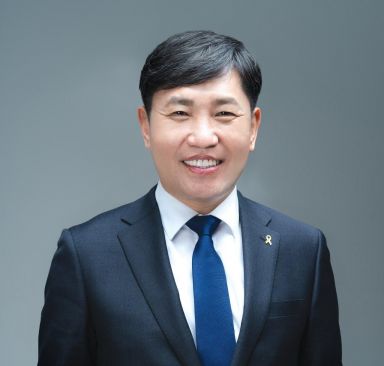
[Asia Economy Honam Reporting Headquarters Reporter Yoon Jamin] Assemblyman Jo O-seop (The Democratic Party of Korea, Gwangju Buk-gu Gap) stated on the 21st, "To establish a metropolitan railway network in the Honam region, Gwangju, Jeonnam, and Jeonbuk must communicate and cooperate to prepare a unified joint proposal."
Assemblyman Jo explained that since it is difficult to realize metropolitan railway networks in local areas by approaching them solely from an economic feasibility (B/C) perspective, new alternatives and grounds must be created under the principle of 'supply first, demand later.'
The metropolitan railway projects requested by Gwangju Metropolitan City in last year's 4th National Railway Network Construction Plan include four projects: ▲Gwangju?Naju Innovation City Metropolitan Railway ▲Gwangju?Hwasun Metropolitan Railway ▲Gwangju Station?Songjeong Station double-track electrification ▲Dalbit Inland Railway.
In the case of the Gwangju?Naju Innovation City Metropolitan Railway, Gwangju City submitted the section from Sangmu Station to Seogwangju to Innovation City to Naju Station, while Jeonnam Province plans the section from Seogwangju to Nampyeong to Innovation City to Naju Station to Pyeongdong Station, showing discrepancies between the two.
Moreover, Gwangju City plans a separate route with Sangmu Station as the starting point of the Gwangju?Naju Innovation City Metropolitan Railway, but it is explained that an extension line continuing from the Phase 3 Line of Urban Railway Line 2 (Baegun Square to Hyochon District) is more realistic for establishing the metropolitan railway.
Assemblyman Jo said, "Active consultations are necessary for Gwangju City and Jeonnam Province to jointly respond with a unified plan by adjusting the route of the Gwangju?Naju Innovation City Metropolitan Railway," adding, "It is difficult to overcome the metropolitan railway network issue by increasing economic feasibility (B/C) alone, so a response strategy such as 'supply first, demand later' is needed from the perspective of national balanced development and regional balanced development."
He continued, "According to the feasibility study conducted by Gwangju City after 10 years of reinforcement, the Gwangju?Naju Innovation City Metropolitan Railway reduced the number of new stations from 10 to 6, but the economic feasibility (B/C) slightly increased from 0.56 to 0.62," and explained, "The Gwangju?Hwasun Metropolitan Railway also reduced the number of new stations from 6 to 4, but the economic feasibility decreased from 0.41 to 0.38."
He also emphasized, "There is a need to not limit the metropolitan railway network to Gwangju?Naju?Hwasun in Gwangju and Jeonnam but to connect the Dalbit Inland Railway section from Gwangju to Damyang to Sunchang to Namwon to Jangsu as a metropolitan railway network and prioritize it as the first phase," and urged, "Gwangju, Jeonnam, and Jeonbuk should conduct a 'joint study for the establishment of the Honam region metropolitan railway network' to respond to the 4th National Railway Network Construction Plan and the 2nd Metropolitan Area Wide Transportation Network Basic and Implementation Plans to be established this year."
Furthermore, he stated, "The Honam region metropolitan railway network can serve as the foundation for the Honam region's win-win development, including the establishment of a super metropolitan ecosystem competitive with the metropolitan area, economies of scale, an economic union for regional balanced New Deal, and joint responses to public institution relocations," emphasizing, "If the first phase of the Dalbit Inland Railway is utilized to connect to the Jeonbuk area, a genuine Honam region metropolitan railway network encompassing Gwangju, Jeonnam, and Jeonbuk will be established."
He added, "While the Busan-Ulsan-Gyeongnam, Daegu-Gyeongbuk, and Daejeon-Chungnam regions are securing metropolitan railway networks with a unified voice, Gwangju and Jeonnam are setting different plans," and stressed, "To respond to major national statutory plans related to metropolitan railway networks to be established this year, it is urgent to establish a communication and cooperation system as soon as possible."
© The Asia Business Daily(www.asiae.co.kr). All rights reserved.

















