Rapid Payment and Administrative Processing Are Key
Underreporting of Small Business Income Also a Realistic Obstacle
Cash Transactions by Microbusinesses Remain a Blind Spot
Concerns Over Intensified Social Conflicts... Calls for Flexible Operation
[Sejong=Asia Economy Reporters Kim Hyunjung, Son Seonhee, Jang Sehee] As Prime Minister Chung Sye-kyun officially announced on the 21st the review of compensation plans for sales losses of small business owners and self-employed individuals, the ruling Democratic Party and the government are expected to accelerate their movements. The government evaluates structural legislation, accurate assessment of damage scale, and rapid payment as key administrative tasks but anticipates a difficult path until institutional measures are established. There is also a strong opinion that efforts to minimize social dissatisfaction through flexible responses tailored to specific situations and fiscal conditions should be pursued alongside rigid legislation.
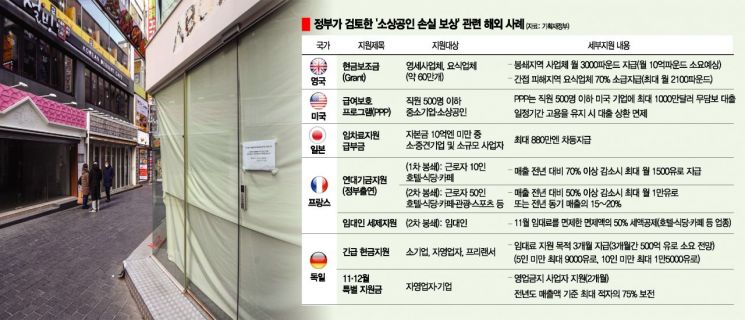
According to the ruling party and government on the 21st, the Ministry of Economy and Finance has already reviewed whether major advanced countries such as the United States, Japan, Germany, the United Kingdom, and France have legislated loss compensation systems in response to the COVID-19 pandemic. This is the background behind Deputy Minister Kim Yong-beom’s remark the day before that "it is not easy to find countries that have legislated such laws." In fact, these countries provide direct cash support for sales losses in certain industries at a significant rate, but the only system applicable on a regular basis is the U.S. Paycheck Protection Program (PPP), which is linked to loans.
◆ Compensation for Small Business Owners and Self-Employed: Is Legislation Enough?= Since last year, the ruling party has internally been planning a cash compensation scheme linked to the scale of damage caused by government-ordered business suspension and restrictions for small business owners and the self-employed. The idea is to resolve the issue through a legal system that automatically pays compensation as the state forcibly restricted business operations. However, the approach of the state "compensating" the "damage" of self-employed and small business owners is unprecedented, making realistic legislation difficult, according to consensus inside and outside the government.
Currently, Article 23, Paragraph 3 of the Korean Constitution stipulates that compensation must be paid if losses occur due to public authority. Recent compensation cases related to highly pathogenic avian influenza (AI) and African swine fever (ASF) are representative examples, where the government directly pays compensation to each livestock farm based on assessment criteria when preventive culling is implemented.
However, compensation for small business owners is expected to face difficulties in accurately assessing damage and proving causality. Obstacles include the fact that many small business owners have underreported income, and that microbusinesses, whose livelihoods are threatened, mainly operate in cash, making past income difficult to verify. Although a plan to compensate 50-70% of previous sales depending on administrative measures is being actively discussed, it is likely to encounter limitations due to large variations even within the same industry depending on commercial districts or specific products handled.
Researcher Choi Hyun-soo of the Korea Institute for Health and Social Affairs said, "It is important to have a system that strictly selects support by accurately reflecting the level of damage," adding, "Once the comprehensive income tax filing is completed in May, it will be possible to assess damage compared to past economic activities, so compensation plans including special employment types will be necessary." He emphasized, "An infrastructure for accurately assessing damage must be properly established."
A government official pointed out, "Even under normal circumstances, sales could decrease due to changes in the epidemic, emergence of nearby competitors, or operational issues, so it is necessary to clarify causality."
There are also criticisms that the minimum procedures required for compensation through legislation may reduce timeliness. Another government official explained, "Drafting, inter-ministerial and ruling party consultations, review by the Ministry of Government Legislation, legislative notice, and Cabinet meetings alone take more than two months even if expedited. Although this time can be shortened through ruling party member legislation, it involves conflicts with opposing public opinion."
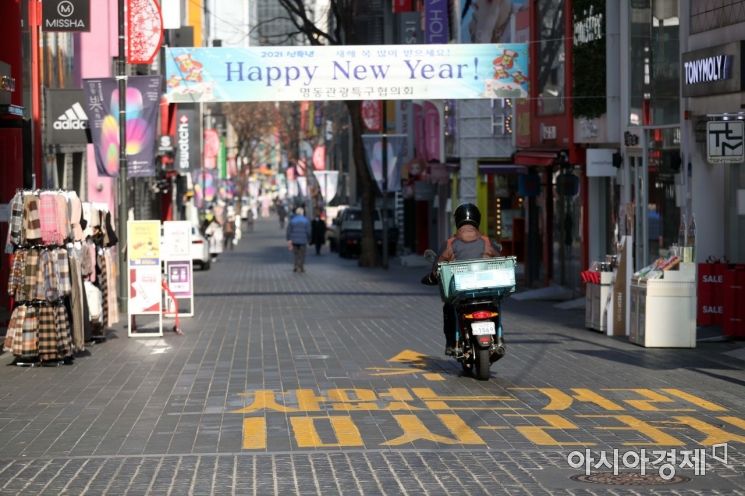 On the 4th, when the ban on private gatherings of five or more people was expanded nationwide, a food delivery worker was busy moving through the quiet Myeongdong street in Jung-gu, Seoul during lunchtime due to the impact of the novel coronavirus disease (COVID-19). Photo by Moon Honam munonam@
◆ Exhausted by Prolongation... Social Conflicts Expected to Intensify= As the COVID-19 crisis approaches one year, social conflicts are intensifying. On the 21st, the Korea Entertainment Food Industry Central Association held a press conference in front of the main gate of the National Assembly in Yeouido, Seoul, demanding loss compensation commensurate with the scale of business suspension damage, along with ▲ cessation of business suspension orders ▲ permission to operate under compliance with quarantine rules ▲ fairness in measures among industries. Acting President Choi Wonbong of the Korea Entertainment Food Industry Central Association emphasized, "I was driven to the brink of closure after being unable to operate for eight months in 2020," adding, "It is hard enough to prepare even the costs of closure, and the government trampled on our desperate hope to resume business."
Earlier, 203 operators of indoor sports facilities such as gyms, bowling alleys, billiard halls, and swimming pools filed lawsuits against the government claiming damages of 1.015 billion KRW, and the National Cafe Owners Association filed a lawsuit claiming about 1.8 billion KRW.
However, some argue that compensation through legislation may hinder appropriate and flexible responses depending on the situation. Professor Sung Tae-yoon of Yonsei University’s Department of Economics said, "Legislative promotion may cause rigidity, making appropriate and flexible responses impossible depending on the case," adding, "Since accurate damage estimation is difficult, it should be operated flexibly considering budget and soundness."
© The Asia Business Daily(www.asiae.co.kr). All rights reserved.


















