National Economic Advisory Council Meeting
Encouraging Institutions to Reduce Real Estate Investments
Exploring Methods to Redirect Private Investment Funds
Plan to Request Investment Restrictions from Financial Authorities
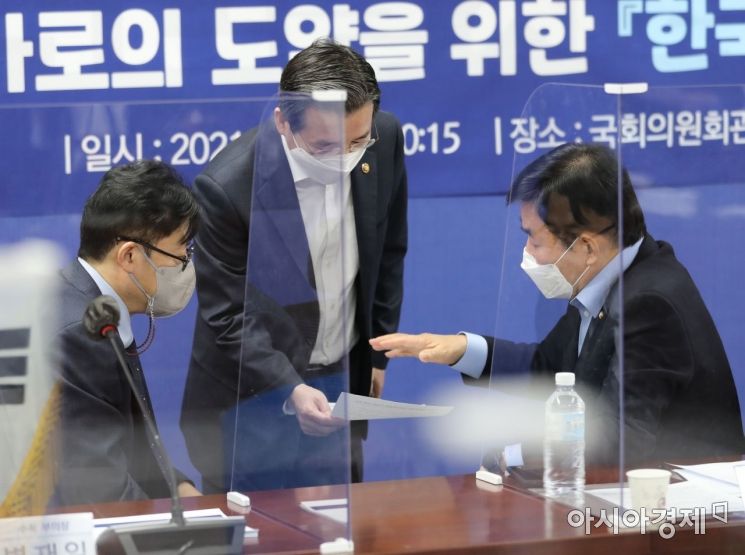 Kim Jin-pyo, Chairman of the National Economic Advisory Council, is attending the 1st meeting of the 2021 National Economic Advisory Council held at the National Assembly on the 21st, conversing with Kim Yong-beom, 1st Vice Minister of Strategy and Finance, while reviewing documents. Photo by Yoon Dong-joo doso7@
[Asia Economy Reporter Jeon Jin-young] The Democratic Party of Korea and the government are exploring various measures to redirect funds concentrated in real estate investment toward the Korean New Deal projects and innovative companies.
On the morning of the 21st, the party and government held the first National Economic Advisory Council meeting of the new year at the National Assembly, discussing ways to convert the 2,214.9 trillion won in real estate finance into investments in the Korean New Deal fund, domestic unicorn companies with growth potential, and innovative companies. To this end, they plan to induce institutional investors to reduce real estate investments and ensure that the reduced funds naturally flow into private investments related to the Korean New Deal.
This will be achieved through measures and recommendations such as investment restrictions. Kim Jin-pyo, a Democratic Party lawmaker who chaired the meeting, said in a phone interview with Asia Economy, "Housing prices have already reached their limit, so capital concentrated in real estate is highly likely to flow into speculation," adding, "This means preventing that in advance and instead guiding funds to move toward a good project called the Korean New Deal."
Kim also revealed plans to request such investment restrictions from financial authorities. He said, "The financial authorities should provide guidelines so that institutional investors do not borrow excessively to buy real estate." Insurance companies and securities firms are already selling real estate assets or reducing their investment proportions. The intention is to widely apply this trend to other institutional investors such as pension funds and mutual aid associations. The party and government also plan to issue recommendations to reflect this approach in the asset management guidelines of institutional investors. In response, financial authorities have agreed to prepare preemptive measures to reduce future risks.
Various incentive systems will also be established to channel real estate funds toward the Korean New Deal. At the meeting, the Financial Services Commission decided to establish selective incentive systems such as priority allocation of excess returns for long-term investments and priority loss compensation, as well as measures to mitigate investment risks. The Ministry of SMEs and Startups will expand the K-Unicorn Project, which nurtures prospective unicorn companies with a corporate value of over 100 billion won. Additionally, the issuance of multiple voting rights stocks by unlisted venture companies and the establishment of SPCs for loan purposes by venture funds will be permitted. Furthermore, investment conditional loan systems used to foster venture companies in Silicon Valley, USA, will also be introduced.
Democratic Party leader Lee Nak-yeon said in his opening remarks, "For the Korean New Deal to succeed, finance, New Deal funds, and public participation are all necessary," adding, "Especially, it is necessary to find ways for each citizen to perceive the Korean New Deal as something for their own lives."
Kim Yong-beom, the first vice minister of the Ministry of Economy and Finance, echoed Kim’s views, saying, "To turn the COVID-19 crisis into an opportunity to upgrade the Korean economy, market liquidity must flow into productive sectors that drive economic recovery and present new growth visions."
Vice Minister Kim added, "Voices from the industrial and financial sectors calling for guiding market liquidity into productive areas are louder than ever," and "We are focusing on discovering profitable and good investment destinations to connect liquidity to productive investments. Comprehensive policy support, including in the Korean New Deal sector, is part of these efforts."
© The Asia Business Daily(www.asiae.co.kr). All rights reserved.
![User Who Sold Erroneously Deposited Bitcoins to Repay Debt and Fund Entertainment... What Did the Supreme Court Decide in 2021? [Legal Issue Check]](https://cwcontent.asiae.co.kr/asiaresize/183/2026020910431234020_1770601391.png)















