Weak Dollar and Economic Recovery Expectations
Drive Global Funds into Emerging Markets like Vietnam, Russia, and Brazil
Asia-Pacific Equity Funds Outperform North American Funds Significantly
[Asia Economy Reporter Minji Lee] Park Mo (53), who joined an emerging market fund with a lump-sum investment in early 2018 upon the recommendation of a sales agent, was recently surprised when he saw the fund's return rate sent via text message. Since joining, the fund had only recorded negative returns, and after March last year, it seemed like he would lose all his money, but now it is showing double-digit returns. He said, "I considered it a burden and didn't even check the returns, but now that I see profits, I feel relieved."
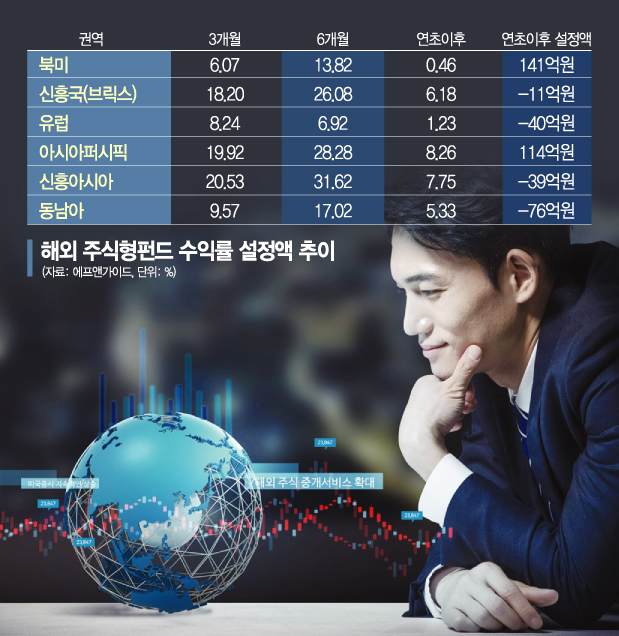
According to financial information company FnGuide on the 21st, emerging market funds have outperformed North American regional funds since the beginning of the new year. By region, the returns were highest for Asia Pacific equity funds (8.26%), Emerging Asia equities (7.75%), and Emerging market equities (6.18%). North American equities recorded the lowest return at 0.46%. Even over the recent 3-month and 6-month periods, funds centered on emerging markets significantly outperformed developed market stocks.
The surge of global capital into emerging market stock exchanges such as Vietnam, Russia, and Brazil greatly contributed to the sharp rise in each country's indices. The driving forces behind the movement of global capital were the weak dollar and expectations of economic recovery due to vaccine distribution. The dollar has remained at a low level as large-scale stimulus measures gained momentum following the election of U.S. President Joe Biden. Additionally, since late November last year, the spread of optimism about COVID-19 vaccines has led to a ‘reflation trade,’ where investors buy stocks in anticipation of economic and inflation recovery, which helped rebound the previously underperforming individual emerging market stock exchanges.
The Vietnam VN Index surged about 13% from December last year until the day before, and on the 18th, it touched the 1200 level intraday for the first time in two years. The Russian RTS Index and Brazil's Bovespa Index recently recovered to pre-COVID-19 levels, rising 16% and 9.9%, respectively, since December last year.
Global capital inflows into emerging markets are likely to continue for the time being. Lee Chang-min, a researcher at KB Securities, explained, "Despite the emergence of dollar strength due to upward pressure on interest rates, there has been no capital outflow from emerging markets recently, so the formula that dollar strength equals weakness across emerging market financial markets will not hold. If reflation is strengthened by the U.S.'s large-scale fiscal stimulus, there will be a higher incentive to include emerging market stocks such as Taiwan, Korea, and China, which are expected to benefit from policy support, in portfolios."
Among individual funds, the fund with the highest return since the beginning of the year was the ‘Korea Investment KINDEX S&P Asia TOP50 Securities Listed Index Investment Trust,’ recording 13.27%. This fund is based on the ‘S&P ASIA50 Index,’ which consists of the top 50 stocks by free-float market capitalization listed in major Asian countries, including Tencent, TSMC, Samsung Electronics, and Meituan. Following were ‘Samsung Your New Pension Emerging Dynamic Securities Convertible Investment Trust’ (11.78%), ‘Korea Investment China Vietnam Securities Investment Trust’ (9.47%), and ‘Midas Asia Leaders Growth Stock Securities Investment Trust’ (9.45%).
Meanwhile, domestic investors appear to be realizing profits as emerging market indices recover. Except for Asia Pacific equity funds (KRW 11.4 billion inflow), all others showed net outflows. Since the beginning of this year, KRW 1.1 billion has exited emerging market equities, and KRW 3.9 billion has left emerging Asia equities, while North American equity funds saw an inflow of KRW 14.1 billion over the past month.
© The Asia Business Daily(www.asiae.co.kr). All rights reserved.
![User Who Sold Erroneously Deposited Bitcoins to Repay Debt and Fund Entertainment... What Did the Supreme Court Decide in 2021? [Legal Issue Check]](https://cwcontent.asiae.co.kr/asiaresize/183/2026020910431234020_1770601391.png)















