Early Next Month, 50,000 Pfizer Doses to Be Supplied First... AstraZeneca for Elderly in Nursing Hospitals at Month-End
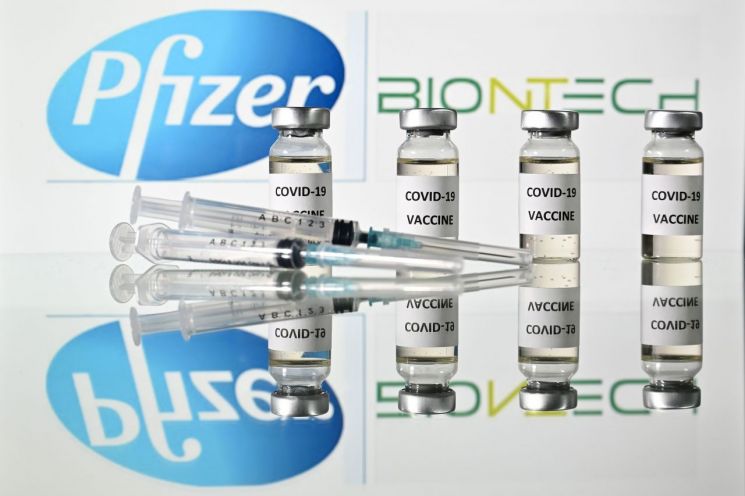
[Asia Economy Reporter Seo So-jeong] The first recipients of the novel coronavirus infection (COVID-19) vaccine in South Korea have been decided as medical staff at infectious disease-dedicated hospitals. Since these medical personnel are on the front lines treating COVID-19 patients, they have been prioritized as the top vaccination targets to prevent infection.
The government plans to vaccinate 50,000 doses of the Pfizer vaccine, initially procured through the international joint purchase and distribution project 'COVAX Facility' in early February, to medical staff at infectious disease-dedicated hospitals. The AstraZeneca vaccine, to be supplied at the end of February, will be administered to workers at nursing hospitals and the elderly.
Professor Ki Moran of the National Cancer Center stated on the 21st, "The 50,000 doses are enough for all medical staff at infectious disease-dedicated hospitals," adding, "It is strongly being considered that the first domestic vaccination will take place at the vaccine center to be piloted at the National Medical Center."
The National Medical Center Vaccine Center to Serve as the 'Central Center'
Initially, the government identified high-risk groups in nursing hospitals and nursing facilities as the first vaccination targets. Jung Eun-kyung, head of the Korea Disease Control and Prevention Agency (KDCA), said, "Since severe cases and mortality rates are high among the elderly, and the medical community faces significant burdens in long-term critical care, vaccination will first begin focusing on high-risk groups in nursing hospitals and nursing facilities."
However, due to the initial supply of Pfizer vaccine being limited to 50,000 doses, the priority vaccination target was changed to COVID-19 medical institution workers. This is because the elderly living in group facilities such as nursing hospitals number around 560,000, and limiting doses to 50,000 could raise issues of selection.
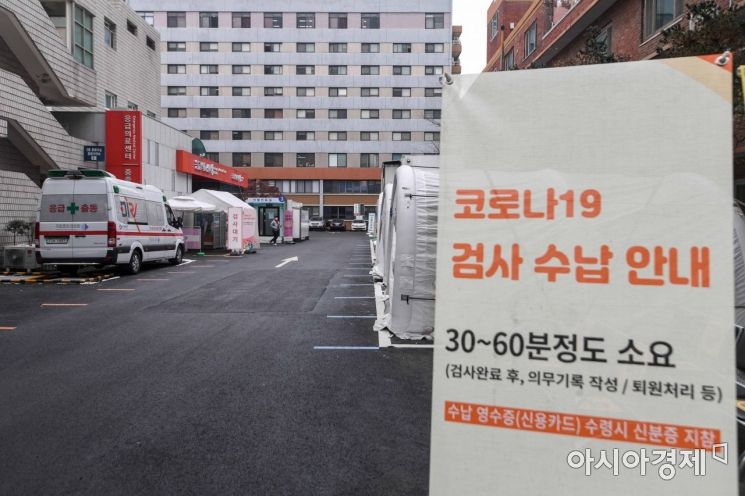 On the 12th, the screening clinic set up at the National Medical Center in Jung-gu, Seoul, which is reviewing the announcement of the 'Social Distancing' adjustment plan to be applied from next week, showed a quiet scene. Photo by Kang Jin-hyung aymsdream@
The vaccinations will be conducted at the vaccine center established at the National Medical Center. Due to the Pfizer vaccine’s requirement for distribution and storage at minus 70 degrees Celsius, a separate vaccination site is necessary. A National Medical Center official said, "We are preparing a facility next to the National Medical Center where vaccinations will be administered, and where post-vaccination adverse reactions and side effects can be monitored and managed," adding, "We are discussing with the KDCA for it to serve as the central vaccine vaccination center."
The government is proceeding with a 'special import' procedure to introduce the Pfizer vaccine and expedite vaccinations. Since the Pfizer vaccine has received emergency use authorization from the World Health Organization (WHO), and experts from the Ministry of Food and Drug Safety participated in the review, the government plans to advance the introduction timeline as much as possible. According to the government’s plan, Pfizer vaccinations will begin in early to mid-February. The AstraZeneca vaccine, initially expected to be the fastest to be administered, is now scheduled to start vaccinations as early as the end of February. The KDCA is currently revising priority vaccination groups and plans in line with the Pfizer vaccine introduction and intends to announce details by the end of this month.
Vaccine Priority Controversy... Overseas Vaccination Information Should Be Disclosed
However, as vaccinations with two types of vaccines, Pfizer and AstraZeneca, begin in February, some controversy over 'vaccine priority' may arise. Since the Pfizer vaccine is known to have a 95% efficacy rate, while AstraZeneca’s is only about 62%, preference for the vaccine with higher efficacy may increase. The government has stated that the public cannot choose their vaccine.
Professor Chun Eun-mi of the Respiratory Medicine Department at Ewha Mokdong Hospital said, "In the UK, Pfizer and AstraZeneca vaccines are being administered simultaneously, but there is not much information about this," adding, "Since the difference in vaccine efficacy may cause anxiety among the public, it is necessary to collect overseas vaccination cases and transparently disclose the information."
© The Asia Business Daily(www.asiae.co.kr). All rights reserved.
![Clutching a Stolen Dior Bag, Saying "I Hate Being Poor but Real"... The Grotesque Con of a "Human Knockoff" [Slate]](https://cwcontent.asiae.co.kr/asiaresize/183/2026021902243444107_1771435474.jpg)

















