Increasing Floor Area Ratio to 700% in Station Areas and Taking Part of the Land
Homeowners and Landowners Dissatisfied... Relaxed Floor Limits Also Strict
Few Additional Units for Sale, Public Reconstruction Lacks Appeal
[Asia Economy Reporters Jo Gang-wook and Ryu Tae-min] Although the government has announced an ‘innovative real estate policy’ and is putting all its efforts into expanding housing supply, key plans are already showing signs of faltering. Even with the government’s unprecedented incentives for transit station area high-density development and public reconstruction?considered core measures of the supply plan?the market response remains lukewarm.
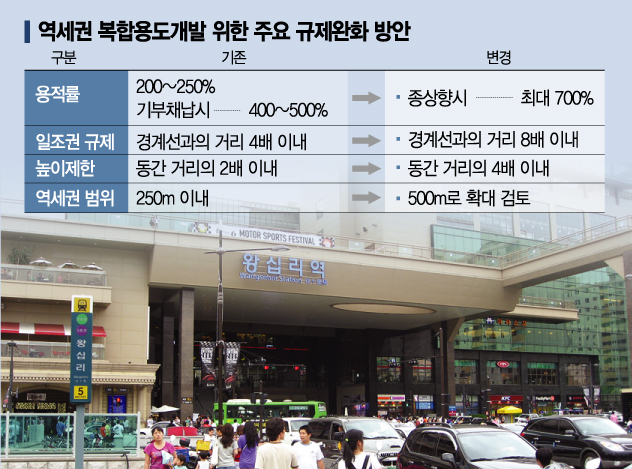
According to industry sources on the 21st, the government and Seoul City recently approved an amendment to the Enforcement Decree of the National Land Planning and Utilization Act to raise the floor area ratio (FAR) of 100 transit station areas in Seoul from the current 200?250% to 700%. At the same time, they are accelerating institutional improvements to ease regulations for ‘Street Housing Maintenance Projects’ involving public participation, allowing the maximum number of floors to increase from 7 to 15. They are focusing efforts on securing policy effectiveness by launching large-scale promotions through business briefings targeting complexes that have received preliminary consulting for public reconstruction.
However, the market reaction is cold. A member of a real estate community on internet portal sites like Naver said, “They want to raise the FAR to 700% and take part of my land, so why would landowners or homeowners agree to this?” adding, “It’s much better to keep the FAR as is and hold onto the land shares as they are.” Another member argued, “Just because rental housing is built in Daechi-dong or Dogok-dong and people move in doesn’t mean they become residents there,” and “In fact, moving in there might cause more alienation and a greater sense of relative deprivation.”
There is especially strong resistance to the fact that at least half of the increased housing from high-density development is likely to be supplied as public rental or public sale housing. Another real estate community member expressed skepticism, saying, “They say they will recoup development profits, but would anyone readily proceed with a project just because high-density development is allowed?”
Criticism has also been raised that the criteria for easing floor limits in Street Housing Maintenance Projects are excessively stringent. According to Seoul City standards, in ‘Type 2 General Residential Areas with buildings up to 7 floors,’ not only must 20% of the housing be rental, but additional public contributions are required to raise the building height to a maximum of 15 floors. Moreover, to receive the maximum FAR, the rental period must be at least 30 years, and there are also requirements regarding project area and location, making it practically difficult to construct a 15-floor building.
The ambitious public reconstruction project, which aims to supply 50,000 units, faces similar challenges. Although the government has been holding business briefings since the 19th for complexes that received preliminary consulting for public reconstruction, residents of these complexes are underwhelmed.
Among the complexes participating in the preliminary consulting, Shinbanpo 19th Complex?the only apartment in the Gangnam area?is expected to increase by 97 units if public reconstruction proceeds, but 74 of these will be public rental or public sale units, leaving only 23 units as an increase in general sale units. Kim Seong-jin, the head of the Shinbanpo 19th Reconstruction Association, said, “Unless the additional units are converted to public sale rather than rental, there is no real merit in choosing public reconstruction.”
Similarly, Gwanak-gu Miseong Geonyeong and Yeongdeungpo-gu Singil 13 District, also subjects of preliminary consulting, expressed skepticism, saying, “The high ratio of public contributions is insufficient to ease the burden on residents.”
Professor Jo Joo-hyun of Konkuk University’s Department of Real Estate said, “Since sufficient incentives are not provided, such as allowing residents to retain a significant portion of development profits, it is natural that residents’ responses are not positive,” adding, “Without policy changes to secure profitability, participation in projects may remain passive.”
© The Asia Business Daily(www.asiae.co.kr). All rights reserved.
![User Who Sold Erroneously Deposited Bitcoins to Repay Debt and Fund Entertainment... What Did the Supreme Court Decide in 2021? [Legal Issue Check]](https://cwcontent.asiae.co.kr/asiaresize/183/2026020910431234020_1770601391.png)















