[Sejong=Asia Economy Reporter Joo Sang-don] The establishment of a foreign inflow monitoring network to analyze various migration routes, concentrations, and components of long-distance transported pollutants such as fine dust has been completed and will now be fully operational to identify the causes of domestic fine dust.
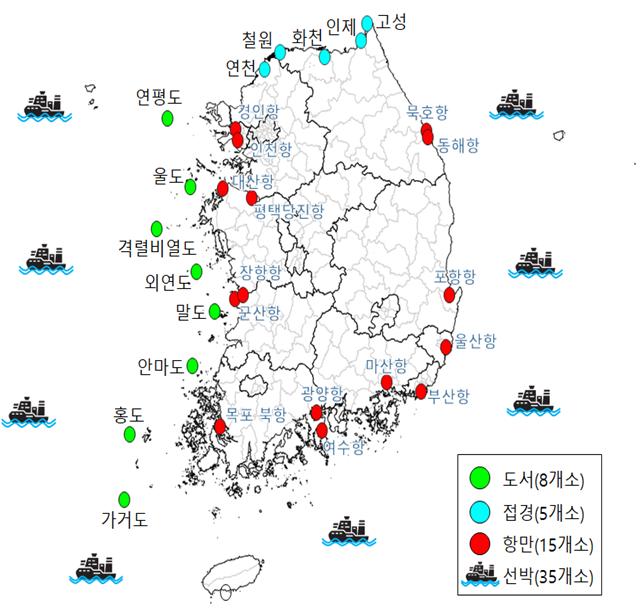
On the 20th, the Ministry of Environment announced that it has completed the installation of a total of 63 foreign inflow fine dust monitoring networks and will begin full-scale operation.
The foreign inflow monitoring network consists of a total of 63 sites: 8 island areas, 15 port areas, 5 border areas (Demilitarized Zone), and 35 large vessels owned by the Korea Coast Guard.
The monitoring network measures particulate pollutants such as fine dust (PM10) and ultrafine dust (PM2.5), gaseous pollutants such as nitrogen oxides (NOx) and sulfur oxides (SO2), as well as meteorological data including wind direction, wind speed, temperature, and humidity on an hourly basis. The measurement results will be disclosed through the Ministry of Environment’s air quality information website (Air Korea), similar to the existing atmospheric monitoring network.
An official from the Ministry of Environment explained, "With the full operation of the foreign inflow monitoring network, we will be able to analyze the causes and migration routes of high-concentration fine dust in Korea in greater detail."
The Ministry of Environment plans to further strengthen meticulous and three-dimensional monitoring of air pollutants inflowing from abroad, by linking and utilizing the foreign inflow monitoring network with environmental satellites, medium-sized aircraft, and ground remote sensing equipment.
Since February last year, the geostationary environmental satellite, launched for the first time in the world, has been intensively observing the fine dust concentration distribution across Northeast Asia, and observation data will be released starting from the first half of this year.
Additionally, by using medium-sized aircraft and ground remote sensing equipment, vertical concentrations of air pollutants from the ground to the upper atmosphere will be measured and analyzed, which will be used not only to verify satellite data but also to identify causes of high concentration occurrences.
Meanwhile, on the afternoon of the same day, Hong Jeong-gi, Vice Minister of the Ministry of Environment, visited Gunsan Port in Jeonbuk Province to inspect the operation status of the monitoring networks installed at the port management office and Korea Coast Guard vessels in the area, marking the completion of the foreign inflow monitoring network. At the site, Vice Minister Hong said, "The operation of the foreign inflow monitoring network will not only establish a flawless monitoring system but also enhance policy utilization by integrating it with fine dust forecasting."
© The Asia Business Daily(www.asiae.co.kr). All rights reserved.
![User Who Sold Erroneously Deposited Bitcoins to Repay Debt and Fund Entertainment... What Did the Supreme Court Decide in 2021? [Legal Issue Check]](https://cwcontent.asiae.co.kr/asiaresize/183/2026020910431234020_1770601391.png)
















