Direction of Diplomatic and Security Policy
"Denuclearization through Dialogue, Humanitarian Aid"
"Early Completion of South Korea's Defense Cost-Sharing"
[Asia Economy Reporter Jo Yoo-jin] Ahead of the inauguration of President-elect Joe Biden, the next heads of diplomacy and security signaled a complete revision of the policy toward the Korean Peninsula during the confirmation hearings. On the other hand, regarding China policy, they are expected to maintain a tough stance by tightening pressure, presenting a diplomatic policy tone that is similar yet different from the previous administration.
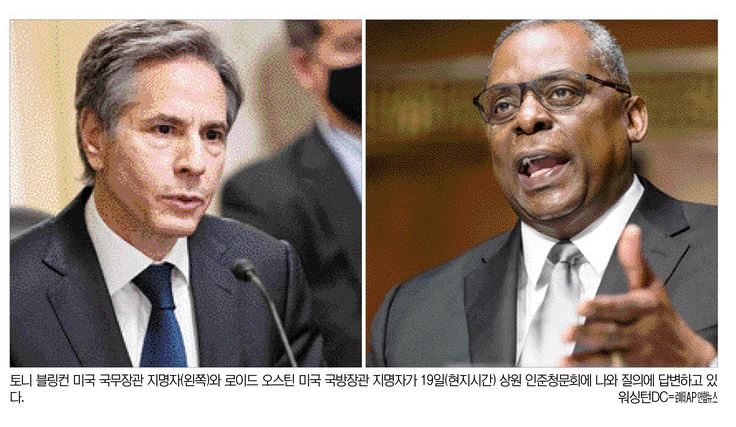
◆ Blinken: "Comprehensive Review of North Korea Approach" = Tony Blinken, nominee for U.S. Secretary of State, stated at the Senate confirmation hearing held on the 19th (local time), one day before President-elect Joe Biden's inauguration, that "the United States must comprehensively review its existing approach and policies toward North Korea." Regarding North Korea's denuclearization issue, he said, "This has been a difficult problem that has troubled every administration," adding, "It has not improved and has actually worsened," implying the necessity of imposing sanctions on North Korea.
He also announced plans to pursue humanitarian aid alongside denuclearization through diplomacy. In response to questions about humanitarian aid, he said, "In North Korea and other similar situations, we clearly need to pay attention to the people of those countries and do what we can to alleviate their suffering."
Blinken, who established the ‘strategic patience’ policy during the Obama administration by strengthening sanctions to bring North Korea to the negotiating table, is widely expected to lead a Biden administration foreign strategy resembling Obama administration 2.0. It is predicted that to bring North Korea to the dialogue table, the administration will move away from the Trump administration’s ‘top-down’ negotiation style and prefer a ‘bottom-up’ approach focused on working-level talks and multilateral negotiations.
◆ Secretary of Defense: "Early Completion of Defense Cost-Sharing" = Regarding the South Korea-U.S. relationship, alliance restoration and easing pressure for increased defense cost-sharing are major issues. On this day, Lloyd Austin, nominee for U.S. Secretary of Defense, stated that if confirmed, he would conclude the defense cost-sharing negotiations with South Korea early.
In a written response submitted to the Senate Armed Services Committee in line with the confirmation hearing, he emphasized cooperation with allies, saying, "If confirmed, I will focus on modernizing alliances in the Indo-Pacific region and, as part of those efforts, will push for an early conclusion of defense cost-sharing negotiations with South Korea." The South Korea-U.S. defense cost-sharing talks have been stalled amid demands for significant increases by the Donald Trump administration.
◆ Pompeo: "China is a Genocidal Perpetrator"…Final Pressure = On the same day, Blinken said, "President Trump’s tougher approach toward China was the right thing to do," adding, "His fundamental principles were correct." This statement signals that the Biden administration will continue the Trump administration’s tough stance on China.
Mike Pompeo, U.S. Secretary of State, applied pressure on China until the end of his term. In a statement released that day, he fiercely criticized, saying, "China’s policies toward Muslims and ethnic minorities in the western Xinjiang region constitute genocide." He stated, "Under the direction and control of the Communist Party, China has committed genocide against Muslim Uyghurs and other ethnic minorities in Xinjiang."
Even after losing the presidential election, the Trump administration continued to release tough policies on China, which some interpret as an attempt to ‘drive a nail’ making it difficult for the Biden administration to easily adopt a conciliatory approach.
Avril Haines, nominee for Director of National Intelligence (DNI), who oversees all intelligence agencies in the U.S., also expressed her intention to strengthen responses to the threat from China. At the hearing, Haines said, "The National Intelligence Office must not shy away from telling the truth about power," adding, "Especially when it is uncomfortable and difficult."
© The Asia Business Daily(www.asiae.co.kr). All rights reserved.

















