Renault, Toyota, Daimler and Major Automakers Target Hydrogen Vehicle Market
Hyundai Motor, the No.1 in Hydrogen Vehicles, Actively Expands Business
[Asia Economy Reporter Changhwan Lee] As countries' carbon neutrality efforts grow, global automakers are increasingly entering the hydrogen vehicle market. Hyundai Motor Company's steps to maintain its number one market share in hydrogen vehicles are also expected to accelerate.
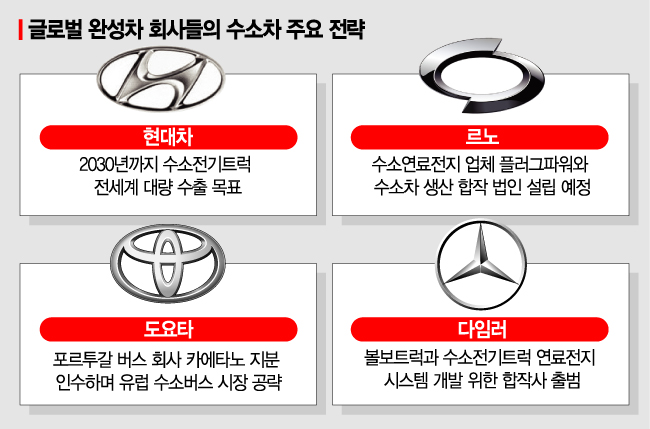
According to the automotive industry on the 20th, Renault Group recently announced that it will establish a joint venture with Plug Power, one of the world's largest hydrogen fuel cell companies, to produce hydrogen vehicles.
Renault aims to capture more than 30% of the fuel cell-based small and medium-sized commercial vehicle market in Europe and plans to build a hydrogen fuel cell system and a state-of-the-art hydrogen vehicle production line in France. To this end, starting next year, it will produce 5 to 6-ton hydrogen vans for transportation and plans to increase annual production to tens of thousands of units within 10 years.
Plug Power was also highlighted as SK Group's first investment destination this year. SK Inc. and SK E&S have invested a total of 1.6 trillion won (1.5 billion dollars) to acquire a 9.9% stake in Plug Power. Industry analysts expect Renault to enter the hydrogen commercial vehicle market with Plug Power and expand its hydrogen vehicle lineup to include pickup trucks and large sport utility vehicles (SUVs).
Japanese automaker Toyota has also officially entered the hydrogen commercial vehicle market competition. Last month, Toyota acquired shares in Portuguese bus manufacturer Caetano Bus, aiming to secure a leading position in the European hydrogen bus market. Additionally, it established a new corporation called the 'Fuel Cell Business Group' to oversee global hydrogen fuel cell-related operations in Europe.
Toyota is also targeting the North American market. Through its commercial vehicle subsidiary Hino, Toyota is collaborating with American commercial vehicle manufacturer Kenworth to develop hydrogen electric trucks. In the passenger car sector, last month, Toyota launched a fully redesigned sedan-type hydrogen fuel cell vehicle, the MIRAI, announcing plans to increase production tenfold compared to the previous model.
German Daimler, the parent company of Mercedes-Benz, also launched a joint venture with Sweden's Volvo Trucks in June last year to develop fuel cell systems for hydrogen electric trucks. The two companies showcased the first hydrogen electric truck concept car, the GenH2, aiming for pilot operation in 2023 and sales in 2025.
Hyundai Motor Company, the global leader in hydrogen vehicle market share, is also actively expanding its business. Hyundai has announced a goal to export 25,000 units of the 'Xcient hydrogen electric truck' to Europe, 12,000 units to the United States, and 27,000 units to China by 2030.
In July, Hyundai plans to pilot hydrogen electric trucks developed for domestic specifications in logistics operations in collaboration with CJ Logistics, Coupang, and Hyundai Glovis by next year. In the passenger car sector, on the 18th, Hyundai released a facelifted model of the Nexo, enhancing safety and convenience while lowering the price.
According to market research firm SNE Research, among the 6,664 hydrogen fuel cell vehicles sold worldwide until last September, Hyundai's market share was an overwhelming 73.8% (4,917 units), ranking first. Toyota was second with an 11.5% share (767 units), and Honda was third with 2.8% (187 units).
© The Asia Business Daily(www.asiae.co.kr). All rights reserved.
![User Who Sold Erroneously Deposited Bitcoins to Repay Debt and Fund Entertainment... What Did the Supreme Court Decide in 2021? [Legal Issue Check]](https://cwcontent.asiae.co.kr/asiaresize/183/2026020910431234020_1770601391.png)
















