Increase Chronic Kidney Disease Patient Satisfaction through Latest Equipment Introduction and Environmental Improvements
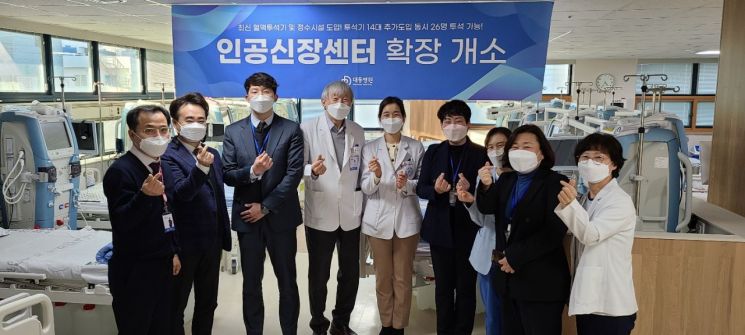 On January 19th, medical staff pledged to provide the best medical services at the opening ceremony of the expanded Artificial Kidney Center at Daedong Hospital.
[Asia Economy Yeongnam Reporting Headquarters Reporter Kim Yong-woo] Daedong Hospital (Hospital Director Park Kyung-hwan) announced that it has completed the remodeling of the Artificial Kidney Center on the 4th floor of the main building and held a commemorative ceremony for the expansion and opening of the Artificial Kidney Center on the 19th, officially beginning its operation.
The kidney, commonly called "kongpat" in Korean, filters waste products from the blood and excretes them as urine, while regulating blood pressure and electrolyte concentrations in the blood. When the kidney fails to function properly, waste accumulates in the body, impairing various bodily functions, a condition known as renal failure. In particular, chronic renal failure gradually worsens kidney function over a long period, making recovery difficult. Dietary therapy, medication, and other treatments are used to control further deterioration, or patients may require hemodialysis or kidney transplantation.
According to the National Health Insurance Service’s Health Insurance Review and Assessment Service (HIRA) statistics on diseases of public interest, the number of chronic renal failure patients increased by 46.14%, from 170,567 in 2015 to 249,283 in 2019, with the highest prevalence in people in their 70s, followed by those in their 60s and 50s. This increase is attributed to population aging and higher early diagnosis rates through national health screenings, resulting in a steep rise in chronic renal failure patients requiring hemodialysis.
In response to the growing number of local patients requiring dialysis due to chronic renal failure, Daedong Hospital’s Artificial Kidney Center expanded its capacity by adding 14 dialysis machines, enabling 26 patients to undergo dialysis simultaneously. To improve treatment satisfaction for dialysis patients, the center introduced the latest hemodialysis equipment and water purification facilities, installed individual bedside TVs, and set up separate isolation dialysis rooms to prevent infections among dialysis patients.
The Artis physio dialysis machine from Baxter, introduced by Daedong Hospital, offers ▲ personalized customized dialysis ▲ reduced frequency of hypotension during dialysis ▲ real-time monitoring of dialysis effectiveness ▲ shortened recovery time after dialysis. Utilizing this equipment, the center applies the latest dialysis treatment method, HDx (Expanded HD), which more effectively removes middle molecules during dialysis.
Kim Min-ji, head of the Artificial Kidney Center and nephrology specialist at Daedong Hospital, stated, “Although dialysis treatment technology has advanced, common complications such as hypotension, dizziness, and fatigue occur during dialysis, which can affect dialysis effectiveness and patient prognosis.” She added, “This expansion will improve treatment environments including equipment and facilities, and through collaborative care with various specialists such as endocrinology, cardiology, vascular surgery, and radiology, we expect to establish a system that provides personalized dialysis treatment tailored to each patient.”
Meanwhile, Daedong Hospital has consecutively received excellent artificial kidney room certification twice from the Korean Society of Nephrology last year, and plans to recruit additional nephrology specialists starting February to provide internationally standardized treatment for dialysis patients.
© The Asia Business Daily(www.asiae.co.kr). All rights reserved.

















