Prospects for Maintaining the 'Buy American' Policy
US-China Relations Expected to Involve Both Competition and Cooperation
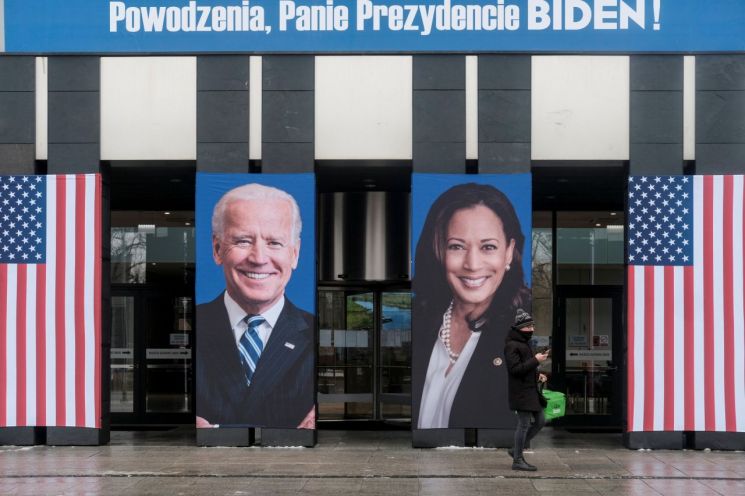
[Asia Economy Reporter Jeong Hyunjin] On the eve of the inauguration of the Joe Biden administration in the United States, analyses suggest that the Biden administration's trade policy will focus on rebuilding the U.S. economy damaged by the novel coronavirus disease (COVID-19) and restoring leadership through alliance cooperation.
The Korea International Trade Association's International Trade and Commerce Research Institute forecasted in its report titled "Trade Policy Outlook After the Inauguration of the Biden Administration," released on the 20th, that the Biden administration's trade policy will be based on values emphasizing democracy, inequality resolution, and a norm-centered order. This marks a shift from the Trump administration's focus on benefits centered on large corporations.
The Trade Association stated that, first, as the economic recession caused by COVID-19 continues, the Biden administration is expected to maintain a policy stance protecting domestic industries in the U.S. The association said, "The 'Buy American' policy, which prioritizes purchasing American-made products to promote economic recovery, aligns with the Trump administration's stance, and trade remedy measures such as anti-dumping and countervailing duties, demanded by the American industry, will continue under the new administration."
Regarding the U.S.-China relationship, which worsened during President Trump's tenure, the association said, "The Biden administration is highly likely to establish an Asia-Pacific strategy that builds a united front among allied countries concerning trade, investment, technology, and supply chains to check China," adding, "Since cooperation with allies is emphasized, future U.S.-China conflicts are expected to expand from trade to diplomacy and from bilateral to multilateral levels."
It also emphasized, "Given that cooperation and coordination with China are necessary on global issues such as COVID-19 and climate change response, close attention should be paid to how the Biden administration will establish U.S.-China relations."
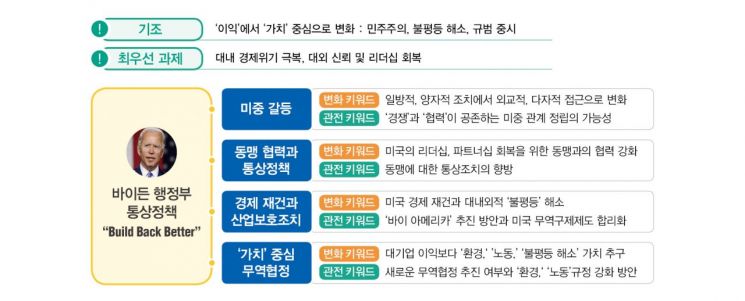
The Trade Association also mentioned that the Biden administration must resolve various trade measures and other trade issues imposed on allied countries by the Trump administration at an appropriate time to restore cooperative relations with allies. In particular, it predicted that trade conflicts between the U.S. and Europe will inevitably require adjustment, including Section 232 measures imposing tariffs on steel and aluminum imports, Europe's digital services tax collection, and aircraft subsidies, as the alliance with European countries is strengthened.
Furthermore, the Trade Association noted that since President Biden has expressed his intention to pursue trade negotiations after domestic economic recovery, ongoing trade talks with the United Kingdom, China, Kenya, and others are being paced accordingly. It is currently uncertain whether the U.S. will rejoin the Comprehensive and Progressive Agreement for Trans-Pacific Partnership (CPTPP), which it withdrew from in 2017. It also anticipates that even if new agreements are pursued in the future, they may seek a new type of trade agreement that does not undermine social values such as labor and environment, rather than the existing trade agreements focused on market opening.
Seol Song-yi, a senior researcher at the Trade Association, said, "Our companies should prepare for the possibility that the Biden administration will change trade measures toward allied countries and thoroughly manage risks by reassessing U.S.-China linked supply chains amid prolonged U.S.-China disputes," adding, "As the role of Congress in U.S. trade policy is expected to increase, our government and related agencies should expand outreach activities targeting the U.S. Congress to promote bilateral goodwill and strengthen networks."
© The Asia Business Daily(www.asiae.co.kr). All rights reserved.


















