24% Increase in Rentals Over One Year... 59.1% Surge in Ddareungi Usage from February to April Amid COVID Spread
54% of Users Concentrate on Commute Hours... 1 in 4 Seoul Citizens Are Members
[Asia Economy Reporter Lim Cheol-young] Amid the normalization of social distancing due to the spread of the novel coronavirus infection (COVID-19), the use of Seoul's public bicycle system 'Ddareungi' has been steadily increasing. It is analyzed that Ddareungi, a non-face-to-face transportation method during the infectious disease phase, is establishing itself as a daily transportation means.
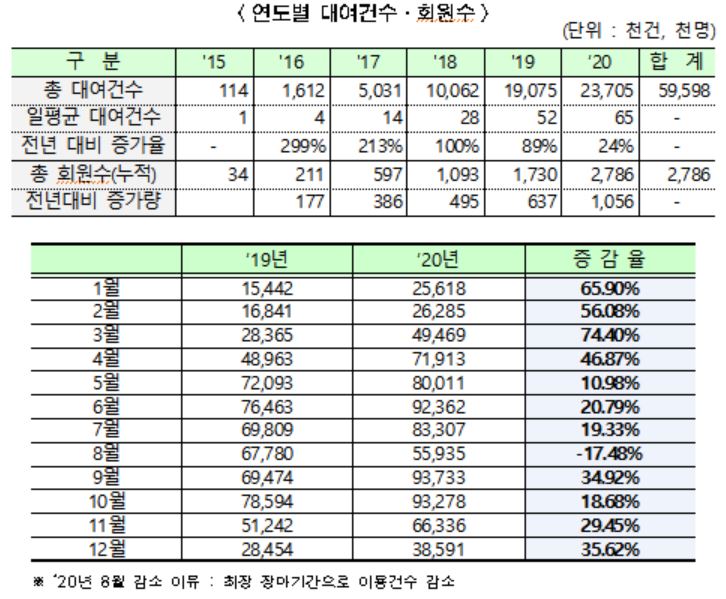
According to Seoul City on the 20th, the number of Ddareungi rentals last year reached 23,705,000, a 24% increase compared to the previous year. This means that each Seoul citizen used Ddareungi more than twice on average. In particular, usage from February to April, when the first large-scale COVID-19 outbreak occurred, increased by 59.1% compared to the same period last year. In March, it rose by 74.4%, marking the highest record.
The number of members also increased significantly. The cumulative number of Ddareungi subscribers exceeded 2,786,000, which is about one in four Seoul citizens. Last year, new subscribers reached a record high of 1,207,000. Most new members were in their 20s and 30s (64.7%), showing high popularity among young adults, while usage frequency was prominent among those in their 50s and 60s.
Users were especially concentrated during weekday commuting hours rather than weekends, with 54% of users during these times. During commuting hours, which bridge gaps before and after public transportation use, rentals were mainly near subway stations such as Magoknaru Station and Yeouinaru Station, with returns in business districts like Yeouido.
Seoul City analyzed that Seoul citizens have embraced Ddareungi as a non-face-to-face transportation method that allows social distancing during the infectious disease phase, establishing it as a daily transportation means.
Accordingly, Seoul City expanded the number of Ddareungi bicycles to a total of 37,500 and rental stations to 3,040 locations, the largest scale among public bicycles in local governments nationwide. Convenience of use was also enhanced. They introduced 2,000 units of the ‘Saessak Ddareungi,’ which are smaller and lighter, and lowered the minimum usage age to 13, allowing users to choose according to age and body size. QR-type terminals incorporating Internet of Things (IoT) technology were also introduced.
Since the facilities are shared by an unspecified number of people, thorough disinfection and sterilization efforts are underway. Regular disinfection is conducted at all rental stations, and two hand sanitizers are provided at each location. From August to November last year, a total of 140 ‘Ddareungi Disinfection Teams’ were formed and operated through public jobs for vulnerable employment groups. They frequently disinfected surfaces of rental stations and bicycles, checked and replaced hand sanitizer supplies, and operated a disinfection system.
© The Asia Business Daily(www.asiae.co.kr). All rights reserved.

















