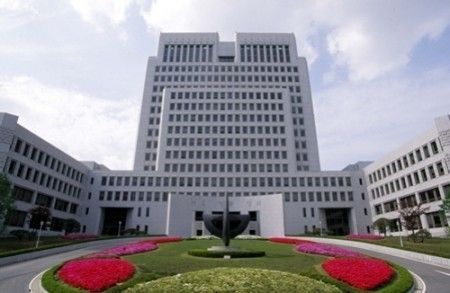
[Asia Economy Reporter Kim Daehyun] The Supreme Court has ruled that a rear-end collision caused by a drunk person’s improper operation of vehicle functions while the engine was off cannot be considered an accident that occurred during driving.
On the 19th, the Supreme Court’s 3rd Division (Presiding Justice Kim Jae-hyung) announced that it upheld the lower court’s ruling, which acquitted the defendant A in part, in the appeal trial of A, who was charged with violating the Act on the Aggravated Punishment of Specific Crimes (dangerous driving causing injury) and other charges.
A was prosecuted for driving his passenger car about 100 meters on Jandari-ro, Mapo-gu, Seoul, in July 2018, with a blood alcohol concentration of 0.148%, in a state of intoxication. At that time, A failed to start the engine, but the vehicle’s brakes were released, causing it to roll down a slope and collide with the front of a taxi that was stopped. As a result, the taxi driver B suffered injuries including cervical sprain and tension for two weeks.
The first trial court judged that even though the car rolled backward unintentionally, it should be considered “driving.” The court explained, “The defendant’s acquaintance tried to start the engine, but due to unfamiliarity with the function, the engine turned off and the car rolled backward. Then A switched seats and got into the driver’s seat, and the vehicle collided with the taxi behind. The rear brake lights of the vehicle repeatedly turned on and off from the time A sat in the driver’s seat until the collision.” The court sentenced A to a fine of 10 million won for violating the Road Traffic Act and the Act on the Aggravated Punishment of Specific Crimes.
The second trial court acquitted A of violating the Act on the Aggravated Punishment of Specific Crimes. It ruled that A was not guilty of dangerous driving causing injury and only recognized the charge of drunk driving, reducing the fine to 4 million won. The court reasoned that since A manipulated the brake without starting the engine and did not set the transmission to “reverse,” it did not constitute driving.
The prosecution appealed, but the Supreme Court rejected it. The court stated, “Even if A manipulated the brake with the intention to drive the vehicle causing it to move backward, since the engine was not started, it is difficult to consider that the vehicle was used according to its original purpose.” It confirmed the lower court’s ruling, stating there was no error in the legal interpretation regarding the “driving” of a vehicle.
© The Asia Business Daily(www.asiae.co.kr). All rights reserved.

















