Low Transition Rate Due to COVID-19... Biden Likely to Increase Pressure on China After Inauguration
Biden May Expedite Phase 2 Trade Agreement Including Financial Market Opening
[Asia Economy Beijing=Special Correspondent Jo Young-shin] Despite the US-China Phase One trade agreement last year, China's trade surplus with the United States increased. Although President Donald Trump pressured China to correct the trade imbalance with the US, there has been little significant change.
Accordingly, with the inauguration of President-elect Joe Biden, the possibility of leveraging the US-China trade imbalance to check China has increased.
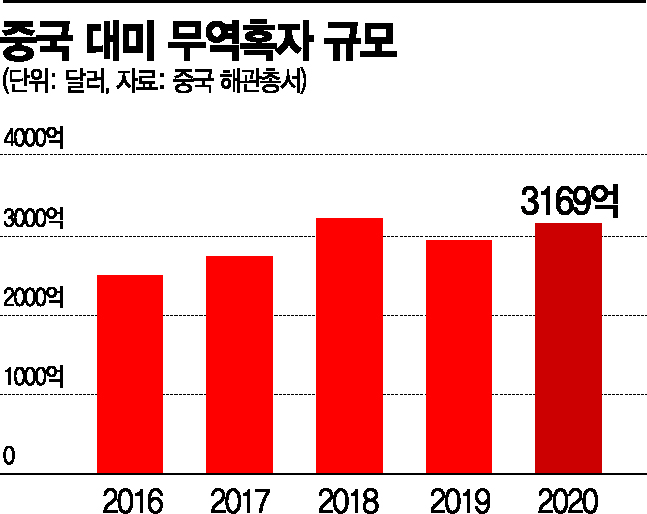
According to the General Administration of Customs of China on the 19th, China's trade surplus with the US last year was tentatively estimated at $316.9 billion. This is a 7.1% ($21.1 billion) increase from $295.8 billion the previous year.
China's imports from the US increased by 9.8% to $134.91 billion compared to the previous year, but exports were overwhelmingly higher at $451.81 billion, resulting in an even larger surplus.
China's trade surplus with the US has increased annually, with $250.8 billion in 2016, $275.8 billion in 2017, and $323.3 billion in 2018. Although the surplus shrank by $27.5 billion in 2019 due to intensified US trade pressure, the trade surplus increased again last year.
In January last year, China signed the Phase One trade agreement with the US, promising to increase imports of US products such as manufactured goods, agricultural products, and energy by $200 billion (approximately 220.42 trillion KRW) over two years compared to 2017, until 2021.
As of the end of last year, official statistics on the implementation rate of the Phase One trade agreement have not been released, but it is highly likely that China did not fully comply. According to a report by the Washington think tank Peterson Institute for International Economics (PIIE), as of the end of October last year, China's imports of US goods (based on US exports) amounted to $71 billion, only 57% of the promised amount.
The low implementation rate of the Phase One trade agreement is attributed to the halt of the Chinese economy in the first quarter of last year due to the COVID-19 pandemic.
It is also possible that China deliberately did not fulfill its commitments. With President Trump failing to win re-election, China may have adjusted the pace of US product imports toward the end of the year.
Furthermore, as the trade imbalance has expanded again, there is speculation that the incoming Biden administration may hasten the Phase Two trade agreement with China.
Since pressure tactics such as tariffs negatively affect the US economy as well, there are suggestions that financial market opening and other measures may be expedited.
With the Chinese economy achieving positive growth last year and an 8% growth forecast this year, it is expected that the Biden administration's pressure will intensify.
Above all, as the economic size gap between the US and China narrows, the possibility of intensified US-China conflicts has increased. Overseas research institutions such as the Brookings Institution in the US predict that China’s economy will continue to grow and surpass the US GDP within seven years. Currently, China's GDP is estimated to be about 70% of the US level.
Meanwhile, regarding the expansion of the trade surplus, the General Administration of Customs of China stated that exports of COVID-19 prevention supplies such as masks, medical protective clothing, ventilators, and medical monitors surged, making China's trade surplus the largest since 2016. This explains that the trade surplus increased due to the unexpected variable of COVID-19.
© The Asia Business Daily(www.asiae.co.kr). All rights reserved.
![Clutching a Stolen Dior Bag, Saying "I Hate Being Poor but Real"... The Grotesque Con of a "Human Knockoff" [Slate]](https://cwcontent.asiae.co.kr/asiaresize/183/2026021902243444107_1771435474.jpg)











