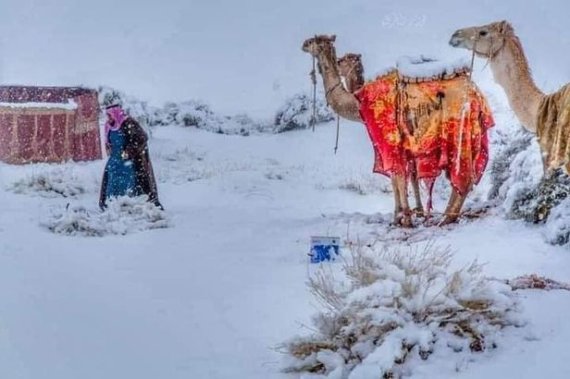
 Snow accumulated on the 14th (local time) in the Asir region in the southwest of Saudi Arabia (Saudi). Photo by Facebook screen capture
[Asia Economy Reporter Suwan Kim] An unusual sight was witnessed as snow accumulated in the scorching desert. Especially, abnormal climate phenomena are occurring worldwide, such as snow falling and temperatures dropping below freezing in the Sahara Desert in Africa and the Saudi Arabian (Saudi) desert in the Middle East, which are known for their year-round heat.
According to foreign media including the British daily Daily Mail on the 18th (local time), on the 13th, the temperature in Ain Sefra, a desert village in Algeria, Africa, dropped to minus 3 degrees Celsius, and snow accumulated in the Sahara Desert.
In the Asir region of Saudi Arabia, temperatures dropped to a minimum of minus 2 degrees Celsius this month, marking the first time in 50 years that temperatures fell below freezing. Especially, snow fell, covering the desert and hills with snow. It is unusual for snow to fall in the deserts of Africa and the Middle East.
Villagers rushed outside to see the snow, and they even covered camels shivering from the cold with blankets.
Earlier, photographer Karim Boushetata shared photos of the Sahara Desert on his social media last week.
In the released photos, sheep are seen walking on the thinly accumulated snow on the desert, and the white snow formed patterns along the sand grains.
The shooting location, Ain Sefra in Algeria, is called the "Gateway to the Sahara Desert," situated at an altitude of about 1000 meters and surrounded by the Atlas Mountains.
The temperature in this area usually rises close to 40 degrees Celsius in July, and even in the coldest period of January, it is known to maintain an average of 12 degrees Celsius.
Typically, deserts have large temperature differences between day and night, so snow can fall in the middle of winter nights, but it usually melts when the sun rises the next day.
The snow that fell this time is analyzed to be due to cold high pressure moving into the desert, which lowered the temperature across the African continent.
Meanwhile, Saudi Arabia has experienced repeated such weather anomalies in recent years.
Last year, temperatures in some northwestern regions of Saudi Arabia, including Tabuk, dropped below freezing, prompting warnings, and earlier in April 2019, snow also fell once.
Additionally, after snow accumulated in the Sahara Desert for the first time in 37 years in 2016, similar scenes were observed in 2017 and 2018.
Experts analyze that snow falling in desert areas is a weather anomaly caused by climate change.
Eric Leister, chief meteorologist at AccuWeather, said, "Snowfall in this region is rare, but not completely unusual."
Professor Sumant Nigam, a climate researcher and marine scientist at the University of Maryland, said, "Our results apply only to the Sahara Desert, but there is a possibility that other deserts around the world could be affected."
© The Asia Business Daily(www.asiae.co.kr). All rights reserved.
![Clutching a Stolen Dior Bag, Saying "I Hate Being Poor but Real"... The Grotesque Con of a "Human Knockoff" [Slate]](https://cwcontent.asiae.co.kr/asiaresize/183/2026021902243444107_1771435474.jpg)
















