Strengthening Security in Industry and Medical Fields by Connecting Communication Networks
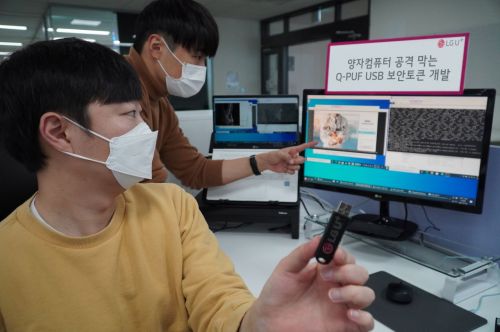 LG Uplus announced on the 19th that it has developed a 'Q-PUF USB' security token containing Post Quantum Cryptography (PQC) technology that can prevent attacks from quantum computers, and applied it to the Digital New Deal project. The photo shows LG Uplus employees holding the Q-PUF USB equipped with post-quantum cryptography technology. Photo by LG Uplus
[Asia Economy Reporter Minyoung Cha] LG Uplus announced on the 19th that it has developed a ‘Q-PUF USB’ security token containing quantum-resistant cryptography (PQC) technology capable of blocking attacks from quantum computers and applied it to the Digital New Deal project.
LG Uplus, together with ICTK Holdings, upgraded the quantum-resistant algorithm to address security threats during authentication and developed the ‘Q-PUF USB,’ a USB-type security token.
The Q-PUF USB is a USB-type security token created by combining ICTK Holdings’ hardware security technology, Physical Unclonable Function (PUF), which prevents physical replication, and a Quantum Random Number Generator (QRNG). It generates cryptographic keys used in application services using quantum random numbers from the QRNG and protects them using PUF, providing high security. Unlike existing security tokens where administrators inject keys or certificates, the Q-PUF USB issues certificates through its own hardware and stores the issued private keys in internal secure storage, eliminating concerns about external leakage and enhancing security.
Additionally, among the characteristics of ICTK Holdings’ PUF is the ‘Inborn ID’ (also known as semiconductor fingerprint), which cannot be cloned or altered, enabling uniqueness verification and ownership-based authentication functions. This can be used for various authentications, encrypted communications, and data encryption in remote services, thereby strengthening security for remote control or remote medical services. Previously, LG Uplus implemented cryptographic authentication technology using quantum-resistant signature technology in collaboration with Seoul National University Industrial Mathematics Center and Cryptolab. By storing encrypted information in the Q-PUF USB, more complete cryptographic security technology can be provided to customers.
LG Uplus is deploying the Q-PUF USB in the Digital New Deal project. Last year, while carrying out government Digital New Deal tasks, quantum-resistant cryptography modules were installed on dedicated lines used by LG Innotek factories (covering the 640 km section from Pyeongtaek to Busan) and Eulji University Hospital (covering the 207 km section from Nowon-gu, Seoul to Daejeon). The Q-PUF USB was applied to applications used in industrial and medical fields, enhancing security even in sections close to actual users. The Q-PUF USB was applied to encryption and decryption of industrial data, data transmission through encrypted channels, and security of medical data.
Quantum-resistant cryptography is an encryption method that uses complex mathematical algorithms that would take billions of years to solve with a quantum computer. Since the currently widely used RSA encryption method can be easily broken by quantum computers, next-generation security technologies like quantum-resistant cryptography are necessary. It can be applied to key exchange, data encryption and decryption, integrity authentication, and other core security elements, and can be implemented with software alone without additional equipment.
Seol Guseong, Head of LG Uplus Wired Business, said, “We will expand the application of quantum-resistant cryptography technology in next-generation 5G services such as upcoming remote control and remote medical services to complete a strengthened end-to-end security system that can withstand attacks from quantum computing.”
Jungwon Lee, CEO of ICTK Holdings, said, “The application of a domestic venture’s unique security technology to next-generation 5G infrastructure security is a significant example of win-win cooperation between technology ventures and large corporations, and we hope it becomes a model case for building the 5G ecosystem.”
© The Asia Business Daily(www.asiae.co.kr). All rights reserved.

















